
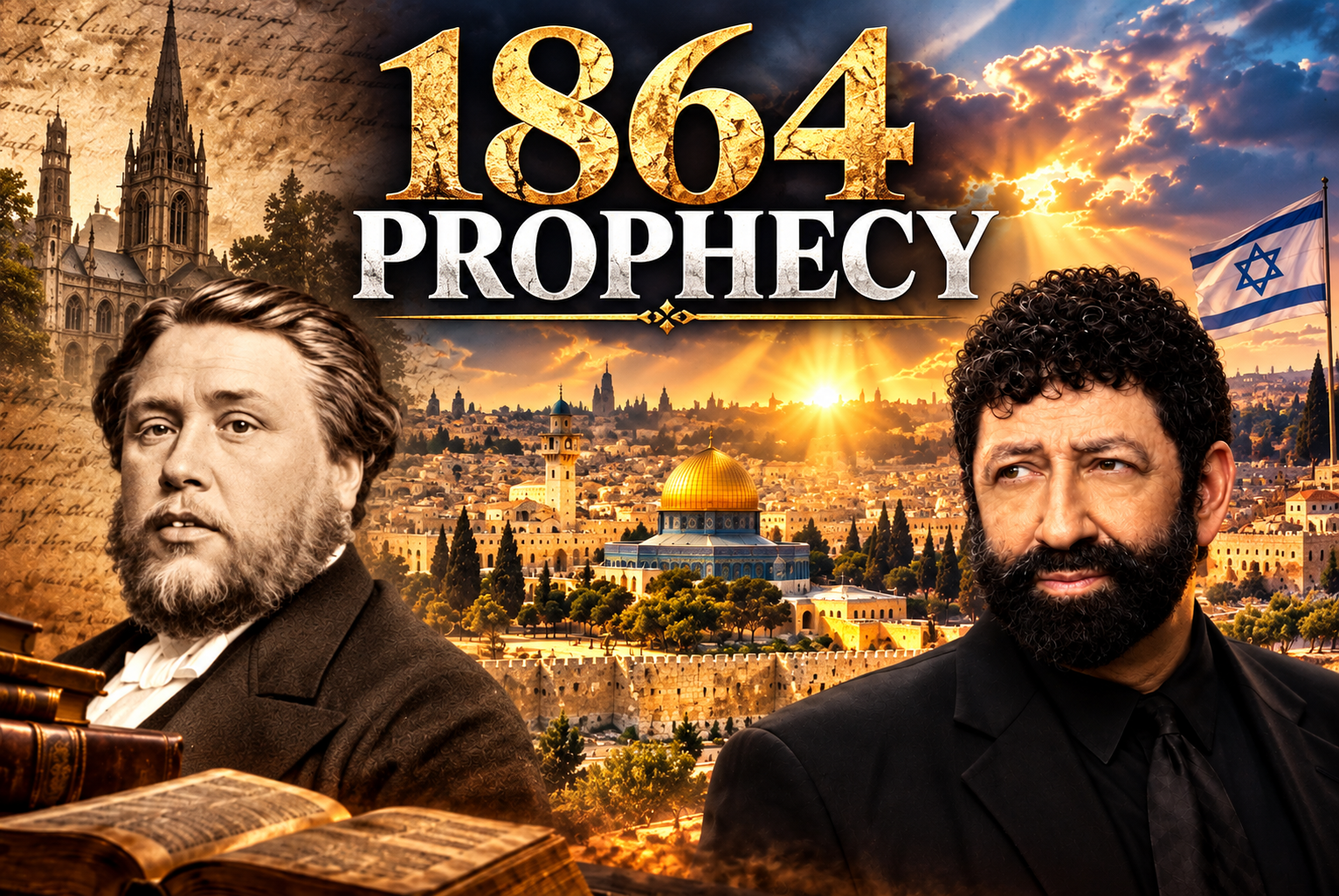
More than 80 years before Israel became a modern nation, Charles Spurgeon spoke boldly about the Jewish people’s restoration. But according to Jonathan Cahn, there was another remarkable dimension to the legendary preacher’s words—one pointing directly toward Jerusalem and the Temple Mount.
In a message examining Israel’s place in biblical prophecy, Cahn highlighted statements Spurgeon made in an 1864 sermon, when the Jewish people remained scattered throughout the nations and the establishment of the modern State of Israel was still generations away.
Spurgeon’s prediction of Israel’s national restoration is striking enough. He declared that Israel would be “restored as from the dead,” that a “native government” would emerge and that “a state shall be incorporated.”
Yet Cahn pointed out that Spurgeon’s vision stretched beyond the existence of a Jewish state.
“The day shall come when all the high hills shall leap with envy because this is the hill which God has chosen,” Spurgeon said.
“He’s talking about the Temple Mount,” Cahn said.
Spurgeon continued by speaking of a time when pilgrims and their land would again visit Zion, and it would flourish. He then cited the biblical promise that God would gather the children of Israel from among the nations, bring them back into their land and make them “one nation.”
For Cahn, those words carry tremendous prophetic significance because Israel and Jerusalem are not merely geopolitical locations. He argues they are central pieces of the biblical prophetic timeline.

To order Jonathan Cahn’s new book, The Altar of Pergamon, visit Amazon.com.
Cahn pointed first to Israel’s declaration of independence in May 1948. He then turned to another pivotal moment: Jerusalem’s restoration to Jewish control during the Six-Day War in 1967.
In Cahn’s interpretation, both developments were necessary before the return of Jesus.
“He cannot come back if there’s no Israel,” Cahn said. “He said, ‘I’m coming back to this place, this people and this land.’”
Cahn similarly emphasized Jerusalem, saying the Jewish people had to be not only back in Israel, but also back in the city. “He said, ‘I’m coming back here. I will come back, you Jerusalem.’”
That gives Spurgeon’s 19th-century words an entirely different weight.
When he delivered them in 1864, Cahn noted that no Jewish nation had existed in the land for centuries. Modern political Zionism had not officially begun, and the events of 1948 and 1967 were still far off.
Yet Spurgeon also anticipated something that Cahn believes is still unfolding: Israel’s spiritual restoration.
Spurgeon said the biblical promises implied that “the people of Israel are to be converted to God.” Cahn connected that expectation to Jewish people coming to faith in Jesus as Messiah, particularly following the events surrounding Jerusalem in 1967.
For Cahn, the lesson isn’t simply that Spurgeon made an extraordinary prediction. It is how he arrived there.
“He simply took this word as the word of the living God,” Cahn said. “He took it at its full strength.”
More than a century and a half later, the questions surrounding Israel, Jerusalem and the Temple Mount continue to dominate world attention. But Cahn’s message points believers beyond the headlines: If Scripture accurately foretold Israel’s restoration when such a development appeared impossible, then God’s people should pay close attention to what His Word says must still come next.
Abby Trivett is a writer and editor for Charisma Media and has a passion for sharing the gospel through the written word. She holds two degrees from Regent University, a B.A. in Communication with a concentration in Journalism and a Master of Arts in Journalism. She is the author of the newly released book, The Power of Suddenly: Discover How God Can Change Everything in a Moment. For interviews and media inquiries, please contact [email protected]. Learn more about Abby at abbytrivett.com.
