
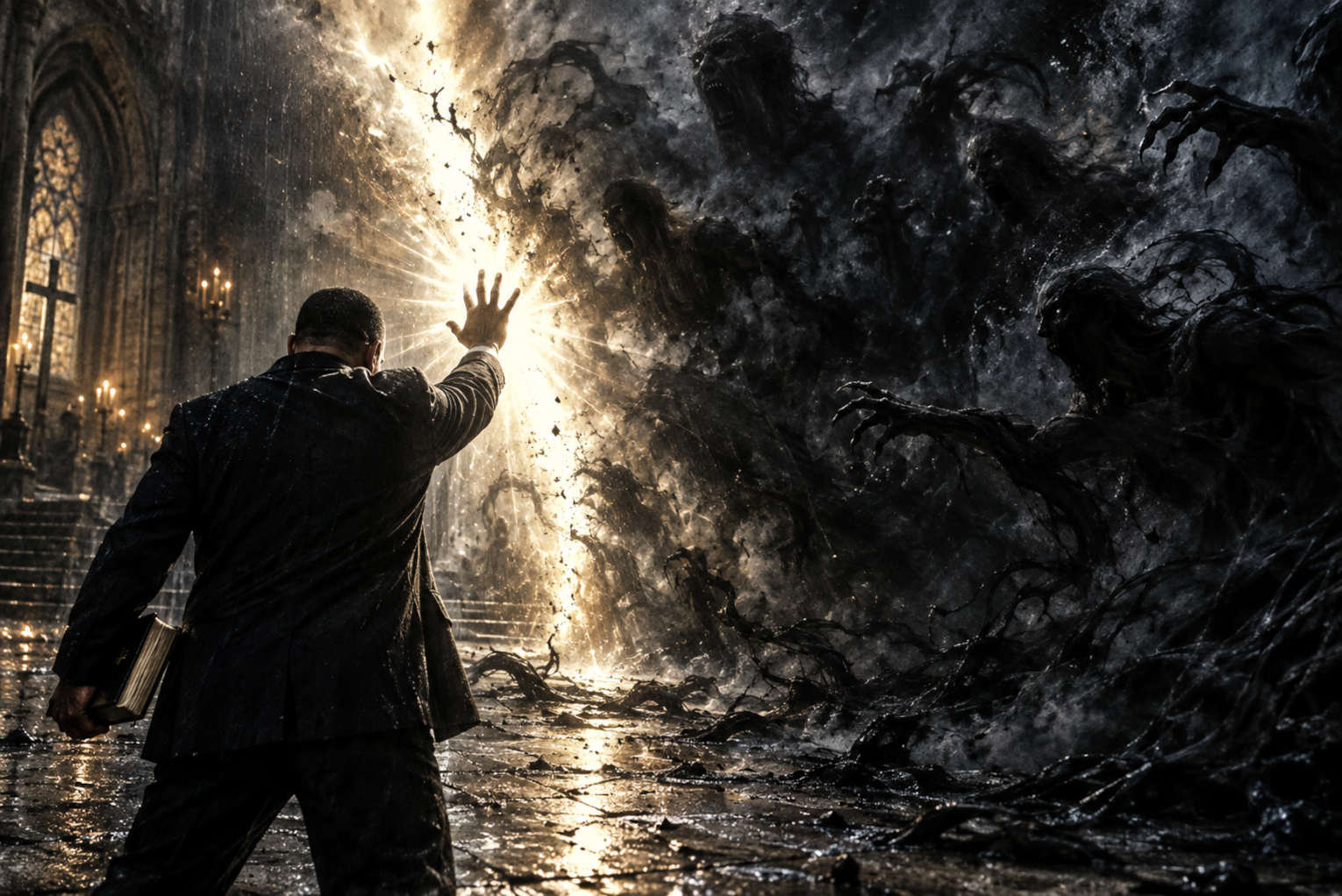
The attack we fail to recognize may be the one that gains the most ground.
John Ramirez knows what it means to search for an opening. Before coming to Christ, he practiced witchcraft. Spiritual warfare, from that side of his former life, was a struggle for dominion, influence and leverage over other people. Today, the man who once sought those openings warns that the church has left too many of them unguarded.
“I call it the blind spot. You can’t see us coming because you have no discernment,” Ramirez told Charisma Media in a recent interview.
We know the story of David facing Goliath. The giant stood where everyone could see him. Ramirez pointed instead to Saul, the king who later pursued David. The danger closest to David was far less obvious than the giant across the valley.
That is the warning at the center of Ramirez’s message. Spiritual warfare is not limited to a dramatic confrontation at an altar. It reaches into our habits, our priorities and our readiness to respond when someone needs help. While Christians debate the signs of a changing world, we can neglect the prayer and discipleship that prepare us to stand.
The signs are already here. Ramirez compared them to previews before a movie: glimpses of what is still to come. “Look at the news media, look what Hollywood’s doing, look at what the music industry’s doing,” he said. Our response cannot begin when the full force of a battle is upon us. The time to seek God, learn His Word and strengthen the church is now.
The enemy’s blind spot
In his former life, Ramirez understood spiritual conflict as a contest for leverage. “If you don’t have leverage and you have no victory, you can’t conquer nothing without leverage,” he said. Those words describe the way he once sought influence over other people. The church often expects the enemy to approach head-on. A threat can be close enough to seem familiar before anyone recognizes it.
“It’s demonic, but we have normalized it,” he said of things he believes Christians have learned to accept.
That warning extends beyond the stories of alleged manifestations that make headlines or circulate online. An entire congregation can become accustomed to shallow prayer. Believers can attend services for years without learning to recognize the Holy Spirit’s leading. A need can arise right in front of us, and we may have no idea how to respond.
Public incidents Ramirez identified as spiritual manifestations have convinced him that believers must be ready to minister beyond church walls. When an encounter unfolds outside the sanctuary, there may be no prayer team waiting nearby. Yet the authority Christians rely on does not depend on the setting. “Whether I’m 30,000 feet or I’m underground. The authority of Jesus Christ work in both places.”
“Don’t walk away from it. God put you in that place, God put you in that moment, God put you in that time, God put you on that plane,” Ramirez said. “God put you in that territory. God put you in that job.”
Not every unexpected encounter calls for the same response. The person before us matters more than any desire to prove we are bold. Someone in distress may need urgent medical attention, a listening ear, prayer or several forms of help together. A Christian who wants to minister well must first pay attention. Discernment starts there.
Discernment also means refusing to identify every mental health crisis or emotional outburst as demonic. The distinction is essential when spiritual warfare moves from an idea in a sermon to a person standing before us.
“I don’t believe everybody got a demon. I mean, let’s be real, you know,” Ramirez answered.
People can have health conditions, and spiritual oppression is real. Neither a diagnosis nor a deliverance claim should become an excuse to stop seeing the person. We can take spiritual warfare seriously and respond to immediate human needs with care. Prayer is central to that response, and so is the humility to recognize what we do not know. The Holy Spirit’s power is not limited to people who share a particular testimony: “We can minister to all people because we have the Holy Spirit.”
Ramirez wants discernment shaped by an ongoing relationship with God. Time in Scripture and prayer makes a difference before a crisis appears. When pressure comes, the habits we have practiced are the ones we will reach for.
“So are we spending time with the Word of God or we just hanging out with social media?” he asked.
The question cuts through the noise. We can devote hours to watching strangers argue about spiritual matters while giving little time to the Lord. Then we wonder why we cannot hear Him clearly. The blind spot is not always something hidden in another person. Sometimes it is the part of our own lives we have stopped examining.
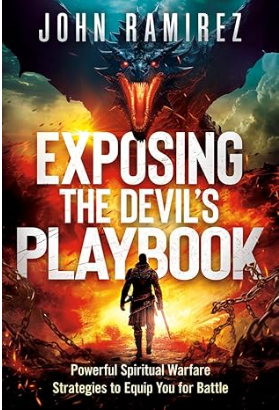
Order John Ramirez’s Book, “Exposing the Devil’s Playbook” on Amazon.com!
A church equipped for the fight
Why do so many Christians seem unprepared when spiritual opposition becomes visible? Ramirez’s answer was direct.
“How could you be ready for a fight if you’re not trained? If you’re not a disciple.”
A full sanctuary is a gift. So is a well-run service. But a crowd and a schedule cannot replace discipleship. Ramirez painted a familiar picture: “We got services, we got a Starbucks in the back of the church and people drinking their lattes and sitting there and no one wants to raise hand and no one wants to get real with God anymore.” We need to know the Scriptures, learn to pray and grow in our understanding of the authority of Jesus Christ. If that work is postponed until an emergency, the church has waited too long.
Ramirez challenged ministers who use artificial intelligence to prepare messages while neglecting prayer. The deeper issue for him is dependence: What happens when the work of seeking God gives way to the fastest way to fill a pulpit?
“I’m not a communicator and I don’t need AI. I got the Holy Spirit. I bend my knee, pray, and God will give me a word,” he said.
His criticism does not stop with pastors. “Christians play on Sunday. We pray on Sundays, we worship on Sunday, we raise hands on Sundays, and we go to church on Sunday.” When our phones command our attention from morning to night, prayer can become whatever time remains. Scripture is reduced to a verse glanced at between notifications. We still speak the language of faith, but the daily practice that strengthens it grows thin.
“If you don’t have a prayer life, if you don’t have a prayer, who you hearing from? Who you hearing from?” Ramirez asked.
The question is uncomfortable because it asks us to examine the source of our confidence. Strong words are easy to deliver on a stage or in a video. Spiritual authority is lived out when no audience is watching. It appears in the patient work of loving a neighbor, sharing the gospel, praying for the hurting and obeying God when doing so costs us something.
Ramirez contrasted accounts of two people who shared their faith aboard airplanes. He viewed one as acting from conviction and the other as seeking an audience. “One is doing it for YouTube and the other one doing for heaven,” he said.
That distinction belongs in any discussion of public deliverance or evangelism. A camera can document an encounter, but it cannot tell us whether the person at its center is being loved. We must guard against making another person’s suffering a stage for our ministry. Boldness without discernment can draw attention to us when our purpose is to point people to Christ.
The same temptation appears in the way Christians treat one another online. Ramirez criticized channels devoted to exposing other believers while giving little attention to Scripture, salvation or discipleship. Sin and misconduct require honest accountability. Gossip dressed as ministry still damages the body.
“We’re not the Holy Spirit police,” he said. A channel built chiefly on exposing others is a poor substitute for the work of ministry. “You’re not leading people to the Lord. You’re not teaching. You’re not discipling. You’re not preaching the word of God.”
We can spend our energy watching believers tear one another down and call it vigilance. Meanwhile, a neighbor needs prayer. A new Christian needs someone to open the Bible with them. A family needs a church willing to walk alongside them. These are not small tasks set aside while the real battle happens elsewhere. They are part of how we stand firm.
Discipleship also prepares us for suffering that cannot be explained away. Ramirez has struggled with his eyesight since 2024. His mother died after a battle with stomach cancer. He prayed over her, anointed her and read Scripture to her, yet he still had to face the grief of losing her.
Do believers belong on offense or defense in spiritual warfare? “We’re in both,” Ramirez answered. “We’re gonna go to trials and tribulations. We’re gonna go to testing.”
We pray for healing and keep trusting God when healing does not come as we hoped. We resist the enemy and endure trials without pretending they do not hurt. Spiritual warfare is more than confronting a manifestation. It also includes the determination to remain faithful when suffering tests everything we have preached.
“I don’t quit, I don’t give up, I don’t surrender, I don’t wave a white flag,” Ramirez said. “The devil never have the last laugh. We do.”
Watchmen in our own communities
The battle Ramirez describes has a local address. He called Christians to pray for their neighborhoods, cities and regions. Before thinking about a distant spiritual conflict, we can look at the people and places God has already entrusted to us.
“I pray for my community,” he said. “I’m the watchman at war.”
The statement is simple. Its implications are demanding. What would change if we regularly brought our streets before the Lord? If we knew the names of families nearby, asked where people were hurting and prayed for open doors to share Christ? A watchman pays attention because the place and its people matter.
Too often, “they’re not crying out for the souls, they’re not crying out for the communities,” Ramirez said. A new house, a better car and an easier life cannot be the whole horizon of our prayer lives. Our communities need the gospel. Our churches need strength. People need freedom, comfort and the hope found in Jesus Christ.
“Christians don’t pray outside of the box anymore. We don’t pray outside of the box,” he said. “Seek the kingdom of heaven first.”
Prayer also asks something of us. Ramirez told the story of a woman who traveled from Switzerland to a ministry meeting in Miami seeking deliverance. He believes she received freedom there. Her willingness to cross an ocean moved him because it showed how deeply she wanted God to intervene.
“Christians are not going the extra mile anymore for nothing. They want convenience. They want comfortability,” he said.
We do not need to travel across an ocean to show that hunger. We can make time to seek God where we are. We can return to Scripture when other voices are louder. We can step forward to pray with someone and remain with them when an easy answer does not appear. The sacrifice may be quiet, but it is real.
“When you sacrifice something, you get God’s attention,” Ramirez said. “Jesus will always do his part, but he’ll never do yours.”
His warning carries a sense of urgency. He believes the incidents we see today are a preview of greater spiritual pressure. He also pointed to Christians facing persecution in other parts of the world and warned against assuming that we will never face trials of our own.
“A storm is coming.”
Fear is not preparation. Isolation is not strength. We prepare by drawing near to Jesus, growing together as His church and learning to care for people when the battle reaches their lives. The authority Christians claim must be joined to the character of the One whose name we speak.
“I think it’s time that we wake up and be the church. I think it’s time that we wake up and rise and let the world know that we here and we’re here to stay,” Ramirez said.
His closing image was a torch. Light is visible because darkness surrounds it, and a torch is meant to be carried. Our calling is to take the light of Christ into the places where He has put us.
“We need to be a torch,” Ramirez said. “We don’t have to be aggressive or mean or nasty. Or we don’t have to be pushy or anything like that. We don’t have to be that because that’s not Christ.”
That conviction gives the warning its purpose. Spiritual warfare is real, and people are worth fighting for. We can refuse to surrender ground to fear, distraction or complacency. We can pray for our communities and disciple believers who will stand firm long after a powerful service ends. We can speak truth without making the people we are called to reach into our enemies.
The preview is before us. “We need to take authority back,” Ramirez said. Now is the time to open the Word, bend our knees and take our place.
Prepared by Charisma Media Staff.
