
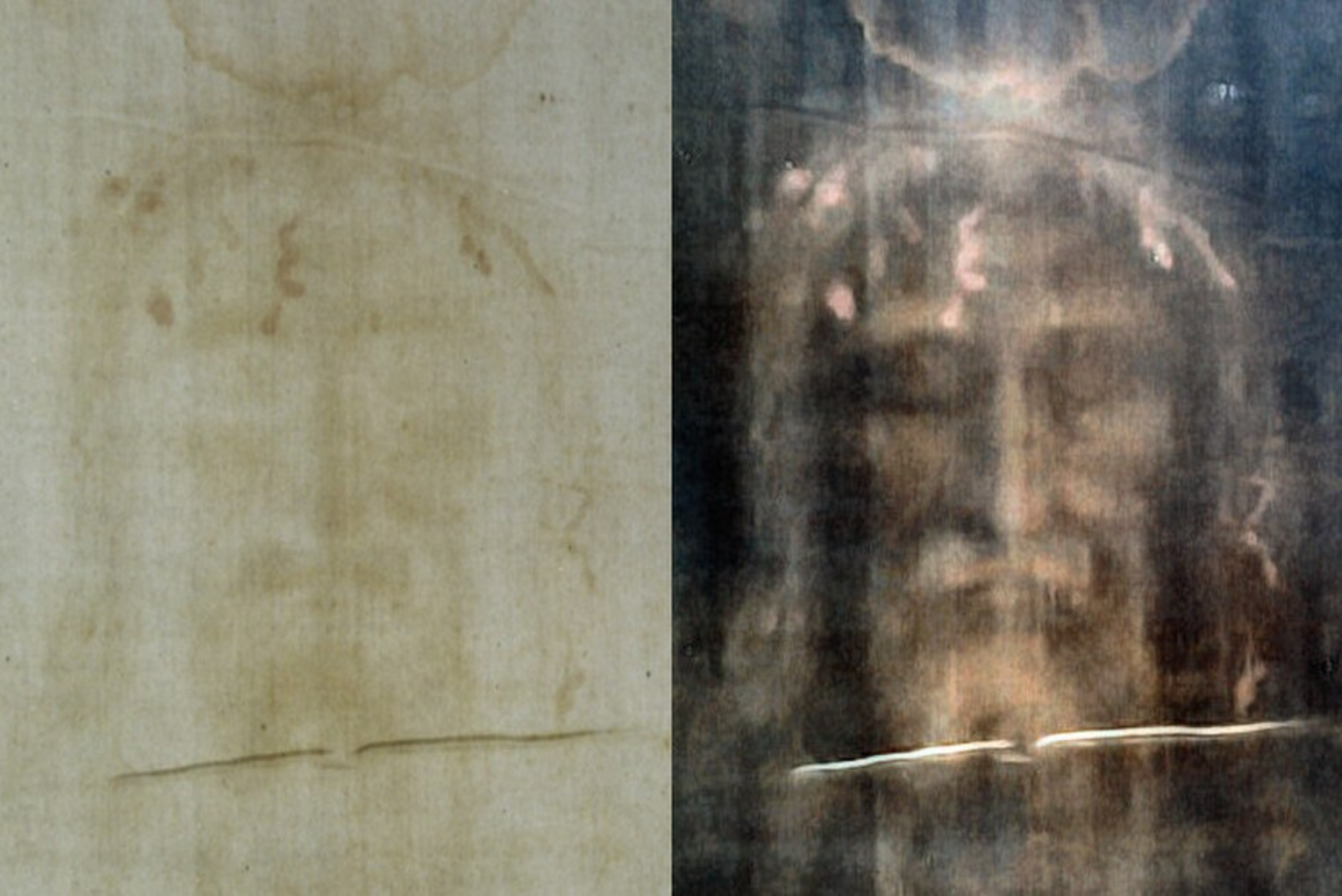
The Shroud of Turin has puzzled scientists, historians and believers for decades. Now, a new theory could explain one of the biggest biblical questions surrounding the mysterious cloth.
According to the Daily Mail, immunologist Dr. Kelly Kearse has proposed that the answer could be surprisingly simple. The image may not have been visible yet.
The 14-foot-long Shroud bears the faint, bloodstained image of a man who appears to have been crucified. Some believe it is the burial cloth that wrapped the body of Jesus Christ after His crucifixion, while others argue it is a medieval creation.
But there has always been a problem for those who believe the Shroud is authentic.
John 20 tells us that after Jesus rose from the dead, Peter entered the tomb and found the linen cloths lying there. The face-cloth that had covered Christ’s head was folded separately. Yet Scripture never says Peter saw an image of Jesus mysteriously imprinted on the linen.
If the Shroud really was there, why wouldn’t something that extraordinary have been mentioned?
Kearse’s theory offers another possibility.

To order Dinesh D’Souza’s new book, The Stones Cry Out, visit Amazon.com.
In an opinion paper published Aug. 12 in the Journal of Historical Archaeology & Anthropological Sciences, Kearse explored whether the image could have developed through a process called “latent coloration.” Essentially, the linen could have been altered without an image becoming immediately visible. Aging or heat could have caused the discoloration to emerge later.
According to the Daily Mail, Kearse pointed to experiments using very short ultraviolet laser pulses on linen.
When researchers used enough energy to create an immediately visible mark, something significant happened: Bloodstains on the linen were damaged or even vaporized.
But when the energy was lowered, researchers saw a very different result.
The weaker pulses could alter the linen while leaving the blood relatively unharmed. At first, no image was visible. The discoloration emerged only later, after the material was heated or naturally aged.
That detail could be critical to the Shroud mystery.
If this really was Christ’s burial cloth, His blood would have touched the linen before the body image appeared. Any process that created the image would therefore have needed to alter the fabric without destroying the blood already present.
That would mean Peter and John could have walked into the empty tomb, seen the linen exactly as Scripture describes and never witnessed the mysterious image we associate with the Shroud today.
For years, skeptics have asked why the Bible never mentions an image on Jesus’ burial linen. Perhaps the answer isn’t that the Shroud couldn’t have been there.
Perhaps the image simply wasn’t there yet.
Abby Trivett is a writer and editor for Charisma Media and has a passion for sharing the gospel through the written word. She holds two degrees from Regent University, a B.A. in Communication with a concentration in Journalism and a Master of Arts in Journalism. She is the author of the newly released book, The Power of Suddenly: Discover How God Can Change Everything in a Moment. For interviews and media inquiries, please contact [email protected].
