


America has long celebrated the promise of “life, liberty and the pursuit of happiness.” But according to author and commentator Dinesh D’Souza, many Americans have forgotten what that final phrase was originally intended to mean—and the consequences could be far-reaching.
Today, the pursuit of happiness is often defined as personal fulfillment, self-expression or doing whatever feels right. Yet America’s founders envisioned something far different.
Drawing on the writings of the second President John Adams, D’Souza argues that true happiness was never meant to be rooted in self-gratification but in the lifelong pursuit of virtue.
“We think today of happiness in relativistic terms, something each person pursues in their own way,” D’Souza says. “To John Adams…this was bad advice.”
The contrast becomes especially striking when compared with the famous line from Shakespeare’s Hamlet: “To thine own self be true.”
While modern culture often embraces that sentiment as a guiding principle, Adams believed human nature was far too flawed to simply trust every impulse.
“Adams understood that people are an imperfect amalgam of the admirable and the abominable,” D’Souza explains. “That being yourself does not automatically lead to good character. It’s more likely, in fact, to lead to self-absorption.”
Instead, Adams believed character had to be intentionally cultivated.
“The only way to attain a good character is, like everything else, to work at it,” D’Souza says. He describes how Adams encouraged people to imagine a noble character and then intentionally strive to become that person. “Walk like that character, think like him, feel like him, act like him. Over time, through the result of continual effort and the slow working of habit, one can become that person.”
According to D’Souza, Adams himself modeled that philosophy, earning a reputation as an incorruptible and deeply honest public servant.
That commitment reflected an even older idea first articulated by Aristotle.
“The founders subscribed to the Aristotelian belief that genuine happiness is achieved when the activity of the soul is in perfect harmony with virtue,” D’Souza says.
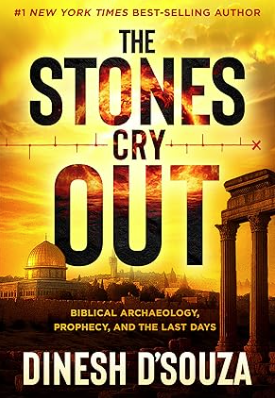
To order Dinesh D’Souza’s new book, The Stones Cry Out, visit Amazon.com.
For Adams, this wasn’t merely personal advice—it was the foundation upon which the American experiment would either stand or collapse.
“Without virtue,” D’Souza notes, “he believed America could not succeed.”
Adams famously warned, “The preservation of liberty…depends on the intellectual and moral character of the people.”
That conviction shaped his understanding of constitutional government. Unlike a monarchy, where political responsibility rests primarily with the king, Adams believed a republic places that responsibility squarely on its citizens.
“In a republic…the people are the government,” D’Souza says. “So the virtue of the state is a reflection of the virtue of the people.”
Recognizing humanity’s sinful tendencies, Adams never assumed virtue would develop naturally. D’Souza explains that Adams believed faith in God, education and a clearly defined Constitution all worked together to restrain corruption and empower citizens to remove leaders driven by selfish ambition.
His warning feels increasingly relevant today.
“We’re more likely to think of pursuing happiness in narcissistic terms than in the way that Adams and the founders perceived it,” D’Souza observes.
Scripture echoes this same timeless principle. Proverbs 14:34 declares, “Righteousness exalts a nation, but sin is a reproach to any people” (MEV). America’s greatest challenges may ultimately be spiritual before they are political. Laws and elections certainly matter, but lasting national renewal begins with transformed hearts.
As believers pray for revival across the nation, Adams’ reminder deserves fresh consideration: A free republic is sustained not merely by its Constitution, but by the character of the people who live under it. If America hopes to preserve its liberty for generations to come, the pursuit of happiness may first require a renewed pursuit of virtue.
Abby Trivett is a writer and editor for Charisma Media and has a passion for sharing the gospel through the written word. She holds two degrees from Regent University, a B.A. in Communication with a concentration in Journalism and a Master of Arts in Journalism. She is the author of the newly released book, The Power of Suddenly: Discover How God Can Change Everything in a Moment. For interviews and media inquiries, please contact [email protected].