


There are moments in life when pain presses so heavily against the soul that it feels almost physical—when you’re awake in the midnight hours, wondering if anyone sees, if anyone hears, if anything will ever change. In those raw places, heaven does more than listen. It responds.
These stories don’t simply recount survival. They pull back the curtain on spiritual battles unfolding in everyday lives. They show us the people the world often overlooks: the wounded, the weary, the ones carrying scars in places others never see. Society may label them “too damaged” or “beyond help,” but heaven sees something different.
From Hell’s Grip to Heaven’s Throne
Joshua Miles grew up in a God-fearing household with a pastor father who lived the Scriptures. But you cannot inherit salvation. “I still made my own life’s choices,” he admits. And the man Joshua chose to become was dangerous. The streets of Montgomery, Alabama, knew him well. Bullets had flown at him before—fifty rounds from AR-15s that somehow left him untouched. He mistook God’s protection for his own invincibility.
Then came what everyone thought was the flu. It was early 2020, before the world had a name for COVID-19. Josh’s fever climbed to 116 degrees. For days it raged, cooking his brain in ways doctors couldn’t diagnose. He kept working, kept pushing—until the morning his father loaded him into the truck to race toward the emergency room.
They never made it. Somewhere on that interstate, Josh’s body surrendered. A stroke, a heart attack, and a seizure struck simultaneously. His soul lifted. Suddenly, he could see everything—the truck weaving through traffic, the city lights below, every perspective at once. But what struck him most was what he felt: his father’s prayers rising like heat through the atmosphere, tangible as smoke.
“The highest respecting moment from my father is the fact that his first reflex was to pray,” Josh recalls. One hand on the wheel, one hand raised, his father called out the name of Yeshua and spoke in tongues, declaring life over his dying son. But the prayers had not yet reached their destination. And neither had Josh.
In an instant, the aerial view vanished. Josh felt himself sucked downward—not far in distance, but dimensions away. The journey grew heavy, empty, filled with turmoil. He was going to hell.
“It’s not about fire,” he explains. “You literally feel the absence of God. That is the torturous feeling.” Without the presence of God that fills our earthly atmosphere, everything burns. Your body, your mind, your spirit. You are being cooked from within by the sheer emptiness of existing apart from your Creator.
The darkness was darker than black—yet somehow Josh could see through it. Millions of souls stood on shelves of glowing molten rock, suffering in a dim orange haze. Demonic figures moved among them. Every negative feeling humanity has ever known compressed into each passing second: paranoia, regret, bitterness, thirst—not merely for water but for the living water his soul had rejected.
“You see every single thing that replays over and over,” Josh says—every chance God gave him, every moment of protection he’d mistaken for luck, every squandered opportunity to turn his life around. The regret was crushing. And the worst part? “You know this was the most just decision you’ve ever seen made.”
He belonged there. He knew it. But somewhere above, in a truck hurtling down an Alabama interstate, a father’s prayers were shifting the atmosphere.
Josh felt a transition, a pulling upward, a journey that felt like light-years traveled in the span of a microsecond. Colors streaked past so fast they blurred into white. Weight disappeared. Then, in an instant, he stood somewhere else entirely: heaven.
The first thing he felt was reverence—an overwhelming humility that had nothing to do with fear and everything to do with awe. “The presence of God is so powerful that you just don’t feel like you belong in his presence,” Josh explains. “It’s a humbleness. You don’t have to look. You can feel it so much.”
He found himself before the throne, with prisms of light forming a being and a seat that were both transparent and solid. Unlike hell, Josh knew immediately this was not his permanent destination. He could feel something happening inside him—a reprogramming, a rewriting of his spiritual code. Everything was perfect. And all he wanted was to be obedient.
Then he was back—gasping in a truck seat soaked with sweat, his father still praying, still believing. His clothes were drenched through. This was real.
The aftermath was brutal. Josh couldn’t walk properly or speak coherently. Doctors said he would never fully recover. But strangely, he could still sing. He could still drive. God had preserved the very gifts He intended to use.
When Josh regained the ability to tell his story, his bishop suggested a simple church interview. Within weeks, it had millions of views. God’s timing was surgical: a pandemic had locked the world indoors. Eyes were glued to screens; hearts were desperate for something real.
“If I didn’t come back, that’s where I would’ve stayed,” Josh says of hell. But he did come back—pulled from the pit by a father’s prayers and a God who wasn’t finished with him yet.
Today, Josh carries a message that burns in his bones: “Every time we wake up, and we open our eyes, there should be extreme levels of gratitude because you get another chance to get it right.” He’s stood in both places. And he’s living proof that even from hell’s grip, the hand of a praying father—and the mercy of an eternal God—can still reach down and pull you through.
From Trauma to the Throne Room
Cheryl Beck knew the feeling of dying the way most people know the feeling of falling asleep—intimately, repeatedly, from a childhood spent at the edge of oblivion. Born into a Luciferian cult that considered her expendable, she had left her body more times than she could count as a little girl, flying with angels over treetops while unspeakable things were done to the shell she’d left behind. But this time was different. This time, she was 42 years old, lying in a hospital bed on the very floor where she worked as a nurse, and the telemonitor strapped to her chest was about to flatline.
It had started with a myelogram—dye injected into her spine to diagnose the source of her chronic pain. What the doctors discovered would have been unbelievable to anyone who didn’t know her history: compression fractures running the length of her vertebrae, a C4-C5 break in her neck, hip fractures, a chunk of pelvic bone missing, a face that looked like cracked glass beneath the skin. The accumulated wreckage of ritual torture, all healed crooked and wrong because the cult’s doctor had dismissed every injury as the complaints of a “hypochondriac child.” But the procedure itself triggered an anaphylactic reaction that swelled her brain and organs. Then came internal bleeding. Then the heart attack.
She was drifting in the ICU when her heart decided to do aerobics. That’s how she described it later—not fluttering, but full gymnastic routines inside her chest. As a nurse, Cheryl knew exactly what to do. She pressed the event button on the telemonitor and waited. Then everything went quiet. Her heart settled, and then she realized it wasn’t beating at all. She wasn’t breathing either. There was no pain, no gasping for air, no panic—only stillness so complete it felt like the whole world had pressed pause. Then came the pull: her spirit drawing inward from her fingertips and toes, gathering at her center like water spiraling down a drain, and then—pop—she was out.
Cheryl hovered above her hospital bed, looking down at her own body with the clinical eye of a woman who had spent her career assessing the dying. She could see through the walls somehow. Her friend was going crazy at the telemetry station down the hall. Someone was calling a code blue.
She turned away from all of it, looked up, and there he was. Her son, Samuel, stood before her, enveloped with her in a globe of white light so bright it should have been blinding but wasn’t. He was tall—a young man of twenty-three, the age he would have been if he had lived. The age he would have been if he hadn’t been sacrificed on a Christmas Eve altar when he was three months old, offered to the god Kronos so that Cheryl’s father could ascend in the cult’s hierarchy.
She threw her arms around him. Joy erupted from somewhere deep inside her, a laughing-crying-singing sensation she had never experienced. There was no pain here. For the first time in her existence—the broken bones, the nerve damage, the constant grinding ache—all of it was gone. There was only peace, and this boy she had never gotten to raise, this son she had been forced to watch die.
She stared at his face, trying to memorize every detail. His eyes held a depth of wisdom that made her feel like the child between the two of them—not wounded wisdom but something pure and luminous. He had been taught of the Lord. She could see it as clearly as she could see his smile. Whatever horrors had been done to his infant body on that altar, his spirit had been safe. He had grown up in the presence of God.
“Look,” Samuel said. To her right, something was happening in the distance—a point of blue light that swelled into a window, then a doorway, then a portal large enough to swallow galaxies. And somehow her vision zoomed toward it, telescoping across impossible distances until she was peering into the throne room of God.
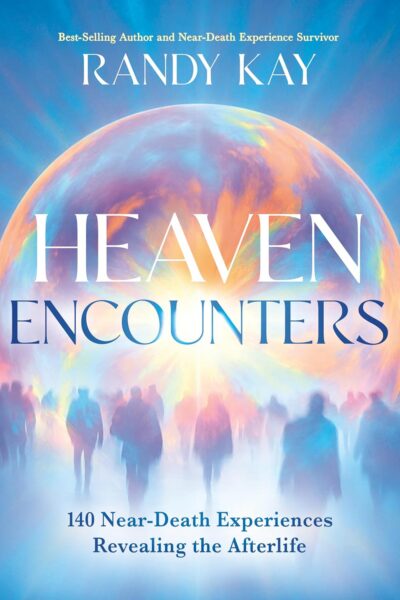
To order Randy Kay’s new book, Heaven Encounters, visit Amazon.com.
The floor at God’s feet moved. Cheryl’s vision zoomed closer, and she gasped.
The floor wasn’t a floor. It was people—millions of them, each one no taller than the sole of God’s sandal, yet each one distinct and alive and worshipping. They were dancing, and as they danced their robes changed colors in perfect synchronization with the music, like a halftime show orchestrated by heaven itself. “I want to go there,” Cheryl thought. “This is where I belong.”
Then she was zooming backward, pulled away from the portal, deposited once again in front of Samuel.
“But I want to stay,” she said. Samuel smiled—a warmth that contained no judgment, only love. “Mom, you have to go back. You have a lot of work to do.”
She argued. Someone else could do the work, surely. Hadn’t she suffered enough. Samuel just chuckled. “Mom. You have to go back.” Three faces flashed before her eyes—her living children, seven and ten and twelve years old, waiting for their mother to come home. “OK,” she whispered. “But as long as I’m unconscious, I want to spend time with you.”
She didn’t think to ask for miraculous healing. All she wanted was to hold her firstborn son for as long as heaven would let her. Then—zoom—she became a ball of light, and she was slamming back into her broken body just as the code team burst through the door.
The pain returned like a wave crashing over her. She could feel the heart attack now, feel every damaged nerve and fractured vertebra screaming back to life. But they didn’t have to resuscitate her. Her heart had started on its own. Cheryl Beck survived. She would go on to speak publicly about the cult that had stolen her childhood and her son, despite the danger, to dream of building a ranch for children rescued from trafficking, to live with a pacemaker and unshakable hope.
But she had seen. She had held Samuel and watched the robes of the redeemed turn colors at the feet of God. She knew her son had been raised in glory and was waiting for her in that place where the music never stopped.
And one day, when her work was finally done, she would join him there.
The Lungs from Heaven
Mike Olsen was dying by degrees. Idiopathic pulmonary fibrosis, a cruel disease that slowly turns living lungs to scar tissue, had reduced this former pastor and actor to a man tethered to oxygen tanks. The diagnosis carried no explanation and offered no cure, only waiting. But God was already speaking in the language He has used since ancient times: signs and wonders woven into the fabric of ordinary moments.
One night, Mike and his wife, Patty, were driving home from visiting a friend when Patty began to sing an old song by John Michael Talbot, “Father, I Put My Life in Your Hands.” As she sang, she lifted invisible burdens toward heaven—the finances, the fear, the impossible weight of loving someone who was dying.
Mike joined his voice to hers, and then, out of the darkness, a deer materialized directly in their path. There was no time to swerve. Going 55 miles an hour, they had no choice but to cry out the only name that matters: “Jesus!”
The deer vanished. It wasn’t struck; it didn’t leap aside. It vanished, as if it had never existed at all.
They sat trembling on the shoulder of the highway, searching the darkness for any trace of the animal. Nothing. Mike, ever the student of Scripture, began turning the encounter over in his mind, searching for its meaning. He thought of Psalm 42:1 (MKJV), which says, “As the deer pants for the water,” but that didn’t fit. He considered his son’s Irish dancing nickname, the Leaping Deer, but that also proved to be a dead end.
Then it came to him: the tribal banners of Israel. The deer was the symbol of Naphtali (Gen. 49:21), a name that means to wrestle or struggle. In that moment, Mike understood. Six months before the transplant call would come, God had dispatched a messenger in the form of that deer to tell him, “I see you. I know. Do not be afraid.”
The prophetic tapestry continued to unfold. Just days before Mike received the call that donor lungs were available, a woman he had never met came to pray over him, at his wife’s invitation. Without any knowledge of his transplant status, she stopped mid-prayer and said, “You’re going to think I’m crazy, but I just saw a vision of lungs coming down from heaven and being placed into your chest.”
Days later, Mike stood in his backyard workshop, crafting folk art, when the voice of God interrupted: “Put that stuff up. You need to go now.” He obeyed. Minutes after he walked in the house, the phone rang. The hospital had lungs for him.
The surgery took 12 hours. The first lung was successfully transplanted. But as surgeons began closing Mike’s chest after the second transplant, disaster struck. A clamp was removed too early. Mike bled out on the operating table.
In that moment between heartbeats, Mike Olsen left his body.
His first thought was characteristically wry: “At least I’m going up—that’s a good sign.” But the ascent was not uncontested. Dark voices swarmed around him, accusatory and mocking: “You’re not good enough. Who do you think you are?” Mike recognized the enemy instantly and wielded the only weapon of consequence: “In the name of Jesus,” he said, “leave me alone and shut up. I am a child of God.”
Silence fell. And then he saw light. Rainbow-colored brilliance swirled around him, and the lights began to sing. Myriads of angels sang, “Mike’s coming home! Mike’s coming home!” But another voice interceded, gentle yet authoritative: “No. He’s just here for a visit.”
What Mike encountered next defies human language. He stood in a brightness that extended as far as sight could reach. And in that brilliance, he felt what he had preached about for decades but had never truly known: Jesus was everywhere. Every molecule of that realm pulsed with His presence. The glory of the Lord filled the temple, and Mike was standing inside it.
In an instant, every worry he had carried on earth seemed absurd. The finances, the health fears, even his spiritual insecurities dissolved like morning mist in the face of absolute grace. The slate was not just wiped clean; he realized it had been clean all along. The reality finally dawned on him: “It’s all Jesus, Mike. It was never about you.”
And then his heart turned toward another. Somewhere on earth, a family was grieving. Someone had died so Mike could live. Someone had donated the very lungs now being stitched into his chest. Emotion overwhelmed him as the thought crystallized: “I want to thank my donor.”
He sensed a presence behind him and turned. There stood Jesus, and beside Him a figure Mike somehow instantly knew to be the donor. The forms were not entirely distinct; Mike couldn’t discern gender or features. But the knowing was absolute. Mike had met his lung donor in heaven.
Jesus stepped forward, placed His hand on Mike’s left shoulder, and said gently, “Mike, these are your new lungs. Just receive them.”
“Yes, Lord,” Mike whispered.
And with that holy agreement between heaven and earth, Mike began to descend, floating back toward the operating table, back toward the body that awaited him, back toward a life extended by grace.
Mike Olsen came back from death with a message that burns in his chest as surely as those new lungs breathe: God sees you. God loves you deeply. Stop worrying about what He’s already handled.
Each of these testimonies points to a truth that transcends individual healing: The same Jesus who heals our brokenness on earth will welcome us into His presence in heaven, where all pain will cease and joy will be eternal. Your brokenness is not your disqualification—it’s your commission. Heaven is calling your name.
Randy Kay died for over thirty minutes in 2005 and encountered Jesus in heaven, an experience that transformed him from a biotech CEO into one of today’s leading voices on near-death encounters and eternal realities. He is the best-selling author of Dying to Meet Jesus, Revelations from Heaven, and Heaven Stormed, and hosts the popular podcast and TV program Heaven Encounters, reaching millions worldwide. An ordained pastor and international speaker, Kay lives in Carlsbad, California, with his wife, Renee, and together they enjoy their children and grandchildren. His new book, Heaven Encounters, is available now on Amazon.com.