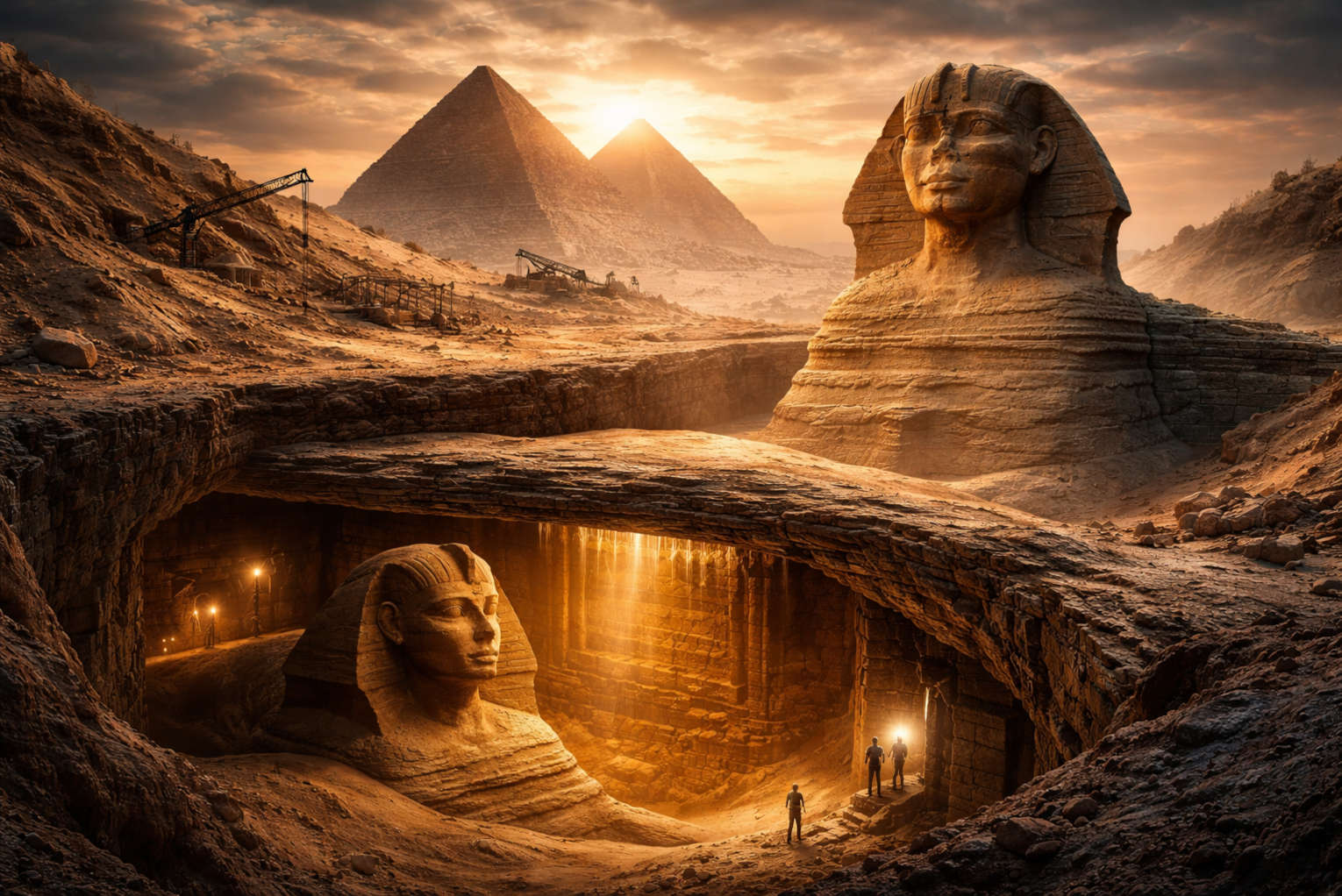
A stunning new discovery beneath Egypt’s Giza Plateau is raising fresh questions about what the ancient world truly knew and built, and what may still be hidden beneath the sands.
As reported by the Daily Mail, researchers now believe a second Sphinx may lie buried underground, along with what they describe as a massive subterranean network stretching beneath the pyramids.
Italian researcher Filippo Biondi said his team has identified “precise geometrical correlation, 100 percent of correlation, in this symmetry,” pointing to a mirrored location across the plateau where the structure is believed to exist. He added, “We are very confident to announce this… we have a confidence about 80 percent.”
A Second Sphinx Beneath the Surface
The theory begins with an ancient artifact already known to historians, the Dream Stele, positioned between the paws of the Great Sphinx. The carving appears to depict two sphinx figures, which researchers now say may reflect a literal architectural reality rather than symbolism.
By tracing alignments from the pyramids to the known Sphinx, Biondi said his team uncovered a mirrored geometric pattern that points directly to another location. Satellite scans of that area revealed a large mound, which he believes is concealing the second structure.
“That small mountain has a height of approximately 108 feet,” Biondi said. “The first Sphinx sits slightly below the surrounding surface, in a shallow depression, so it is possible the second Sphinx could be hidden beneath this higher mound.”
Underground Shafts and a “Megastructure”
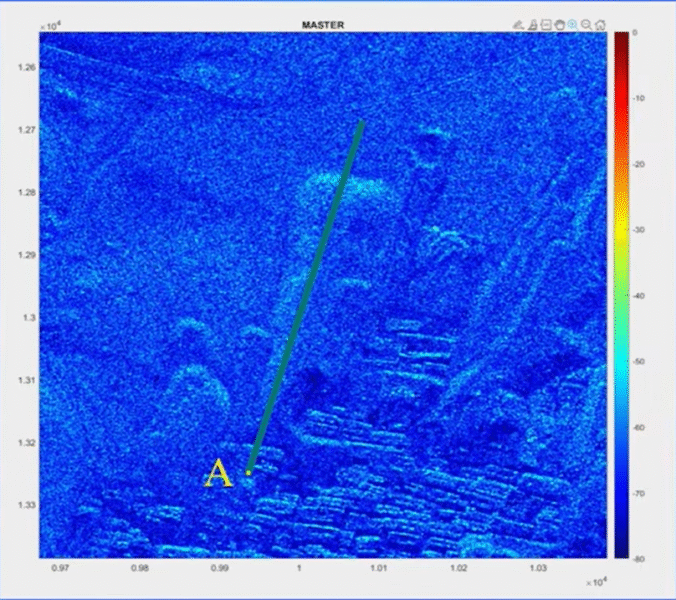
The findings extend far beyond a possible second monument. Using radar imaging, researchers identified what appear to be shafts and tunnels beneath both the known Sphinx and the suspected second site.
Preliminary scans revealed vertical structures and horizontal passageways that closely resemble one another, forming what Biondi described as “incredible symmetry” between the two locations.
He said the data points to something much larger beneath the plateau itself.
“Down underneath the Giza Plateau, there is something very huge that we are measuring,” Biondi said. “There is an underground mega structure.”
Researchers believe the vertical features represent solid shaft walls, while deeper scans show tunnels branching outward, suggesting a complex underground system rather than isolated chambers.
What Lies Beneath Giza
The team has identified potential access points, including shafts located between the Sphinx and the Khafre Pyramid. One large shaft appears blocked by debris, which Biondi said could be removed to allow entry into deeper levels.
“We have located some special entrances where we can work in situ,” he said, adding that a formal proposal has been prepared for Egyptian authorities to begin excavation.
If confirmed, the discovery would reshape understanding of the Giza Plateau, suggesting the pyramids and Sphinx were part of a far more intricate and intentionally designed system than previously understood.

Order Dinesh D’Souza’s New Book, “The End of Time” on Amazon.com!
Knowledge Increasing in the Last Days
These discoveries arrive at a time when new technologies are rapidly uncovering what was once hidden beneath the earth. From satellite radar to advanced imaging, layers of history long buried are now being brought into the light.
Scripture speaks directly to such a moment. In Daniel 12:4, the prophet records that in the time of the end, “knowledge shall increase.”
What is unfolding at Giza reflects that very reality. Ancient structures, once thought to be fully understood, are revealing a deeper complexity that challenges our modern assumptions.
Each new discovery does not close the case. It opens it wider.
If a second Sphinx exists, and if vast underground systems connect these monuments, then the question is no longer just what was built, but why. What purpose did these structures serve, and what knowledge did ancient civilizations possess that has since been lost?
The sands of Egypt are beginning to give up their secrets, and with each revelation, the sense grows stronger that humanity is rediscovering pieces of a past that was never as simple as it seemed.
James Lasher, a seasoned writer and editor at Charisma Media, combines faith and storytelling with a background in journalism from Otterbein University and ministry experience in Guatemala and the LA Dream Center. A Marine Corps and Air Force veteran, he is the author of The Revelation of Jesus: A Common Man’s Commentary and a contributor to Charisma magazine. For interviews and media inquiries, please contact [email protected].