
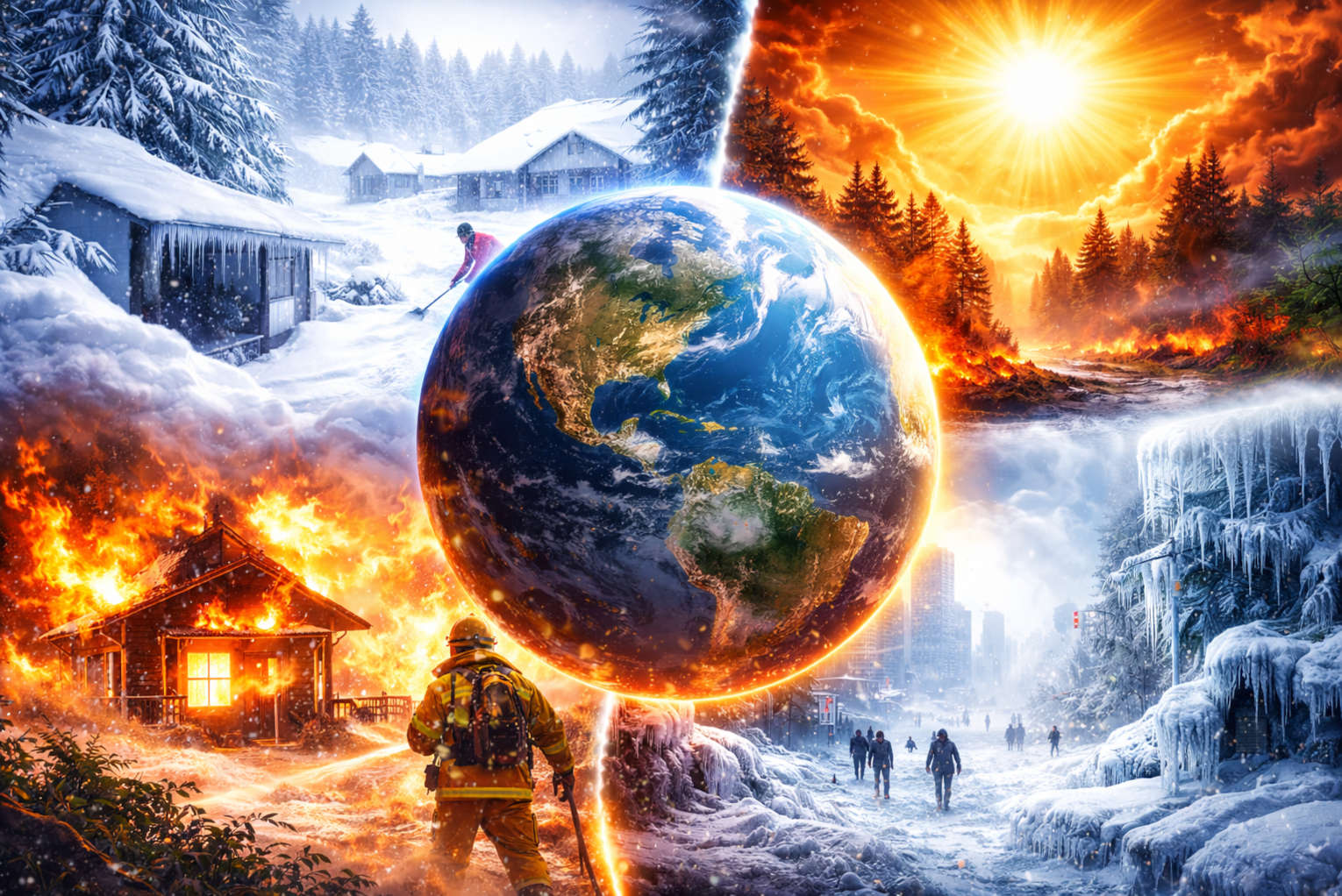
You may have noticed that this has been a really strange winter. In some areas, there has been far less snow than usual, while in other areas, people are literally being buried in their homes by mountains of snow. In some areas, it has been much colder than average, while in others, record-high temperatures are being shattered. I have been writing about how global weather patterns have been going nuts for a long time, and initially, some skeptics weren’t buying it. They thought that I was exaggerating, and they were convinced that conditions would “return to normal” eventually. But now even the New York Times is talking about how “weird” the weather has been this winter.
The weather has been a bit weird across the United States this winter. As historic amounts of snow fell in the Carolinas and bitter cold gripped practically everywhere else east of the Rockies, some of the western states have basked in high temperatures more typical of late spring than the dead of winter.
Perhaps no other contrast tells this story better than the fact that, since the start of the year, Florida has recorded more snow than Salt Lake City.
Read the last sentence of that quote from the New York Times again.
Florida is not supposed to get more snow than Salt Lake City.
That is crazy.
We have never seen anything like this before, and it is being caused by “a weather pattern that settled into place around the middle of January and hasn’t budged for weeks.”
These two extremes are the result of a weather pattern that settled into place around the middle of January and hasn’t budged for weeks. It’s kept the western United States unusually dry, depriving ski resorts and water reservoirs of their much-needed snowpacks. And it’s plunged the eastern two-thirds of the country into bitterly cold temperatures that have lingered for weeks.
This same pattern that brought 80-degree temperatures to Los Angeles this week sent ice, freezing temperatures and power outages to Tennessee, Mississippi and Louisiana late last month. It has given Phoenix its warmest winter ever in records going back to 1885 and delivered a rare snowfall to Wilmington, N.C., last weekend.
The worst snow drought in history threatens to cause a major crisis in the western third of the nation.
At this point, the amount of snow cover is about a third of what it normally should be.
A record snow drought with unprecedented heat is hitting most of the American West, depleting future water supplies, making it more vulnerable to wildfires and hurting winter tourism and recreation.
Scientists say snow cover and snow depth are both at the lowest levels they’ve seen in decades, while at least 67 Western weather stations have measured their warmest December through early February on record. Normal snow cover this time of year should be about 460,000 square miles — about the size of California, Utah, Idaho and Montana — but this year it’s only California-sized, about 155,000 square miles, according to the National Snow and Ice Data Center.
The snowpack — measured by how much water is trapped inside — in Oregon is not only record low, but 30% lower than the previous record, said Jason Gerlich, regional drought early warning system coordinator for the National Oceanic and Atmospheric Administration.
This is going to have enormous implications for farmers in the region throughout the rest of this year.
Unfortunately, high temperatures continue to persist.
On Sunday, the temperature in Denver was 22 degrees above normal.
Hopefully colder temperatures will arrive soon, because there is not much time left before spring arrives.
Of course it isn’t just the United States that has been experiencing bizarre weather.
Last month, Toronto was slammed by “the largest snowfall in the city’s history.”
Toronto is beginning to dig itself out from the largest snowfall in the city’s history, a process which officials say is likely to take “several days”.
Some parts of Canada’s largest city were buried under nearly 60cm (about 23in) of snow and more than 500 flights were cancelled Sunday after Toronto’s main airport was snowed in.
More than 88.2cm of snow have fallen at Pearson international airport this month, marking the snowiest January and snowiest month since records began in 1937.
Toronto is not supposed to get two feet of snow.

Order Amanda Grace’s New Book, “Brace For Impact” on Amazon.com!
But it did.
On the other side of the world, Moscow recently received “the largest snowfall in more than 200 years.”
Russia’s capital Moscow has seen the largest snowfall in more than 200 years this month, Moscow State University meteorologists said on Thursday.
Images from the city of around 13 million people showed residents struggling to make their way through heavy piles of snow on the streets in its central district.
Commuter trains in the Moscow area were delayed and cars were stuck in long traffic jams on Thursday evening.
That was bad, but the record snowfall that hit the Kamchatka peninsula last month was even worse.
Meteorologists say the level of snowfall in Kamchatka since early January has not been seen since recordkeeping began half a century ago.
In December, Petropavlovsk-Kamchatsky saw triple the monthly average of snowfall, while Jan. 1-16 saw around 150% more than the monthly average for that period. The average height of snow in the city reached 170 centimeters (5.5 feet), with drifts exceeding 2.5 meters (8 feet) in certain neighborhoods.
“The last time we saw something like this was over 50 years ago, in the early 1970s,” said Vera Polyakova, head of Kamchatka’s Hydrometeorology Center. “These conditions are exceptionally rare as far as modern observations go.”
By now, I am sure that most of you have seen images of the absolutely massive snow drifts in Kamchatka.
But the record-breaking snowfall that we witnessed in Japan earlier this month was even crazier.
One 91-year-old woman was actually found dead under 118 inches of snow.
Record-breaking snowfall in Japan has been blamed for 30 deaths in the past two weeks, including a 91-year-old woman found buried under 300cm (118 inches) of snow outside her home, officials said.
The heavy snowfall prompted the government of Prime Minister Sanae Takaichi to order the deployment of troops on Tuesday to help in affected areas, according to the Japanese national television NHK.
Are you starting to see what I am talking about?
The weather has been crazy all over the world.
In India, temperatures have been far lower than normal.
The India Meteorological Department (IMD) and media reports show a cold condition affecting northern and central India, with unusually low temperatures and dense fog disrupting daily life. Delhi recorded one of its coldest January mornings in recent years, with temperatures dipping to 3.2°C on 13 January.
Cities across Haryana, Punjab, and Rajasthan recorded near-freezing temperatures, while Gurugram, in the National Capital Region, registered a chilling 0.6°C, among its lowest readings in close to 50 years. Parts of northern India remained colder than several Himalayan hill towns.
Gujarat, where winters are usually mild, has been experiencing a rare cold spell, with night temperatures in Saurashtra and the central and southern regions dropping into the single digits. Minimum temperature below normal by 2-3°C was recorded at many places in Karnataka too.
Meanwhile, temperatures have been crazy hot all over the southern hemisphere.
From Argentina to Australia to South Africa, record heat and raging wildfires are rampaging through the Southern Hemisphere at the start of 2026, with scientists predicting that even more extreme temperatures could lie ahead – and possibly another global annual high – after three of the hottest years on record.
In January, a record-setting heat dome enveloped Australia, sending temperatures near 50 degrees C (122 degrees F) while heat and catastrophic wildfires gripped parts of South America, setting remote parts of Argentina’s Patagonia ablaze and killing 21 people in coastal towns in Chile. In addition, South Africa has been experiencing its worst wildfires in years.
We don’t hear much about the wildfires in the southern hemisphere here in the United States, but they have been really bad.
And the scorching temperatures that we have been witnessing have been nothing short of eye-popping.
In Australia, a number of communities have recently recorded high temperatures in excess of 120 degrees Fahrenheit.
According to BoM, the hottest temperatures of January 2026 were measured in two places in South Australia: in the town of Andamooka on the 29th and at the Port Augusta airport on the 30th, where temperatures reached 50.0°C (122.0°F). In both New South Wales and Victoria, the month’s hottest day was on the 27th, when temperatures reached 49.7°C (121.5°F) at a station in Pooncarie and 48.9°C (120.0°F) at stations in Walpeup and Hopetoun.
When the giant ball of fire that our planet revolves around becomes more active, global weather patterns tend to be more volatile.
Needless to say, the giant ball of fire that our planet revolves around has been very active lately.
But if you think that things are bad now, just wait, because what we have been through so far is just the beginning.
Most people don’t seem to realize this yet, but we really have entered one of the most apocalyptic chapters in human history.
Natural disasters are going to continue to increase in frequency and intensity, and global weather patterns are not going to “return to normal” any time soon.
Michael Snyder’s new book entitled “10 Prophetic Events That Are Coming Next” is available in paperback and for the Kindle on Amazon.com, and you can subscribe to his Substack newsletter at michaeltsnyder.substack.com.
