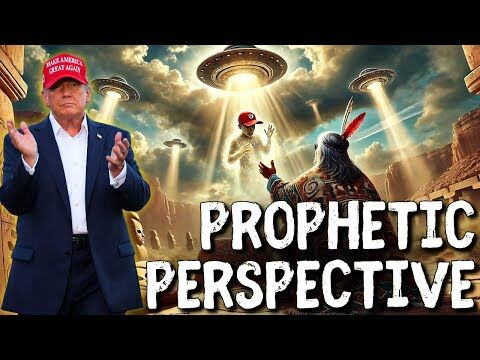



Most pastors avoid UFOs like a live wire. It’s messy, controversial and guaranteed to invite criticism from every direction. That’s why it’s genuinely surprising, and honestly refreshing, to hear ministry leader John Bevere wade directly into the conversation, not as a provocateur, but as a shepherd.
On a recent episode of The John Bevere Podcast, Bevere and his son Arden tackled what many church leaders quietly sidestep: the growing public conversation around UFOs, now rebranded as UAPs, and the spiritual questions they raise. What unfolds is not speculation for speculation’s sake, but a sober attempt to frame a cultural moment through Scripture rather than fear or fascination.
Bevere makes it clear this wasn’t a topic he was eager to address. In fact, he admits that not long ago he would have laughed at the idea of discussing UFOs at all. What changed was a growing conviction that silence could leave believers unprepared. With government officials, military pilots and intelligence agencies openly discussing unexplained aerial phenomena, he argues that Christians need theological grounding, not avoidance.
Rather than treating UFOs as evidence of extraterrestrial life from distant galaxies, Bevere reframes the issue as spiritual. The key distinction he emphasizes is that many of these phenomena are described as interdimensional rather than extraterrestrial. That distinction matters. Scripture already affirms an unseen realm populated by spiritual beings, both faithful and fallen. From that perspective, the idea of nonhuman intelligences interacting with the physical world is not a threat to biblical faith. It’s already embedded in it.
Bevere walks listeners through familiar but often overlooked passages, drawing attention to biblical descriptions of unseen rulers, authorities and powers that operate beyond human perception. He points out that angels in Scripture routinely appear, disappear, traverse realms and interact physically with the world. The Bible, he suggests, is far less materialistic than modern believers sometimes assume.
Where Bevere grows especially firm is in rejecting the idea that these phenomena are neutral or benevolent. He cautions that spiritual deception rarely presents itself as obviously evil. Scripture warns that Satan disguises himself as an angel of light, which means deception can appear advanced, enlightened, or even comforting. In that sense, he sees the modern UFO narrative as fertile ground for confusion, particularly if it is framed as something that could rewrite humanity’s understanding of God, creation, or salvation.
That concern drives Bevere’s pastoral urgency. He repeatedly stresses that his goal is not to sensationalize the topic but to prevent believers from being shaken as these discussions become more mainstream. If Christians are unprepared, he warns, they may either panic or become overly fascinated, and both responses are dangerous.
He distills that concern into two clear dangers:
- Ignorance that leads to shaken faith.
Bevere warns that believers who lack biblical grounding may hear talk of nonhuman intelligence and assume it contradicts Scripture. That reaction, he argues, stems from unfamiliarity with what the Bible already teaches about the unseen realm. - Obsession that leads to distraction.
He is equally concerned about Christians who become fixated on UFOs, conspiracies and hidden knowledge, allowing curiosity to replace devotion. Fascination, he notes, can quietly pull people away from the central focus of the faith.
Throughout the discussion, Bevere returns to a steady refrain: none of this should surprise believers. Scripture has long described a world where unseen powers operate, deception increases, and signs in the heavens unsettle humanity. What is new is not the phenomenon, but the volume of public attention being given to it.
The episode ultimately lands on a grounded, almost old-fashioned conclusion. Bevere does not call for deeper investigation, secret knowledge or constant vigilance over the skies. He calls for focus. Christians, he insists, are not meant to chase every mystery or decode every headline. They are meant to keep their eyes fixed on Jesus, remain rooted in Scripture, and stay faithful to the mission they’ve been given.
In a media environment obsessed with the spectacular, Bevere’s willingness to address UFOs without glorifying them may be the most unexpected part of all. He steps into unfamiliar territory, not to stir fear or hype, but to remind believers that even the strangest conversations of the moment do not sit outside the biblical worldview.
The takeaway from this unusual discussion is simple and steady: whatever may be unfolding in the unseen realm, it does not change who Christ is, what Scripture teaches, or what believers are called to do. The focus remains the same. Stay grounded. Stay discerning. And above all, keep your eyes on Jesus.
James Lasher, a seasoned writer and editor at Charisma Media, combines faith and storytelling with a background in journalism from Otterbein University and ministry experience in Guatemala and the LA Dream Center. A Marine Corps and Air Force veteran, he is the author of The Revelation of Jesus: A Common Man’s Commentary and a contributor to Charisma magazine.