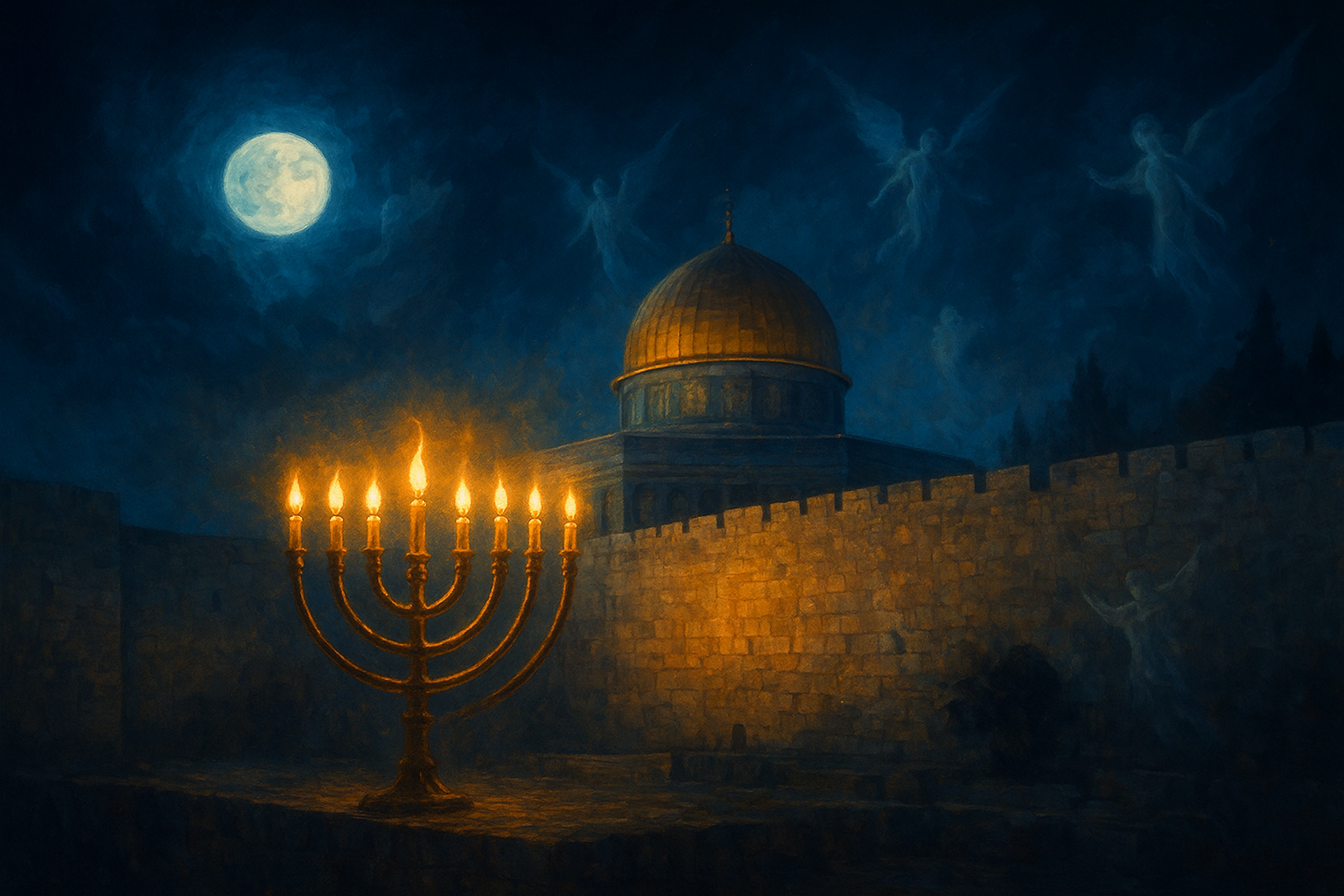

Hanukkah is often celebrated as a festival of lights, a commemoration of the rededication of the temple on the Temple Mount. Yet, according to Jonathan Cahn, the mystery of Hanukkah reaches far beyond its historical context—it points to spiritual realities and prophetic patterns that echo into the end times.
“The war against Israel was fought in the name of Palestine,” Cahn explained, linking the 2023 October 7 attack to a timeline that stretches back thousands of years. He noted that the date of the attack was far from coincidental. “That was the last day of Tabernacles, the very last day of the Hebrew feast,” he said. In ancient times, Hanukkah itself commemorated eight days not because of the oil miracle, as commonly believed, but because of the connection to the Feast of Tabernacles.
Central to Hanukkah, Cahn emphasized, is the Temple Mount, a site that has long symbolized the spiritual battle for Israel. “The events of Hanukkah, more than any place, focus on one site—the Temple Mount,” he said. Cahn noted that both ancient desecrations, including the Greeks placing idols of Zeus, and modern conflicts, like the October 7 attack, are part of a continuing struggle over this sacred location. “Even here what happened on October 7th is linked to the Temple Mount,” he explained, connecting historical events, prophecy, and present-day warfare in Israel.
Hanukkah, Cahn emphasized, is ultimately about light triumphing over darkness—both spiritually and historically. “You are the temple of God. And when you’re totally given to God, you light up. You’re radiant. That’s what God wants,” he said. This illumination is not only symbolic of God’s presence in the temple but also within each believer. The festival’s rededication story, he explained, mirrors the ongoing call for personal and national consecration, a reclaiming of holiness after desecration.
Cahn traced the roots of modern conflict to ancient history, detailing how the enemies of Israel sought to erase its identity. He explained that the Romans, after crushing Jewish revolts, renamed the land, effectively dedicating the city to Zeus. “They were even planning to build a temple of Zeus on the Temple Mount,” he said, connecting these ancient acts of desecration with contemporary struggles over the same sacred site.
Linking the spiritual and the prophetic, Cahn drew a parallel between the ongoing conflict and the cosmic struggle described in Revelation 12: “A great red dragon…stood before the woman who was about to give birth, that when she gave birth, he might devour her child.” Here, Israel is the woman, and the dragon represents Satan’s continuous opposition against God’s purposes. This, Cahn argued, is the same pattern repeated in human history—from attempts to destroy the Hebrew babies in Moses’ day to the attack on October 7.
For believers, the message is both urgent and personal. Cahn reminded his audience, “The enemy is a preemptor. He attacks specifically what God is going to do…If you’re in God’s will and he’s going crazy, it’s a sign of the timing. God is going to do something great.” The attacks on Israel, he said, mirror spiritual attacks on individual believers—a test and a confirmation that God’s purposes are at work.
Hanukkah, therefore, is not just a historical celebration. It is a prophetic reminder that light shines brightest in darkness, that God’s purposes cannot be thwarted and that the ultimate redemption, through Messiah, is coming.
As Cahn said, “Even when it’s the darkest time, you still got a light shining. And in the center of your being…he’s got to reign from the heart.”
Abby Trivett is a writer and editor for Charisma Media and has a passion for sharing the gospel through the written word. She holds two degrees from Regent University, a B.A. in Communication with a concentration in Journalism and a Master of Arts in Journalism. She is the author of the upcoming book, The Power of Suddenly: Discover How God Can Change Everything in a Moment.