
In a timely message, Jonathan Cahn unfolded a stunning mystery—one that stretches from Genesis to Revelation and reveals a cosmic war still raging today.
As Cahn pointed out in Genesis 37:9, Joseph declares, “I have dreamed another dream: and behold, the sun and the moon and the 11 stars were bowing down to me.”
Fast forward to Revelation 12, and the imagery returns with prophetic intensity: “A great sign appeared in heaven: a woman clothed with the sun, and the moon under her feet, and on her head a crown of 12 stars.”
The connection is no accident.
“The first book of the Bible, Genesis, and the last book of the Bible, Revelation, each have a vision or a dream of the sun, the moon, and a set number of stars,” Cahn explains in a powerful message. “One has 11, one has 12. But that’s really simple because there were 12 sons of Jacob.”
So who is the woman of Revelation 12?
For centuries, some suggested she represents the church. Others have pointed to Mary. However, the answer to this is much narrower. The woman gives birth to “a son, a male, who’s going to rule all the nations with a rod of iron.”
There’s only one who could be that person: The Messiah.
“The church does not give birth to Messiah,” Cahn says plainly. “Messiah wasn’t born of the church. The church was born of Messiah.”
Mary did physically give birth to Jesus, but the woman in Revelation is present at the end of the age, fleeing into the wilderness during a time of tribulation. “The woman has to represent something that’s alive at the beginning of the age and at the end of the age over 2,000 years of history,” he explains. “Only one answer—Israel.”
Israel was prophesied to bring forth the Messiah, and throughout the Hebrew Scriptures, Israel is often portrayed as a woman. The 12 stars further confirm the identity, pointing directly to the 12 tribes.
But Revelation 12 is not merely about identity—it is about war.
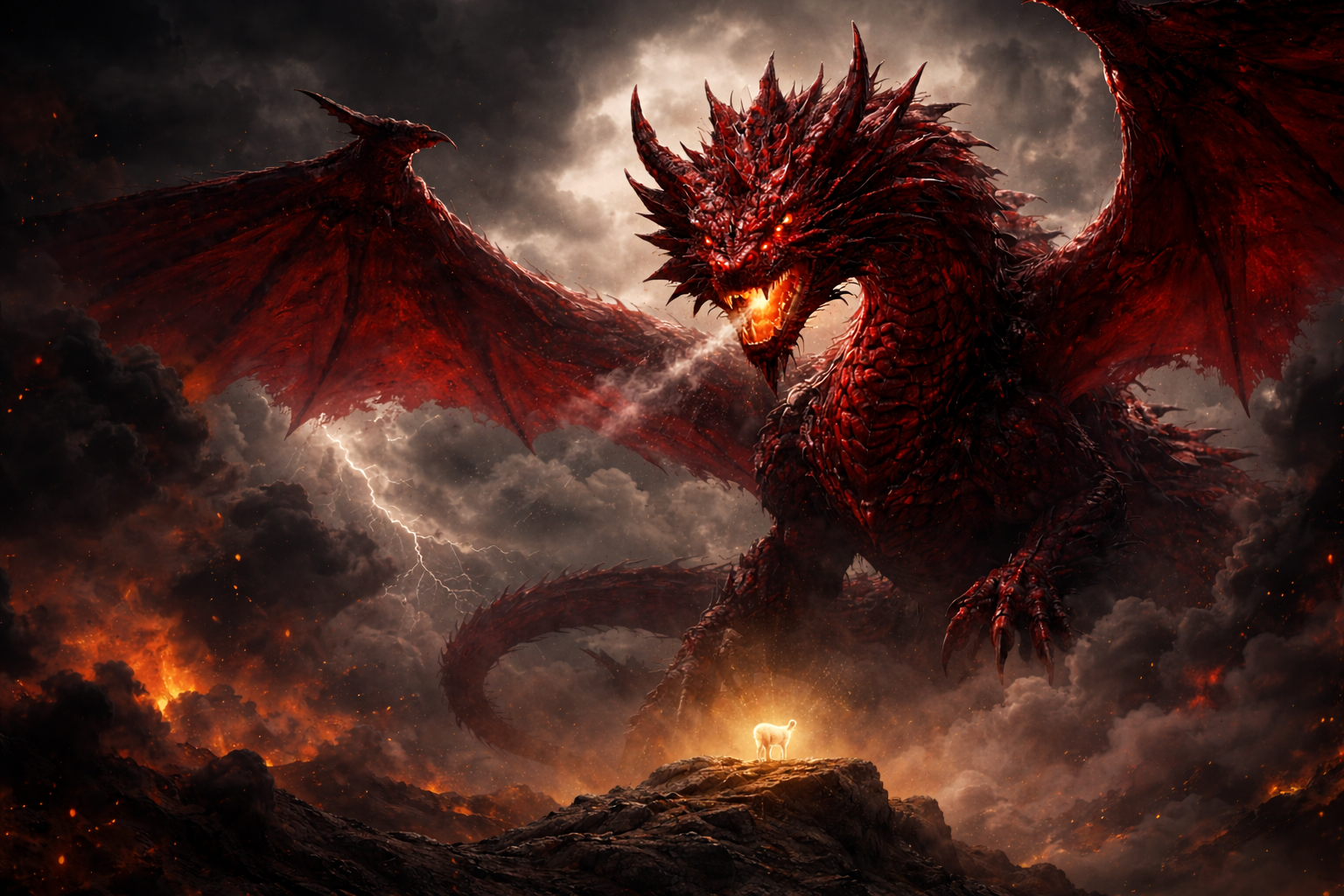
“Another sign appeared in heaven, and behold, a great red dragon,” the passage declares. Revelation 12:9 identifies the dragon as “that ancient serpent called the devil and Satan.”
“This is a mega figure,” Cahn says. “Red—the color of blood, war, danger.” The dragon seeks to devour the child at birth, echoing Herod’s attempt to kill Jesus and Pharaoh’s slaughter of Hebrew infants. “The dragon is a preemptor,” he explains. “He seeks to destroy the works and plans of God before they happen.”
After Messiah’s ascension—“her child was caught up to God and to His throne”—the woman flees into the wilderness for 1,260 days, or three and a half years, a time frame echoed in the book of Daniel and other end-times prophecies.
The dragon’s rage doesn’t stop there.
“The dragon was enraged with the woman and went to make war with the rest of her offspring—those who keep the commandments of God and have the testimony of Yeshua,” Cahn says.
In other words, believers in Jesus Christ.
Yet heaven declares victory in the midst of the battle: “They overcame him by the blood of the Lamb and the word of their testimony, and they did not love their lives unto death.”
“Victorious is not something for some believers,” Cahn declares. “It is to be the natural state of all believers. This is our inheritance.”
In a world shaken by spiritual conflict, Revelation 12 reminds us that the dragon may rage—but the Lamb reigns.
Abby Trivett is a writer and editor for Charisma Media and has a passion for sharing the gospel through the written word. She holds two degrees from Regent University, a B.A. in Communication with a concentration in Journalism and a Master of Arts in Journalism. She is the author of the upcoming book, The Power of Suddenly: Discover How God Can Change Everything in a Moment. For interviews and media inquiries, please contact [email protected].