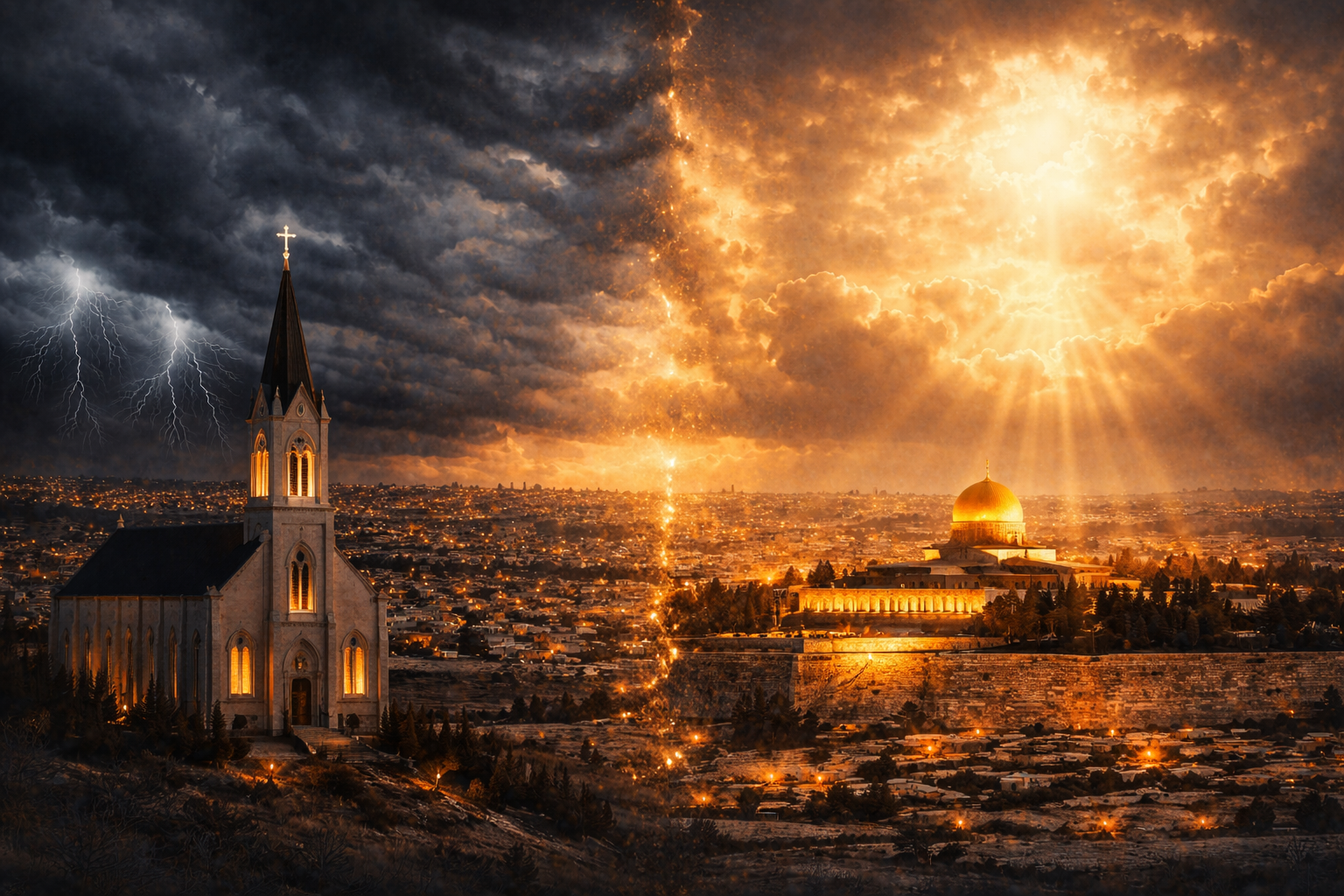

Friend, I want to speak to you from the heart on something that has stirred deep concern in me lately. In our fast-paced world of social media and viral videos, the idea that the Church has replaced Israel as God’s chosen people is spreading like wildfire. Influencers confidently declare that the Church is now “spiritual Israel,” and that God has forever cast aside His ancient covenants with the Jewish people simply because many rejected Jesus as Messiah.
But I have to tell you honestly: this teaching (called replacement theology) grieves me because it is not only biblically shaky but it quietly opens the door to something darker: a subtle form of antisemitism that has wounded the Jewish people and distorted God’s character for centuries. Today, let’s open the Scriptures together, look at them with fresh eyes and rediscover the breathtaking faithfulness of our God.
God’s Everlasting Covenant with Israel
Picture this: Long before there was a Church, God reached down and made an unbreakable promise to a man named Abraham. He said, “I will establish my covenant as an everlasting covenant between me and you and your descendants after you for the generations to come, to be your God and the God of your descendants after you” (Genesis 17:7, ESV).
He didn’t stop there. God specifically chose the line through Isaac—not Ishmael—and then Jacob. From that family line burst forth the nation of Israel. With dramatic power, the Lord rescued them from the iron grip of Egyptian slavery, thundered His covenant at Mount Sinai, and led them into the land flowing with milk and honey.
Time and again in the Old Testament, even when Israel stumbled, God’s voice rang out with fierce loyalty: His commitment would stand forever (Deuteronomy 7:6-9; Jeremiah 31:35-37, ESV). And right in the center of it all, He chose Jerusalem as His special dwelling: “The Lord has chosen Zion; he has desired it for his dwelling place” (Psalm 132:13, ESV).
To order Chad MacDonald’s new book, Defeating Darkness, visit Amazon.com.
Think about that for a moment. It was in that very city—physical, earthly Jerusalem that our Jewish Messiah, Jesus, was crucified, buried, and rose triumphantly from the dead. And one day soon, it will be to that same city that He returns in glory as King of kings and Lord of lords (Zechariah 14:4; Acts 1:11, ESV). God’s story with Israel is not a footnote; it is woven into the very fabric of redemption.
God Has Not Rejected His People
Now, let’s turn to the New Testament and listen closely to the Apostle Paul, a Jewish man who loved his people passionately. In Romans chapters 9–11, Paul pours out his heart. He is heartbroken over the fact that many of his fellow Jews did not recognize Jesus as Messiah (Romans 9:1-3, ESV). Yet he boldly declares:
“I ask then: Did God reject his people? By no means!” (Romans 11:1, ESV).
Then Paul unveils one of the most important “mysteries” in all of Scripture:
“Lest you be wise in your own sight, I do not want you to be unaware of this mystery, brothers: a partial hardening has come upon Israel, until the fullness of the Gentiles has come in. And in this way all Israel will be saved, as it is written, ‘The Deliverer will come from Zion, he will banish ungodliness from Jacob’” (Romans 11:25-26, ESV).
Watch how clearly this passage keeps Israel and the Church distinct while showing God’s beautiful plan:
The “partial hardening” is happening to Israel, the Jewish people as a nation. It is only partial because a faithful remnant of Jews (including Paul and the first disciples) had already embraced Jesus, not to mention the countless Messianic Jews.
The phrase “until the fullness of the Gentiles has come in” describes this present age, the time when God is drawing a great multitude of Gentiles into salvation through the Gospel. This Church Age has a divine deadline. The word “until” shouts that the hardening is temporary, not permanent.
Then comes the glorious promise: “in this way all Israel will be saved.” This does not mean the Church becomes the new Israel, nor does it suggest every Jew who ever lived will be saved automatically. Instead, it points to a coming day when, after the full number of Gentiles has entered, the veil will lift, and a great multitude of Jewish people will turn to their Messiah, Jesus. This fulfills ancient prophecies, like the Deliverer coming from Zion (Isaiah 59:20-21, ESV).
Paul drives the point home with the unforgettable picture of an olive tree. Israel is the cultivated tree with deep roots. Some natural branches were broken off because of unbelief. Wild olive branches like you and me, (Gentiles) were graciously grafted in to share the life-giving sap of the root (Romans 11:17-24, ESV). But Paul gives a strong warning:
“Do not consider yourself to be superior to those other branches… You do not support the root, but the root supports you” (Romans 11:18, ESV).
The natural branches can be grafted back in when they believe—and Paul says they will (Romans 11:23-24, ESV). He seals it with these powerful words about ethnic Israel:
“As regards the gospel, they are enemies for your sake. But as regards election, they are beloved for the sake of their forefathers. For the gifts and the calling of God are irrevocable” (Romans 11:28-29, ESV).
Can you feel the weight of that? God’s covenants with Abraham, Isaac, Jacob and the nation of Israel have never been canceled. The Church hasn’t replaced Israel. We Gentiles have simply been invited into the rich blessings that flow from Israel’s root. What a humbling, beautiful truth!
One Way of Salvation for Jew and Gentile Alike
None of this means there are two roads to heaven. Jesus made it crystal clear: “I am the way, and the truth, and the life. No one comes to the Father except through me” (John 14:6, ESV). Salvation has always been by grace through faith in Christ alone—for the Jew first and also for the Gentile (Romans 1:16, ESV).
Jesus Himself was born Jewish, lived Jewish, taught in the synagogue, celebrated Passover, and fulfilled every feast as the true Passover Lamb. His earliest followers were all Jewish. The New Covenant God promised in Jeremiah 31:31-34 was made specifically “with the house of Israel and with the house of Judah.” When we Gentiles believe, we don’t replace Israel—we become fellow heirs alongside the believing Jewish remnant (Ephesians 2:11-22; Galatians 3:29, ESV).
Rejecting the Antisemitic Roots of Replacement Theology
Here’s where it gets personal for me. Too often, the push to say the Church has completely replaced Israel has grown out of ugly historical antisemitism that has sadly crept into parts of the Church over the centuries. Claiming God has permanently abandoned the Jewish people does not honor the Lord—it actually attacks His faithfulness and can plant seeds of contempt instead of compassion.
Scripture calls us to something far better. We are commanded to “pray for the peace of Jerusalem” (Psalm 122:6, ESV). Paul’s own prayer still echoes: “Brothers, my heart’s desire and prayer to God for them is that they may be saved” (Romans 10:1, ESV). I want that same burning heart. I want to see Jewish eyes opened to their long-awaited Messiah, Jesus, while standing firmly against any whisper of hatred or replacement thinking.
Living in the Time of Fulfilled Prophecy
What an exciting time we live in! After nearly 2,000 years of scattering—the Diaspora—the modern State of Israel was reborn in 1948. This is no accident. It is a dramatic fulfillment of God’s promises:
“I will take you from the nations and gather you from all the countries and bring you into your own land” (Ezekiel 36:24, ESV; see also Ezekiel 37:21-28; Isaiah 11:11-12; Jeremiah 16:14-15, ESV).
Ezekiel’s vision of the valley of dry bones coming back to life first physically, then spiritually, is unfolding before our eyes. Jesus Himself gave us the sign of the fig tree, often a picture of Israel—saying, “When you see all these things, you know that it is near, right at the door” (Matthew 24:32-33, ESV).
We are living in that season. The time is short. Jesus is coming back to Jerusalem—to reign as King.
A Call to Stand in Truth and Love
So let me ask you directly: Will you stand with the clear teaching of Scripture? God’s covenant with Israel has not been replaced by the Church. Through faith in Jesus the Jewish Messiah, we Gentiles are graciously included in the blessings, while God’s promises to Israel remain rock-solid and irrevocable. A glorious day is coming when the partial hardening will lift, and “all Israel will be saved” as many Jewish hearts turn to Christ.
This doesn’t weaken the Gospel, it makes it even more urgent. Every single person, Jew or Gentile, must come to the Father through faith in Jesus Christ alone.
Let’s reject any teaching that divides or carries even a hint of antisemitism. Instead, let’s bless Israel, pray fervently for its peace and salvation, and boldly share the Good News that the Messiah who came from the Jews is the Savior of the world.
Jesus is returning soon—to Jerusalem—to rule and reign.
Maranatha! Come, Lord Jesus.
Bishop Chad MacDonald is the founder of Revival Fire World Ministries and carries an international apostolic mantle. He is a prophetic voice, revivalist, and author. He has also served as an adjunct professor for New Life Bible College and Norvel Hayes Ministries. With a powerful anointing that will change your life, Chad travels extensively throughout the United States and internationally. His meetings are marked by the tangible presence of God and accompanied by powerful deliverances, signs, and wonders. His heart burns to see a return to true Pentecostal power and to see the body of Christ equipped to carry the glory of God. He is the host of Voice of Revival TV and podcast. He is a graduate of World Harvest Bible College (Valor Christian College) and an ordained bishop in the City Harvest Network under the direction of Dr. Rod Parsley. A devoted husband, father of seven, and proud “Pappy” to three grandchildren, he calls Tennessee home.