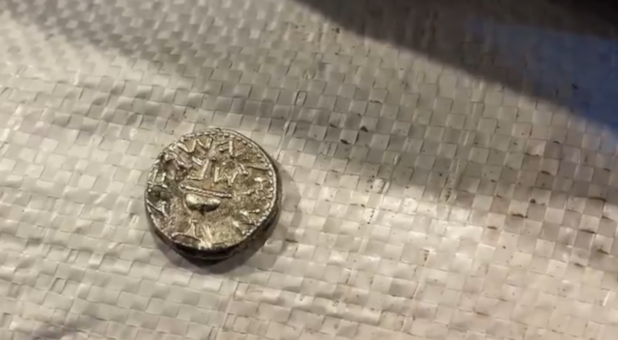

An 11-year-old girl in Israel has discovered a silver shekel coin that archaeologists say may have been minted by a priest on the Temple Mount in Jerusalem 2,000 years ago.
The girl, Liel Krutokop, found the rare coin while sifting through ancient dirt during a family-friendly “archaeological experience” done in coordination with the City of David and Emek Tzurim National Park in Jerusalem.
“We poured the bucket with the dirt on the strainer, and as we filtered the stones that were inside, I saw something round,” Krutokop said in a statement. “At first, I did not know what it was, but it looked different from all the other stones. … I was very excited.”
The coin was engraved with “Second Year,” indicating that it was used during the second year of the Great Revolt of the Jews against the Roman empire between 67-68 AD. On the other side of the coin is an inscription marking the headquarters of the High Priest, and next to it appears in ancient Hebrew the words, “Holy Jerusalem.”
Dr. Robert Kool, head of the Coin Department of the Israel Antiquities Authority, says the coin was probably made from high-quality silver found in the Second Temple reserves.
“If so, we can say with caution that this coin is, apparently, one of the only items we hold today that originated on the Temple [Mount] itself,” Kool said.
“This is a rare find, since out of many thousands of coins discovered to date in archeological excavations, only about 30 coins are coins made of silver, from the period of the Great Revolt,” he added.
Kool theorizes that the coin was minted by a priest who was sympathetic to the Jewish rebels.
“A currency is a sign of sovereignty,” he explained. “If you go into rebellion, you use one of the most obvious symbols of independence, and you mint coins. The inscription on the coin clearly expresses the rebels’ aspirations. The choice to use ancient Hebrew script, which was no longer in use at the time, is not accidental. The use of this script came to express the longing of the people of the period for the days of David and Solomon and the days of a united Jewish kingdom – days when the people of Israel had full independence in the land.”
Experts say the coin was used for trade in Jerusalem 2,000 years ago before the Romans destroyed the temple. It was found in dirt taken from archaeological excavations on the ancient “Pilgrimage Road” in the City of David. Jesus and other Jewish pilgrims would have walked that road to get to the temple.
“This street, which connected the Siloam Pool in the south of the City of David to the Temple Mount in the north, was Jerusalem’s main street during the Second Temple period, where thousands of pilgrims marched on their way to the Temple. There is no doubt that there would have been extensive trading here. This is evidenced by the many weights and bronze coins we have found here. But to find a rebel coin made of pure silver is definitely very special and exciting,” said archaeologist Ari Levy, Director of the Excavation on behalf of the Israel Antiquities Authority.
The coin has been chemically cleaned and will be displayed for the public to see during Hanukkah at Emek Tzurim National Park. {eoa}
For the original article, visit our content partners at cbnnews.com.
Read articles like this one and other Spirit-led content in our new platform, CHARISMA PLUS.