
Yom Kippur, traditionally regarded as the holiest day of the biblical year, falls this Friday evening through Saturday evening on Sept. 29-30. Yom Kippur literally translates “Day of Covering,” but is usually called the Day of Atonement. The English word atonement was devised specifically to convey the “at-one-ment” with God that was attained by following the detailed procedures for sacrifice and priestly cleansing on this day. (Lev. 16 and 23:26-32, Num. 29:7-11) For a basic summary of Yom Kippur, visit https://en.wikipedia.org/wiki/Yom_Kippur.
Our salvation or right standing with God does not depend on our observance of special days or seasons. However, if you have faith to engage authentically by the Holy Spirit in these appointed days, you may find rich blessing in them. For this reason, many Christians and Messianic Jews celebrate Passover, First Fruits (Resurrection Day), the New Year/Yom Teruah and Feast of Tabernacles. Regarding Yom Kippur, however, there can be unique challenges. The day seems to require an embrace of a system for forgiveness of sin specifically rendered ineffective (if not altogether anti-Christian) in the New Covenant. Moreover, Yom Kippur is a solemn day that, as traditionally kept, can appear almost morose. As a result, many Christians who celebrate other feasts give little attention to the highly meaningful Day of Atonement. Nevertheless, I believe that followers of Yeshua can not only observe this day with integrity, but that God invites us, as a 1 Peter 5 holy priesthood, to engage intimately with Him on Yom Kippur in at least five ways. (And just a loving reminder here: Gentile believers can only authentically observe this or other feasts with integrity by being who God created them to be—Gentiles, not Jews.)
1. Yom Kippur is, first and most of all, a time to commemorate Messiah’s stunning self-sacrifice. We are eternally thankful that Yeshua is our once-for-all atonement: “When Messiah appeared as [High Priest] …. He entered into the Holies once for all—not by the blood of goats and calves but by His own blood, having obtained eternal redemption” (Heb. 9:11-12, TLV).
Therefore, throughout the day on Yom Kippur we honor and celebrate Yeshua. He has marvelously done away with sin, not just covered (as in “Kippur”) our sin. Yom Kippur is an appropriate time to seek renewed and expanded understanding of the authority and power of His shed blood. It is a day to engage “the fellowship of sharing in His sufferings” and “power of His resurrection” (Phil. 3:10)
2. With this undertone of celebration for Messiah’s once for all atonement, Yom Kippur is a Sabbath, a day not to work but assemble before YHVH. It is a day on which we “deny” or “afflict” ourselves (Lev. 23:27, 32, Num. 29:7) The Hebrew word generally translated either “deny” or “afflict” means to look down, abase, chasten or harshly deal with. In context, the word refers to an extreme humbling, sober examination and judgment of oneself. For this reason the Jewish people fast on Yom Kippur. The fast is a matter of tradition but fits well with the day. I recommend it for those desiring to engage uniquely with God on Yom Kippur.
Recall that Yeshua calls His followers to self-denial, too, “ Then Jesus said to His disciples, “If anyone will come after Me, let him deny himself, and take up his cross, and follow Me.me” (Matt. 16:24, MEV). Romans 12:1 affirms: “I urge you therefore, brothers, by the mercies of God, that you present your bodies as a living sacrifice, holy, and acceptable to God, which is your reasonable service of worship.”
God does not want our lives focused on self-examination or affliction throughout the year. But He does call us to judge ourselves regarding sin. By rightly judging ourselves and turning from sin, we may avoid coming under His judgment or chastening (1 Cor. 11:31). On a somewhat related note, recall that Israel’s high priest had to atone first for his own sins before he could minister to God’s people. Could God be calling you to consecrate this Yom Kippur as a Sabbath on which to humble yourself, fast and ask Him to search your heart? Would you want to receive anew His precious gifts of conviction, repentance and expanded, holy love relationship?
3. Yom Kippur involves sacrifice. According to the New Covenant, how do we offer God a sacrifice? Hebrews 13:15 says, “Through Him, then, let us continually offer to God the sacrifice of praise, which is the fruit of our lips, giving thanks to His name.” Yom Kippur is a highly appropriate day to spend in sacrificial praise and worship. But bear in mind that for praise to be sacrificial it must cost something, such as time, resources, energy—or pride. The notion of sacrifice is one not often discussed by followers of Yeshua. Therefore, Yom Kippur can be a time to revisit the Scriptures, including those in the New Covenant, regarding the blessing of sacrifice. These are but a few relevant verses through which we can be empowered by the Spirit, through rightly offered sacrifice, for the days ahead:
“Gather to me my consecrated ones, who made a covenant with me by sacrifice …” (Ps. 50:5) Consecrated ones who have made a covenant by sacrifice include those partaking in the New Covenant, with its exchange of Messiah’s life for theirs, and their lives given over to Him. Reaffirming this sacrificial exchange on Yom Kippur can reaffirm covenant with God.
“Sacrifice a thank offering to God …” (Ps. 50:14). Thank offerings were freewill offerings not required for the forgiveness of sin. Instead, they were given to God as an overflow of love and gratitude. He highly and uniquely valued these voluntary offerings. Today, because our sins have been forgiven, thank offerings include voluntary worship and praise—and any other way in which our lives are laid down for Him and His people.
“He who sacrifices thank offerings honors Me and prepares the way so that I may show him the salvation of God” (Ps. 50:23). Sacrificial thank offerings can serve as powerful intercessory acts.
Followers of Messiah “are a holy priesthood to offer up spiritual sacrifices that are acceptable to God through Jesus Christ” (1 Pet. 2:5). Spiritual sacrifices offered voluntarily, not reluctantly, may be a vital function of God’s holy priesthood.
“The sacrifices of God are a broken spirit, a broken and contrite heart” (Ps. 51:17). The value of any sacrifice depends on the disposition of heart with which it is offered.
4. “Do not forget to do good and to share. For with such sacrifices God is well pleased” (Heb. 13:16). A Messianic or Christian observance of Yom Kippur can involve sacrificial giving to others. One of many ways to “do good and to share” with others is to pray for them. Yom Kippur can—and I believe should—be a day on which followers of Yeshua pray intentionally for Israel’s salvation.
In Israel and around the world, Jewish people will gather in synagogues this weekend to fast, recite Scripture, and ask for forgiveness of sin. They will end the day hoping or trusting that their sins were forgiven. In so doing, they will reaffirm the traditional Jewish belief there is a way to the Father not involving Yeshua, His Son. Meanwhile, God’s heart toward them is expressed in Romans 10:1: “My heart’s desire and prayer to God for Israel is that they may be saved.” He yearns for His ancient covenant people to be fully reconciled to Him in Messiah. You, as part of a royal priesthood, can sacrificially intercede on Yom Kippur for that to happen.
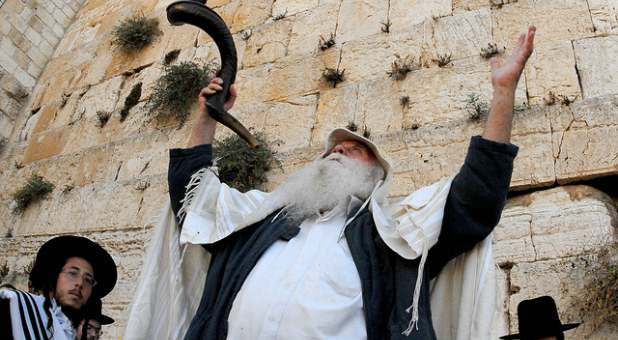
At the end of Yom Kippur, the Jewish people traditionally sound the shofar. According to rabbinic teaching, the trumpet blast signifies that our souls have been freed from sin; therefore, we may have a good year. It also reminds us of the Jubilee, which is heralded by shofar blowing every 50th Yom Kippur (Lev. 25:8-9). Last, the shofar is said to announce the departure of God’s especially near presence on Yom Kippur with His people though the high priest.
5. For believers, the shofar blast of Yom Kippur has deeper meaning. It announces a sealing of that which has taken place by the Spirit throughout the day. In addition, it heralds the coming Day of the Lord or Day of Judgment. This is the glorious yet fearsome day of Messiah’s return. Many Messianic leaders believe Yom Kippur prophetically foreshadows the Second Coming and day of Israel’s national salvation; and therefore, Yeshua will return as Judge and King on a Yom Kippur in the not-too-distant future. This is implicit in Paul’s teaching: “And so all Israel will be saved, as it is written: ‘The Deliverer will come out of Zion, and He will remove ungodliness from Jacob”; “for this is My covenant with them, when I shall take away their sins” (Rom. 11:26-27).
For those choosing to engage with it, Yom Kippur can be a day of special blessing in at least five ways. (1) Yom Kippur can be a Sabbath on which to commemorate Yeshua’s heaven-and-earth-shattering atonement. (2) It is a day to fast and soberly invite the Holy Spirit’s conviction, correction and then reconsecration of ourselves as living sacrifices. (3) It is a day to offer God a genuine sacrifice of praise. (4) Intercession for the salvation of Israel (and others) is highly appropriate this day. (5) Celebration of the promise of Yeshua’s return and hope of His coming is perfect for Yom Kippur. The Bible’s last words remain, “Even so, come, Lord Jesus” (Revelation 22:20) {eoa}
Sandra Teplinsky has been in Messianic Jewish ministry since 1979. She is president and founder of Light of Zion, a Messianic outreach to Israel and the church based in Jerusalem.
This article originally appeared on lightofzion.org.