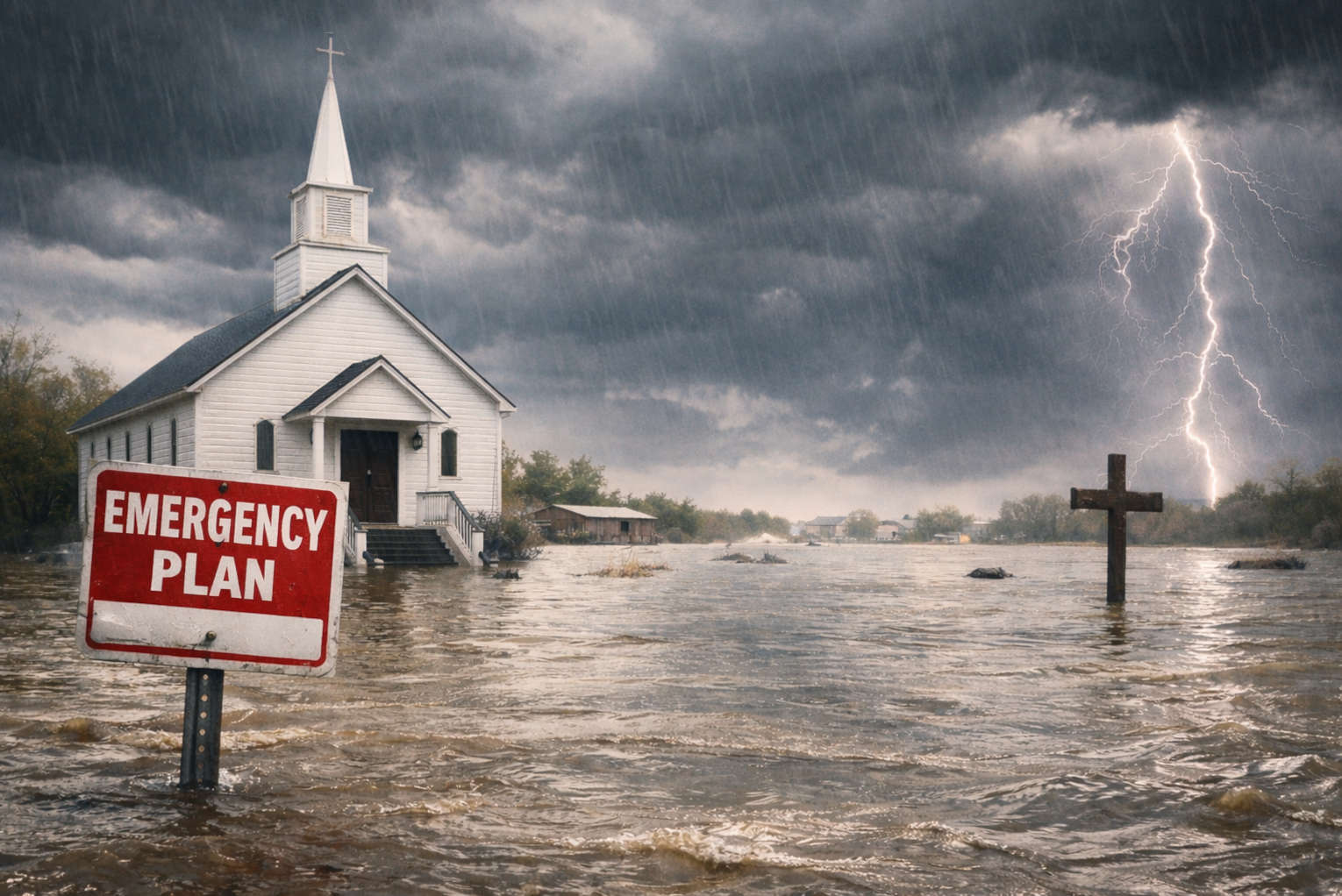

Severe weather and flooding events are becoming increasingly more common, causing billions of dollars in damage every year, not only to homes and businesses, but to churches, camps, and other ministries. Areas not usually prone to floodwaters are increasingly no longer immune.1
In early April 2025, Central Kentucky was struck with multiple rounds of heavy rain, causing widespread flash flooding and historic river crests. Jared Morgan, a managing partner with Lightwell Insurance Advisors, was in his office, watching the news, watching the forecast. And praying.
This wasn’t the first time Kentucky experienced flooding. Earlier in February, severe weather caused flooding that damaged more than 18,000 structures and caused more than $1 billion in damage.2
“Office staff hunkered down and waited for the phone to ring,” said Morgan. “It’s not a great feeling, knowing that there will be damage, knowing that several ministries were going to get hit pretty bad.”
From tropical storm remnants to relentless multi-day storms, extreme flooding like what happened in Kentucky is no longer a rare event for ministries. This is why Shannon Worlin, a risk control specialist for Brotherhood Mutual Insurance Company, advises that every ministry needs a comprehensive plan for responding to floods. “It’s a live document that needs to be carefully created and reviewed annually. You can start small—but start now.”
Brotherhood Mutual also offers a disaster response checklist in their online Safety Library.
Creating a Plan Before a Crisis
A good disaster plan includes these seven key components:
- Form a team. Include all key professionals within your ministry, plus any tech workers, first responders or medical personnel in your congregation.
- Know what’s possible for your area. Once the team is in place, it’s time to perform a risk assessment. Determine which hazards—such as flooding, extreme weather, fire, violent acts, utility and data losses—could affect your ministry. Weigh the probability of each one happening, then tackle the most likely scenarios first. But be sure to go back and create a plan for all risks, no matter how small.
- Find your FEMA zone. Research whether the area has ever flooded. Know what bodies of water, creeks or rivers are nearby, including the nearest drainage ditch. Talking to long-time congregants and neighbors can help put a property in a historical context. Get more info at fema.gov/flood-maps/.
- Create a response plan. Make sure the disaster plan considers evacuation routes. A good place to start is by answering the following questions:
- Which roads may be or have historically become impassable due to flooding?
- Do we have enough vehicles to transport people in an emergency?
- Can we partner with a local school district to help with transportation?
- Where’s a safe rally point?
- Implement a multi-layer communication system. Be sure to include methods that don’t rely on power or the internet. Two-way and HAM radios, weather radios and PA systems with battery backup, airhorns and megaphones can get the word out fast.
- Train employees and volunteers. Tabletop exercises and annual drills help you evaluate and refresh emergency plans. Retreats and outside rental groups, including sports leagues that rent gym space, may not be familiar with your property. You’ll need a system for sharing your disaster plan with these groups.
- Recover, reassess and update. Following an actual emergency, review what worked and what didn’t. Assess the response and damage, then update your plan accordingly.
Understanding the Nuances of Flood Coverages
Water is a unique insurance risk. Because it can intrude onto a property in multiple ways, the source of the water often determines how a ministry would be covered.
Floods are not typically covered by a commercial property insurance policy. The National Flood Insurance Program (NFIP) is substantively different. An NFIP policy is administered by the Federal Emergency Management Agency (FEMA) and only covers water damage resulting from specified causes, such as the unusual and rapid accumulation of surface waters or the overflow of inland or tidal waters. Crucially, it does not cover some causes of water damage that are also excluded from a commercial property insurance policy.
For example, an NFIP policy would not cover damage caused by a sewer backup if the backup is a direct result of an overloaded public sewer system. Adding an insurance endorsement or excess insurance to your ministry’s package policy can provide separate, limited coverage for this type of water damage and more. Talk to your insurance agent about your options.
Find even more ministry-related risk management guidance in the online Safety Library at www.brotherhoodmutual.com/safety-library. Ministries have free access to articles, checklists, sample policies, and more.
Kimberly Miser is a risk management writer at Brotherhood Mutual Insurance Company who collaborates with risk control, underwriting, claims, legal teams, and outside experts to help ministries reduce loss and prevent claims.
1. “Dudley, Taylor, and Ray, Sally. “No community is immune to flooding: Compounding disaster risks and the path forward.” Center for Disaster Philanthropy, 17 October 2024, https://disasterphilanthropy.org/blog/no-community-is-immune-to-flooding-compounding-disaster-risks-and-the-path-forward
2. Flooding Damage Surpasses $1 Billion. Kentucky Edition. https://ket.org/program/kentucky-edition/flooding-damage-surpasses-1-billion/#:~:text=Gov.,to%20roads%20and%20other%20infrastructure. Accessed 28 February 2026.