
A Washington outsider, anathema to his party’s establishment, rides a wave of discontent with politics-as-usual to an early lead in the presidential nominating contest. Seemingly emerging out of nowhere – a year before the first caucuses and primaries not even the longest list of contenders included his name – this unlikely candidate pioneers new campaign strategies to catapult to the top of a crowded field.
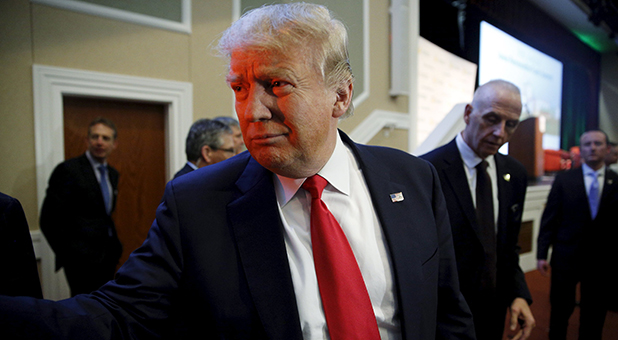
Donald Trump in 2016? The real estate tycoon and reality TV star shaking up the Republican primary race with his brash rhetoric, unorthodox agenda and disdain for retail campaigning in states like Iowa and New Hampshire?
No, Jimmy Carter in 1976. Forty years ago, an obscure Southern governor exploited changes in the presidential selection rules and post-Watergate disillusionment with conventional party politics to win the presidency. Nobody imagined Carter’s victory: Two years before he wrapped up the Democratic presidential nomination, Carter didn’t even merit consideration on the Christian Science Monitor’s comprehensive list of 24 presidential contenders.
Yet Carter invented the modern outsider campaign that has come to define contemporary presidential politics. He laid out the blueprints for Trump’s unconventional candidacy.
At first glance, it may seem strange to point to Carter’s as the first outsider campaign. During the 19th century, American voters occasionally sought alternatives to conventional politicians by tapping such military heroes as Andrew Jackson and Ulysses S. Grant for the nation’s highest office. Dwight D. Eisenhower’s 1952 election represented a return to this tried-and-true pattern. But with the exception of war heroes, Americans normally elected chief executives with experience in government and the imprimatur of their party’s leadership.
True, in 1968, Minnesota Senator Eugene McCarthy’s anti-establishment, anti-Vietnam War campaign forced incumbent President Lyndon B. Johnson out of the race and threw the Democratic Party into turmoil. Four years later, much to the consternation of party bosses, South Dakota Senator George McGovern’s insurgent campaign won the Democratic presidential nomination.
But even though McCarthy and McGovern challenged the party establishment, they had both been Washington politicians, with long records of government service. Besides serving in the Senate, McGovern, for example, had served in the House of Representatives and held a position in the administration of President John F. Kennedy.
Carter was different. Just two years into his only term as Georgia governor, he launched his presidential bid. So obscure that contestants on the TV game show What’s My Line? failed to recognize him, Carter also carried the baggage of his native region, a place most Northerners still regarded with suspicion as a menacing landscape of ignorant Bible thumpers, red-neck sheriffs and reckless lynch mobs.
They thought, according to Carter, “that since I am a Southern governor, I must be a secret racist.” He had no ties to Washington, and none to his party’s establishment, who initially placed its hopes in Senator Edward M. Kennedy (D-Mass.). After Kennedy refused to run, party leaders divided their support among several well-connected Washington insiders: Senators Birch Bayh (D-Ind.) and Henry Jackson (D-Wash.) and Representative Mo Udall (D-Ariz.).
Four years before Election Day 1976, Carter’s top aides laid out their strategy in an elaborate 72-page memo that became the blueprint for outsider politics. It framed both a message and a method that would fill the playbooks of future candidates – Democrats like Colorado Senator Gary Hart, in 1984, and Vermont Governor Howard Dean, in 2004 – and Republicans like Trump.
“Perhaps the strongest feeling in the country today,” memo author and future White House Chief of Staff Hamilton Jordan told Carter, “is the general distrust of government and politicians at all levels.”
Carter played to this sentiment. He emphasized his character and his experience outside Washington as a farmer, naval officer, engineer, small-business operator and devoted family man.
While Carter’s modesty is the polar opposite of Trump’s braggadocio, both men deliberately obscured their policy positions and rested their appeal on their personal qualities: their ability to get things done and their independence from the establishment.
Carter also took advantage of changes in the nominating process to pioneer a new path to the White House. As late as 1968, presidential primaries had been mainly a sideshow. There were only 15 primaries that year, and the eventual Democratic nominee, Vice President Hubert Humphrey, didn’t contest them and lost every one.
But new rules had opened up the process after the conflicts of the 1960s. In 1972, there were 21 primaries. There would be even more in 1976, so Carter began campaigning long before the initial contests.
He also targeted Iowa’s party caucuses, an early event on the campaign calendar that had previously received little attention from candidates, or the national media, and exerted negligible influence on the selection process. Very few Iowans even participated (less than 10 percent of registered Democrats caucused), and the Hawkeye State sent mostly uncommitted delegates to the national convention.
Carter recognized that an all-out effort in Iowa might win name recognition for a relative unknown, garner media attention and build momentum for the primaries. The strategy worked. Even though the largest bloc of voters selected uncommitted delegates, Carter “won” Iowa. His 27 percent of the vote far exceeded that of his nearest rival.
Soon, Carter’s famous smile appeared on the covers of Time and Newsweek, and the outsider was labeled the front-runner.
His rivals never slowed that early momentum. Panicked, party leaders and union officials worried about a Southerner’s appeal in the general election, about Carter’s lack of experience in foreign policy and about views that made him more conservative than the Democratic establishment. They also distrusted his staff, which was composed almost entirely of Georgia loyalists without ties to major Democratic interest groups, like organized labor.
Party leaders united to form the ABC (“Anybody But Carter”) movement. They hoped new entrants into the race, principally Idaho Senator Frank Church and California Governor Jerry Brown, would stall Carter’s drive to the nomination and force a brokered convention.
The ABC movement brought together strange bedfellows. In the Maryland primary, the old-style machine of the Baltimore Democratic boss backed Brown, no friend of the machine, in an effort to derail Carter. Trying, in New York Times columnist James Reston’s words, to expose Carter as “all shell, no peanut,” the ABC movement defeated Carter in a few late primaries. But much like Hillary Clinton’s 2008 campaign against Barack Obama, the ABC proved to be too little, too late.
The 1976 campaign, then, generated many now familiar features of American presidential politics. It not only made the Iowa caucuses a major stop on the road to the White House, it also set the stage for endless campaigns beginning years before the first votes are cast.
Carter’s experience with firebrand Southern orators made him distrust overblown rhetoric and despise the demagoguery that defines much of Trump’s appeal.
But Trump’s strategy – create credibility for an outsider candidacy in advance of the initial contests, stress the candidate’s personal qualities and use early momentum to drive rivals from the field – owes a great deal to the Carter playbook.
In 1976, a frustrated political establishment complained about Carter’s outsider campaign: “We need to elect a government,” one insider insisted, “not a man.”
For better or worse, the 2016 field, and the Republican establishment that hopes to upend Trump, must still play by the rules Carter devised 40 years ago.
Bruce J. Schulman, William E. Huntington Professor of History at Boston University, is the author of The Seventies: The Great Shift in American Culture, Society and Politics.