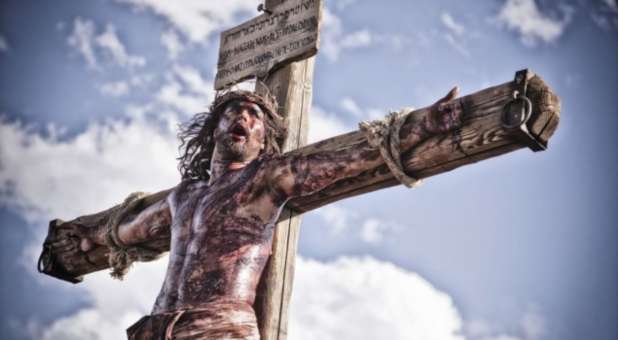

When the movie The Passion of the Christ was released 15 years ago, snobbish Hollywood critics mocked it because it offered a realistic depiction of Jesus’ torture and death. I know people who couldn’t watch the R-rated violence in Mel Gibson’s movie because it was such an accurate portrayal of a brutal, first-century Roman execution.
Yet the blood in that movie was fake. The intense pain Jesus felt on the cross was real.
Nobody performed an autopsy on Jesus’ mangled body after He was taken down from the cross. But doctors who have studied the Bible’s description of His death say the pain would have been beyond excruciating. In fact, the word “excruciating” means “out of the cross.”
His suffering began in Gethsemane, where God laid the sins of the world on His beloved Son. The intense stress caused hematidrosis, a condition in which blood seeps out of sweat glands. Luke the physician, whose description of the crucifixion is the most detailed, wrote that Jesus’ sweat “became like great drops of blood falling down to the ground” (Luke 22:44b).
After His arrest, Jesus was flogged so mercilessly that his skin was stripped off His back, exposing muscle and bone. After being slapped, punched, crowned with thorns and beaten with reeds, He was covered with a red robe and led to Golgotha. There, Roman soldiers drove nails (more like seven-inch spikes) into his wrists—most likely hitting the median nerve, causing more blinding pain. Then they nailed another long metal spike into his feet.
At that point, doctors suggest, Jesus would have suffered dislocation of His shoulders, cramps and spasms, dehydration from severe blood loss, fluid in His lungs and eventual lung collapse and heart failure. Yet, according to Matthew 27:34, Jesus refused to take a pain-killing solution. He chose to endure the pain for us.
How did Jesus handle this agony? Many scholars say He recited Psalm 22 throughout His ordeal. These words, which are quoted more often in the New Testament than any other Old Testament passage, describe in detail the death of the Messiah.
Whenever I imagine what happened at Calvary, I think about these words Jesus muttered from the cross. He had memorized them since he was a boy in the synagogue in Nazareth:
“My God, My God, why have you forsaken me?” (Ps. 22:1). When Jesus prayed this from the cross, any Jew who heard it would have known He was quoting David’s psalm.
“But I am a worm and not a man; a reproach of men, and despised by the people” (Ps. 22:6). Jesus recited these words as a crowd of angry mockers insulted Him.
“I am poured out like water, and all my bones are out of joint; my heart is like wax; it is melted inside my body” (Ps. 22:14). Some victims of Roman crucifixion took as long as nine days to die, but Jesus’ death came in a matter of hours—probably because He had been flogged so cruelly before He was nailed to the rough wood.
“My strength is dried up like a potsherd, and my tongue cleaves to my jaws” (Ps. 22:15a). Victims of crucifixion typically developed serious dehydration because of a lack of blood and oxygen.
“They pierced my hands and my feet. I can count all my bones. They look, they stare at me; they divide my garments among them, and for my clothing they cast lots” (Psalm 22:16b-18, NASB). Jesus’ tormentors stripped Him of His clothes, and He bore our shame. John 19:23-24 tells us that soldiers gambled for his tunic.
But David’s psalm does more than just predict the pain Jesus experienced. It ends in victory. Imagine Jesus reciting these words to Himself as He bled to death:
“I will tell of Your name to my brethren; in the midst of the assembly I will praise You” (Ps. 22:22). The author of Hebrews tells us that Jesus endured the cross “because of the joy set before Him” (Heb. 12:2b). Even as He hung in pitiful agony, He was thinking of union with His bride, the church.
“All the ends of the world will remember and turn to the Lord, and all the families of the nations will worship before You. For the kingdom belongs to the Lord, and He rules among the nations” (Ps. 22:28-29, MEV). Jesus died so all nations might know His forgiveness and salvation! As He poured out His blood on that cross, He was rejoicing that the message of His love would reach the ends of the earth.
“They will come and will declare His righteousness to a people who will be born, that He has performed it” (Ps. 22:31, NASB). This closing verse in Psalm 22 speaks of the great and final victory of the Messiah. Interestingly, the original Hebrew in the last phrase (“He has performed it”) can be translated, “It is finished.” This is exactly what Jesus declared in John 19:30 as He breathed His last! Most likely He recited all of Psalm 22 during the tedious process of death.
I encourage you to meditate on Psalm 22 as you prepare to celebrate the resurrection of Jesus. David’s prophetic psalm helped prepare Jesus for His agonizing death. Jesus knew the pain He would suffer. Yet because of His great love for us, He did not run away from the horrible task of atonement. He was willing to die so we could live.