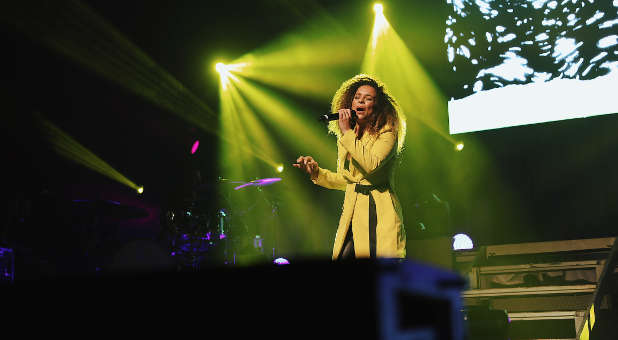

Singer-songwriter Blanca says her new emphasis is on allowing God to use her pain and vulnerability to minister in the lives of others. And she wants believers to know, through her example, that they have the freedom to feel. They don’t have to subdue their emotions or neatly package them before bringing them to God.
“I don’t want to just have this surface appearance of ‘I’m a Christian singer, I have it all together and here are the songs of how I can bring you hope,'” she says. “No, I’m using my story and not allowing the pain I’ve gone through to be in vain. I’m really laying it all on the table and hoping that my healing is your healing as we go through this life together.”
Blanca, who lost both of her parents in the last decade, says the Holy Spirit has shown her the importance of following God into unexpected places and how God strengthens us through the hardest seasons of life. In this interview, she talks about all that, her new Spanish language EP Quebrantado and what she’s seeing in the next generation of Christians.
This interview—originally recorded for our “New Year, New Voices” podcast series—has been edited for length and clarity. Listen to the full interview here.
Berglund: Do you mind sharing your testimony?
Blanca: I grew up not necessarily in a Christian home. I think with my culture, Christianity is something that is respected and that everyone knows in the Latin culture, but it’s not necessarily something that is lived out or like a real, intimate, emotional thing. My parents divorced when I was six years old. My dad was addicted to drugs and alcohol and just kind of at a bad place in his life. And so he ended up going his own way.
Me, my brother and my mom stayed in Orlando, Florida, where I’m from, and I feel that a lot of insecurity and hardship started to form from that place. I dealt with a lot of things that probably young girls shouldn’t have dealt with at that time, from sexual abuse to a lot of anxiety and fear forming at that place.
But the crazy and lovely thing about my testimony is that even when I didn’t know what He was doing, God was doing something on my behalf. My dad came back into the picture when I was a young teenage girl. And little did I know he was the first person I knew who had given his life to Christ. He had found the Lord on his own journey and had a God moment, and came back for his kids and apologized. He just wanted to be a part of our life.
So, he was the one who started taking us to church on the weekend. I started going to church with my dad every Sunday or every other Sunday and seeing the huge change that had happened in his life. I ended up giving my life to Christ at 17 years old with my dad there. We went to a play at a local church in Orlando, and God was just pulling on my heart, and I knew it was time for me to let go of control, and so I gave my life to the Lord at that point. And here I am years later, still serving the Lord and being able to—I hope—encourage people and inspire them through my music.
Berglund: When it comes to encouraging people through music, what are some of the things you’re most passionate about? What are the messages you really want people to take away?
Blanca: I think where I currently stand within my music, I have this huge passion to really be uncomfortably honest with where I’m at and what God is doing, and not feel like I can’t express the emotions that come with life and reality. Sometimes we feel angry. Sometimes we feel really, really sad, and we’re dealing with anxiety, and we have to go to counseling. These are all real issues that I feel like a lot of Christians go through but somehow we feel—I think “condemned” is a strong word, but we just feel ashamed of really being honest about these places that we find ourselves in.
So, when it comes to identity, to finding hope through suffering, to breaking down the walls of religion and really digging deep to have a strong relationship with Jesus, these are all big things that I want to shine through my music.
Berglund: As I talk to young Christian leaders around the country, that is something that I’m hearing from a lot of people: that desire for greater vulnerability and authenticity in the church. Is that something you’ve observed as well?
Blanca: I have. You would probably have a better understanding, because you get to talk to all these different people from different places and walks of life. But for me in my life, or even on this tour, being surrounded by these amazing godly women, I think there is a hunger for authenticity and vulnerability and being able to encourage one another through these places, rather than feeling like it might make us a lesser Christian to really be honest about the things that we struggle with. I think it’s a beautiful thing.
From my experience, I’ve learned that when I’m able to open up these places to the Lord or to community and people, that’s where true light shines in and healing happens, you know? That’s my goal through this new season that I’m in, to really feel the freedom with what God is doing in my life to express myself and be honest through my music.
Berglund: You talked about in Latin culture that a lot of times faith is this big part, but it’s often in a nominal way as opposed to being lived out. With the Latino population growing so much in the United States, but also around the world, as churches continue to have more and more people from the Latino community come in, what effect do you think that’ll have on church?
Blanca: I might be a little biased, but I think the Latino culture and people are just amazing, beautiful people, and they’re hungry and they want more. It’s been cool to watch.
I’ve been exploring avenues to translate my music into Spanish and trying to do things for my roots and my heritage and my culture—to be able to connect with people in their heart language, in their native tongue. There’s a lot of believers within the Latino race who listen to CCM music or they listen to Christian music, but to be able to have that within their actual language is so beautiful. It connects straight to their heart.
I would encourage a lot of churches, radio stations and even magazines out there to continue to do that and have that available, because it’s growing so rapidly when you look at the actual numbers or the statistics of how Latin culture is coming into the United States. In our culture, it’s huge. It has such a big impact.
But from my experience back in the day, I’m realizing that when I talk to young Latin families or second generation Spanish kids—who maybe didn’t grow up in Mexico or Puerto Rico or the Dominican Republic, but their parents did, and then they all moved to the States—they have an understanding and even a fear of God. It’s something that you’re raised with. You pray and you do all these things. But having that deep intimacy and that relationship with God, I feel like it’s something that we’re all kind of journeying into.
Berglund: You just brought up that you’ve been recording music in Spanish. Tell me about your new EP, Quebrantado.
Blanca: I released an album called Shattered, which was my latest English release. The album itself is all about this traumatic experience that I’ve walked through with losing both of my parents. Moreso my mom. My dad passed away in 2011, which was very devastating, but then recently my mom passed away to breast cancer, and it’s where a lot of the songs kind of were birthed from.
As I’m listening to now the finished product of Shattered, my heart behind that was to be very vulnerable and very honest, but also, in some strange way, to try to honor the life and the legacy that my parents left behind for me. I remembered, on many occasions, my mom and my dad being like, ‘Blanca, you should really consider releasing music in Spanish for your family. For your roots. There’s so many people for whom it would be such a blessing to hear your music in Spanish.’
So, I thought, You know what? Now’s the time. I want to do this. I want to find this part of me that has been pushed down and hasn’t really been explored.
So, I went back to Puerto Rico where I’m from. I got to bring my son with me for the first time and just explore the houses my parents grew up in and meet with my family. I hadn’t been there since my dad passed away, so it had been quite a few years. And here I am releasing Quebrantado, which is my first Spanish EP. As scary as it is, because it’s a new territory for me, there’s something so peaceful in it to be like, ‘Man, God, this is exactly where you want me in this current stage in my life, and I feel so much peace from it. And I’m able to feel like I’m connected to my parents in some way.’ It’s been really amazing.
Berglund: How do you see the Holy Spirit moving in the music industry, particularly the CCM industry that you’re in?
Blanca: Oh my gosh, it’s like an unending list of all the beautiful things that I feel like Holy Spirit is doing within our industry. I’m just a huge fan. And I get to see both sides to it. I get to tour with a lot of these artists and just hear their heart and see the difference they’re making with what they have to work with. Outside of the amazing songs that we all get to listen to and love, they’re making a huge impact on my life and the lives of so many people.
I think of even Mandisa. I’m on this tour with her, and in every city that we go to, they’re making a donation to the Salvation Army in that town and helping them with bedding and pillows and coats for kids. It’s such a beautiful thing to see these artists really being the hands and feet of Jesus in these places.
But I feel like from a grand perspective, in the grand scheme of things, in my opinion there’s this beautiful shift happening where a lot of people are growing into who they are. I don’t want to just have this surface appearance of “I’m a Christian singer, I have it all together, and here’s the songs of how I can bring you hope.” No, I’m using my story and not allowing the pain I’ve gone through to be in vain. I’m really laying it all on the table and hoping that my healing is your healing as we go through this life together.
I feel like there’s this beautiful shift happening with artists really falling into who they’re meant to be, you know? Like Lauren Daigle or Tauren Wells. These are huge artists who are just so “them.” Maybe a few years ago people would have told them, “You should change this, or maybe you should do this little different or maybe that wouldn’t fit in the CCM ‘bubble.'” But I see artists being unique and being themselves, and the Holy Spirit is using that to reach a whole new generation of people who have been longing for it.
Berglund: That’s a good point, though, that people are breaking beyond the molds that may have existed in past generations to follow wherever God is leading them in this moment. When I’ve talked to various leaders or pastors, I’ve seen people talking about that it’s not about denominations as much anymore, or our church versus their church. And you’re pointing out that it’s moving beyond even genres or specific industries. I think that’s really cool.
Blanca: I do too. It gets me excited. Even hearing you articulate it so well, like, yes! It’s a beautiful thing.
Berglund: You mentioned earlier the death of both of your parents. I’m sure that that pain is shared by many of our readers who have also gone through really hard things, maybe the loss of loved ones or parents. Do you have any advice for them from what you’ve gone through?
Blanca: I hear stories all the time of people who have listened to my music. Maybe they haven’t gone through the same loss experience, but I think to some extent, we’ve all experienced loss in some form. Whether it’s the loss of a child or the loss of a marriage or the loss of self-worth or a job or direction, it’s just this place we sometimes find ourselves in, where it feels like we’re stuck in a pit and just trying to work through our emotions and our pain.
But the thing that I am working on currently for myself is what I mentioned earlier, and it’s this whole concept of not letting my pain go in vain. I really believe that it’s through the sharing of your story and allowing God to move in these dark places in our lives that it creates this purpose for what we’ve walked and gone through. You can even look at Scripture, where it says, “Count it all joy when we go through suffering and we go through these hardships, because it’s what creates perseverance and hope in our lives.” That would be one thing.
And another thing, it’s like the message of all of this. I feel like it all comes back to this message: Give yourself the freedom to feel. I’ve been in places where I just go numb, and I don’t want to work through my emotions. I don’t want to let God down. I don’t want to let people around me down and be like, “I think I’m going through it right now,” you know? I don’t want to look like I am going through it.
But I’ve been really just encouraging the people that I get to talk to: “It’s OK to feel these things. It’s OK to be upset. God can handle it. You’re not going to scare Him away because you’re feeling all these emotions. Allow Him into those places.”
When you can embrace the fact that you are at that place, I feel like that’s where true healing can come out of.
Find Blanca on Twitter, Instagram and Facebook.