
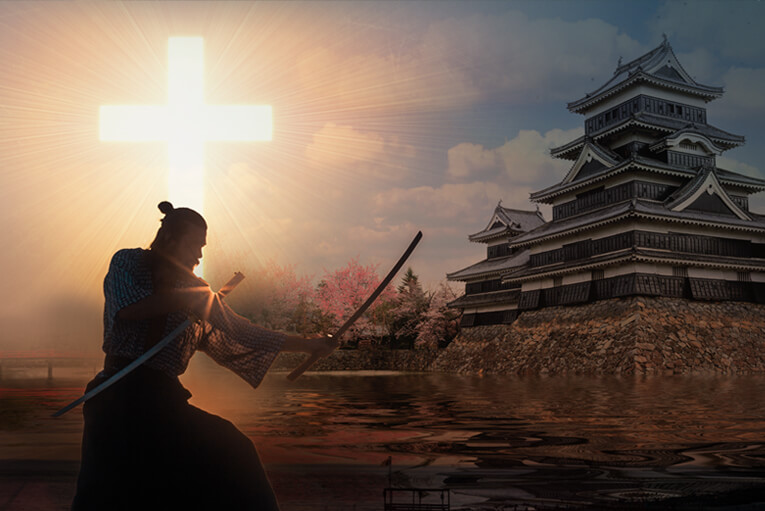

As Christians, we need to exemplify the characteristics of the kingdom that emanate from the character of our King (Jesus). To do this, we need to have a right perspective, perception and attitude so we can advance the kingdom of God. As the late Dr. Edwin Louis Cole said, “The characteristics of any kingdom emanate from the character of its king.”
[responsivevoice_button voice=”US English Male” buttontext=”Listen to this Feature” buttoncolor:”blue”]
Samurai for Jesus
I remember when Daniel Gil began competing on American Ninja Warrior a reality television program that spotlighted men and women encouraging one another and cheering each other on as they tackle daunting obstacles designed to challenge even the most skilled and agile athletes. This was in direct contrast to so many other shows that capitalized on depravity and self-seeking.
With his long curls and ever-present smile, Daniel quickly became a fan favorite. Wearing a shirt with the word “Kingdom” in large letters, he became known as the “Kingdom Ninja.” It’s a reminder, he says, of his first priority in life from Matthew 6:33, “Seek first the Kingdom of God.” Daniel has been a finalist with American Ninja Warrior seven times and was grand champion in 2020.
With both of us being from Houston, Daniel and I had been connected over the years. In fact, he is one of the worship leaders at a church where I am often invited to minister, and we have both traveled with his church to Japan. He considers me a mentor and even quotes me in his recently released book, Kingdom Ninja: A Warrior’s Guide to Spiritual, Mental, and Physical Health: “My friend Doug Stringer reminds me that each life experience can become a life lesson that becomes part of our life story. These are very true words that stick with me when I’m competing.”
Daniel developed a system of values as the foundation for a “Kingdom Ninja”: Glory, Honor, Alive, Legacy, Sacrifice and Hope. He undoubtedly understands the principles of God’s kingdom and is committed to using the platform God has given him to reflect the Good News to a world in need.
Heritage of Honor
As an American of Japanese descent, I have always been intrigued by Japanese history, culture and values. The “Kingdom Ninja” values Daniel developed remind me of the Bushido code, a set of virtues the samurai of Japan and ancient warriors of China and Korea lived and died by. While known throughout Asia, this title is mostly used in Japan and thought to be of Japanese origin. It can also be translated as “The Way of the Warrior” or “The Warrior’s Code.”
Although there are Shinto and Zen connections, these are all values found in Scripture:
>> Rectitude (Eph. 6:14; Isa. 26:7; Prov. 14:34)
>> Courage (Deut. 31:6; 1 Cor. 16:13)
>> Benevolence (Prov. 28:27; Eph. 4:32; Heb. 13:16)
>> Respect (1 Peter. 2:17; 1 Thess. 5:12-13)
>> Honor (Prov. 16:11; 12:22)
>> Honesty (Prov. 16:11; 12:22)
>> Loyalty (John 15:13; Prov. 24:21; 17:17)
The Bushido code came hundreds of years after Christ, so could it be possible these values came from a Christian and biblical influence? While we may not know the answer to that question, we do know there were Christian samurai. They were Japanese warriors who converted to Christianity after Jesuit missionaries from Portugal arrived in the 16th century and shared their faith and beliefs with the people of Japan.
According to an article in War History Online, “Christianity was not common in feudal Japan. As a foreign religion, it was embraced by a small minority of people including some samurai who were the social and military elite.”
It is no surprise that samurai would be drawn to Christianity as a faith expressing moral values that aligned with the Bushido code. Craig Shimahari, writer/director of Good Soil, a 2007 movie about the first Christian samurai, explains: “The priests were effective and exemplified many of the bushido traits of self-sacrifice and serving a master, their master being Christ. The Portuguese were passionate people able to make an arduous journey, and were focused and dedicated, traits that inspired the samurai.”
Christian samurai were often torn between their loyalty to their overlords and their loyalty to God. Knighton tells of one of the most recognized Christian samurai, Takayama Ukon. When Ukon’s direct overlord died, Ukon refused to light incense at the altar during the Buddhist funeral ceremony.
“It was a moment that could have caused offense, but Ukon’s good character carried him through. His allies saw that his honor as a samurai was more important than any religious divisions,” Knighton writes.
About 100 years after the arrival of Christian missionaries, the Shogun began to fear Christianity would usher in European imperialism. The War History Online article continues: “They instituted a sort of Buddhist Inquisition, ferreting out Christians and making them renounce their faith by having them step on the cross or defile other Christian iconography. If they refused to renounce their faith, they were tortured or killed. This went on until 1637, when a rebellion of 37,000 Christians led by the most famous Christian in Japanese history, the samurai swordsman turned ronin [a samurai without a master], Amakusa Shiro, took on the Shogun’s army at Harajo castle.”
All of the rebels were killed, and Christianity was forced underground. Today, although it is no longer illegal, Operation World says only 1.5% of the population are Christian.
Alignment of Values
My heart holds a special place for Japan because I was not only born there, but my mother was Japanese. We moved to the U.S. with my dad, who was in the Navy, when I was almost three. Later, after my parents had divorced and my mom married my stepfather (who was also in the Navy), we moved back to Japan, where I attended an American high school.
It’s interesting how much the values expressed in the Bushido code are embedded into Japanese culture even today. I learned early on that honor, especially, is still a way of life in Japan, especially when it comes to honoring previous generations. It is not considered unusual for parents and grandparents to be cared for in their latter years in the homes of their children and grandchildren. Instead of the elderly being a burden, they are viewed as a blessing, a vast resource of wisdom and knowledge.
I had not been to Japan for decades, but when the Kobe earthquake occurred in 1995, I had the privilege of going back to see how our ministry could help. One evening, I went up to my room and began to weep uncontrollably. I was so overwhelmed by the needs of the Japanese people. Not only were there great material needs because of the earthquake, there were also vast spiritual needs. I was burdened by the brokenness of the people and I began to once again hear the cries of the multitudes in the valley of decision. The Lord was allowing me to feel a small part of His heartache for the lost.
Since that time, God has taken me back many times, including in the aftermath of the 2011 earthquake and tsunami. I’ve had the privilege of praying for people in the Japanese Diet (parliament), and I’ve prayed privately with many other people in their government. Even though they were not Christians, they were willing to receive from me because they recognized how the characteristics displayed in the Christian walk align with the characteristics of their culture and the Bushido code.
Likewise, many people from Asian culture here in America were impacted by watching my life while I spent many years honoring my widowed mother by caring for her in my home. This act alone—common in that culture—opened the door for many conversations about my faith.
Samurai for Revival
In 2019, I visited Japan and met with leaders who were praying for the 2020 Olympics, not knowing it would be delayed by a worldwide pandemic until 2021. When I was asked to provide prayer points and devotional content for many of the groups that would be on-site to pray and share the gospel with guests from around the world, my thoughts went to the Baylor University Revival of 1945.
Much like last year’s outpouring at Asbury University, this revival began with a group of students—unproven in ministry and unproven in life—when the Holy Spirit laid it on their hearts to begin holding revival meetings. The meetings caught fire.
These “unlikely revivalists” carried a passion to share the Good News of Jesus Christ. I was privileged to know one of these unlikely heroes of the faith—perhaps the most unlikely of them all. Reiji (Ray) Hoshizaki was a true “Samurai for Jesus.” At a time when many Japanese Americans were being interned at camps across the nation, Ray had been allowed to remain a student at Baylor, where he chose to be bold in his faith.
The final verses of Hebrews 10, verses 38 and 39, leading into the great Heroes of the Faith chapter (Hebrews 11), describe him very well: “…‘But my righteous one will live by faith. And I take no pleasure in the one who shrinks back.’ But we do not belong to those who shrink back and are destroyed, but to those who have faith and are saved.”
Many of these students, including Ray, were asked to come to other cities across Texas and in neighboring states to lead more revival meetings. At a time of great uncertainty in our nation, especially for those of Japanese descent, Ray did not shrink back. Soon, the movement was spreading throughout Texas and across the South.
Like believers of old whose stories we find in Hebrews 11, Ray’s story became one for the history books, featured along with his fellow students in publications such as Riding the Wind of God: A Personal History of the Youth Revival Movement.
I believe there is new generation of Ray Hoshizakis today, samurais for Jesus, who will not shrink back from the challenges they face—be it their race, economic status or whatever the case may be—answering the call of the Holy Spirit to usher in a new revival with boldness and courage.
Just as in the mid-1940s, our world is facing uncertain and tumultuous times. But the harvest fields are ripe! So many people are searching for answers, peace and hope that can be found only in one place—the cross of Christ.
Land of the Risen Son
David Livingstone, the great missionary to southern Africa, used to say, “Why is it when an earthly king commissions us, we consider it an honor, but when the heavenly King commissions us, we call it a sacrifice?”
The Japanese samurai understood this. In fact, the word samurai simply means “servant.” The entire duty of a samurai was to serve the emperor and defend his honor. As Christians, our loyalty—as Daniel Gil shares through his Kingdom Ninja message—is first to our heavenly King and His kingdom, “seek first the kingdom of God and His righteousness,” (Matt. 6:33, MEV).
During the COVID shutdowns of 2020, it was reported that more people in Japan died from suicide than from the disease. In a culture with such a strong value system, how could that happen? We find the answer in Scripture. Jesus said in John 18:36: “My kingdom is not of this world…”
When we try to carry out a code of honor without the power of the Holy Spirit, much like we see in Scripture when so many tried to keep the Law before the time of Christ, we set ourselves up for a life of legalism and despair. It is only through a relationship with Jesus and keeping our eyes fixed on eternity that we can live out the virtues and values of the kingdom while also walking in freedom. As the samurai were devoted to their Emperor, so we, too, must be devoted to our King.
My heart’s desire is to see the Land of the Rising Sun become known as the Land of the Risen Son. My prayer for the people of Japan, the land of my birth, is for God’s love to tap into these biblical virtues that are an inherent part of the Japanese culture, for the gift of His grace to be revealed, and for God to reveal His redemptive plan and purpose for the people of Japan and beyond.
The brightness of our light is dependent on what and who we are reflecting. Are we reflecting the ideologies of men or the ideology of our King? Let us be samurai for Jesus, letting His light shine before men!
Doug Stringer is founder and president of Somebody Cares America/International. As an American of Asian descent, Doug is considered a bridge-builder of reconciliation amongst various ethnic and religious groups. He is a sought-after international speaker, addressing topics such as persevering leadership, reconciliation, community transformation, revival and more. He is host of A Word in Season with Doug Stringer & Friends, posted weekly on the Charisma Podcast Network.




































Joining in prayer for Japan and other nations