


I am floating above my bed in St. Thomas Hospital. It’s really amazing. I’m looking down, and there I am in a hospital gown, lying on the bed with my eyes closed, tubes and wires sticking out of me and connected to beeping monitors. I look like something out of a Frankenstein movie. Evelyn, my wife of forty years, is sitting comatose on an uncomfortable hospital chair in the corner of the room, with the crossbar digging into the middle of her back. Our son is next to her on a clone of the uncomfortable chair. He’s not paying attention to her. He’s on his cell phone answering yet another one of the endless texts that keep his generation from living in the present.
Oh, well. I like it up here at the ceiling; I have a bird’s-eye view of what’s going on. I love to fly, and this is it. I’m flying!
I was a commercial airline pilot for over thirty years and loved every flight I captained. My dad had a Stearman airplane, and I remember when I was five years old, sitting next to him as he gave me my first flying lesson. By eight years old, I could fly solo, but of course Dad would not allow that. So here I am really flying at last, and I’m loving it. But how does this work?
I can see that I’m attached to my body by some kind of silver cord. Wait—I’ve read about this somewhere. Isn’t that in the Bible? The silver cord? No matter, I’m enjoying my lofty perch. Yet I am somewhat disturbed at seeing my motionless body lying there below me—my face ashen, my eyes closed, my cheeks sunken. And I mentioned the wires, monitors, and fluids that are working overtime to keep me alive. I’m not dead—yet. But here I am, floating, flying. This is really cool! I can see my heartbeat on the monitor. It looks pretty good; maybe I’ll pull through. On the other hand, this is really amazing. Why haven’t other people talked about this? Maybe they have.
As I float down to the floor, I’m about two feet away from my wife’s face. Dear Evelyn. She’s been crying. Her eyes are closed, and she’s clutching a tissue in her right hand. My scatterbrained son is still on his cell phone, seemingly oblivious to the drama going on around him.
“Hey, Phil!” I yell with everything inside me. “Hey, Phil…you idiot! Can’t you see that your mom needs you? Hello in there!”
Part of me expects Evelyn and Phil to hear or see me, but they don’t. What’s really strange is that I can see through the walls in the room as if they’re transparent. I see them shimmer as I look over at the woman in the room next to me. She’s propped up in her bed, watching something on TV. Welcome to hospital life. There’s nobody with her. She’s alone except for the idiot box that has 800 channels and nothin’ on. Isn’t that a lyric from a song?
I find I can actually float—no, fly—through the walls. But this silver cord attached to my body lets me go only so far and then yank, like a dog being chained to its doghouse, and I can go no farther. How does that work? Still, it’s a wonderful feeling to be able to fly around. I’m having fun even though my body below me seems to be giving out.
Back to Evelyn.
We’ve been married…how long? I think it’s been forty years. Or is it forty-one? I suppose I can do the math, but I have trouble adding up the bogies, double bogies, and triple bogies on my golf card, so I’m just going to go with forty years of marital bliss. A nice round number. I’m being facetious. It’s been good. But like all marriages, there have been potholes in the road. Three kids, one miscarriage, the death of our middle child at the tender age of nine—which very nearly led to a divorce—and a partridge in a pear tree when Evelyn built an aviary in our backyard. Her love for her feathered friends was unwavering; I am somewhat jealous. It was her way of coping with our loss. I think a mother’s love for a child is something a man will never fully grasp.
Evelyn’s shoulder-length gray hair is disheveled. She’s been camped out in my hospital room for three days. And no makeup. Normally she wouldn’t go anywhere without her lipstick. Her shoulders are hunched over, and her face is tearstained.
Seeing her this way has made me lose some of my excitement for being outside my body and flying around the hospital corridors.
Phil is still scrolling on his cell.
Where is my daughter? Why isn’t she here? What about Fred—my best friend from college—and also our pastor? Why isn’t he here?
I fly back up to the ceiling and wonder how long this will take. I’m not hungry. I’m not tired. I’m not sick anymore. I’m all here, and I’m flying.
I can see down the hallway. The elevator doors open and out comes a woman with purple hair. Even though the elevator and the woman who just exited from it are about forty yards away, I know it’s my daughter, Marsha. How can I put this in a politically correct way? We are estranged. We are about as far apart as two people can be. Evelyn and I often lament how we lost her. Where did we go wrong?
When we sent her off to college, she was an innocent eighteen-year-old girl with long blonde hair and a smile that could light up a room. She’d had many boyfriends all through high school but never got serious. She sang in the church choir. By the spring of that year—her first year in college—she was a different person. Evelyn and I hardly recognized her. She had chopped all her hair off, shaved one side of her head, and dyed the rest of her hair purple. Evelyn did her best to choke back the tears, but I was irate. “What…why did you do this?” I barked.
I won’t go into the brief time she was with us during spring break, but one bomb after another was dropped on us. She had a girlfriend, and they were “in love.” Marsha was a sophomore, and this girlfriend was a senior. It was she—whose name I will not mention—that groomed Marsha. It took only from Christmas to spring break. Marsha was someone I no longer knew and—I hate to admit—no longer loved.
At least she didn’t bring “the one I will not name” with her. That’s all Evelyn would need now.
I watch as Marsha makes her way to the room, wearing her newly adopted college uniform: baggy pants and a T-shirt with a rainbow-colored Che Guevara on it; one arm tatted up; an unlit cigarette tucked behind her ear; and, of course, the patch of purple weeds that is left of her hair.
Oh, wait. I forgot about the earbuds blasting who knows what into the empty space between her ears. As she half-dances her way up the hallway to my room, she is lip-synching to the song—or whatever it is—blasting in her head that keeps her in her own little fantasy world.
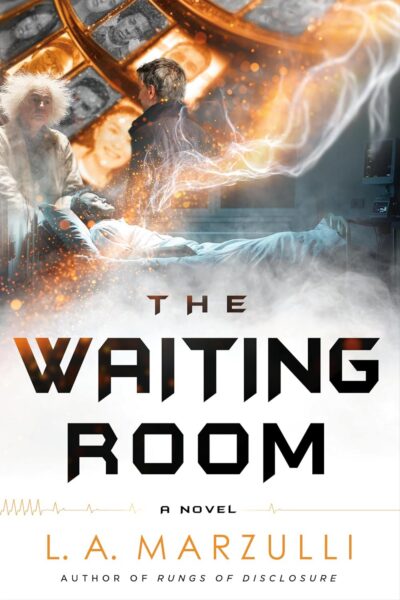
Order L.A. Marzulli’s New Book, “The Waiting Room” on Amazon.com!
I decide to head her off, so I fly down toward her and get in her face.
“Hey, Marsha! Hi. Hello in there.”
She walks right through me, as if I’m not even there. In reality, I suppose I’m not.
I follow her into my room.
What I see next surprises me—no, shocks me. Marsha takes one look at me lying comatose—ashen, half dead—and her hands fly up to cover her face as she breaks into uncontrollable sobs.
Evelyn jumps out of her chair, throwing her arms around Marsha, and the two of them weep on each other’s shoulders.
Phil is jolted out of his cellphone utopia and stands up but doesn’t know what to do. Phil and Marsha are at odds with each other too, so all this is complex, and it’s not going to get fixed in five minutes.
“Is he dying?” Marsha blurts out.
Evelyn nods slightly. “It appears that way. But anything is possible with God.”
At that Marsha “snaps” out of it. “Please don’t bring Him into this. Why would He allow such a thing? Dad’s been healthy all his life, and now he’s at death’s door? I don’t get it. It’s not fair. I’m sure you’re saying your prayers, and I can see they’re really working for you.” She takes a step back from Evelyn—having got hold of her true self—and the purple persona is back.
“Look at him,” Marsha says without filtering. “He’s dying, for Chri—”
“Don’t you dare say that!” Evelyn’s hackles are up. “How dare you take His name in vain at a time like this.”
“Way to go, Evie.” My nickname for her. “Don’t take any wooden nickels.”
Evie loves church, loves the choir, loves Sunday morning, loves telling people about Jesus. Me, not so much. I mean, I’m a Christian. But I’ve never seen a miracle, never been healed of anything, even the common cold. Never felt the presence of the Holy Spirit, whatever that is. All in all, I am what my good friend Fred—or rather Pastor Fred—calls me. I’m a CEO: Christmas and Easter Only, and that works for me. I chuckle to myself.
“OK, sorry,” Purple-Hair mutters under her breath.
Now it’s Phil’s turn. “You know, you come here like you’re going to a club or something, and you’re not here for two minutes before you and Mom are going at it. Don’t you give a flip about anyone but yourself?”
Look who’s calling the kettle black. “Hey, Phil!” I bark. “Thanks for putting down your stupid slave box and actually engaging in reality for once.” Stinking cell phones.
Phil takes a step toward Marsha, but before he can say or do anything, Marsha raises her hand and whacks the cell phone out of Phil’s hand, sending it crashing to the floor.
“What the…” Phil stammers as he picks up the phone, which has a cracked glass screen. “What the…”
Evie glares at Marsha. “I can’t believe you just did that.”
Marsha shrugs, turns away, and plops down in one of the chairs.
As if on cue, Fred comes into the room. We met as roommates in college, and it was Fred who led me to Jesus during our senior year—after endless debates on who Jesus was. What ultimately convinced me was a book Fred gave me about the Shroud of Turin. When he presented it to me, I scoffed and blurted out that it was Middle Ages forgery.
“Not so fast, citizen!” Fred countered. “You don’t know anything about the shroud; that’s ignorance on your part. And the fact that you’re saying you do is arrogance. They are a deadly combination.” And with that he placed the book in my hand. Three weeks later, I came across the line, and with Fred’s help I asked Jesus into my heart. The book on the shroud had convinced me of the resurrection; I was sold. However, unlike Fred, I didn’t really fit into church life and became what Fred called me: a CEO—Christmas and Easter only.
“Evelyn, Phil…Marsha,” Fred says, touching each person as he moves through the room toward my bed. “How long has he been like this?”
“Three days, and he’s fading,” Evelyn says, softly. “It’s not looking good. The doctors say they’ve done all they can do.” She stifles a sob.
Fred touches my forehead and lets his hand rest there. I can see he’s praying, but—out of respect for Phil, who’s become a staunch atheist, and, of course, Marsha—he doesn’t fill the room with the verbiage of a prayer.
Marsha shifts her weight.
Phil scrolls on his phone, though the cracked glass makes it hard for him to read the most recent text.
Fred is from Texas, and even after all the years of living in our little community in Southern California, he still has the Texas twang. I never tire of kidding him about it.
He slowly pulls his hand from my forehead, and I can see he is tearing up.
Whispering to Evelyn, he says, “We’ll see what the Lord can do. It’s not over yet.”
A loud warning sound erupts on one of the monitors.
All eyes focus on the machine.
A nurse runs into the room.
Then another nurse.
Fred and Evelyn move out of the way and stand on the sidelines of the action.
“He’s flatlining,” I hear one of the nurses say.
Two men come in with some sort of paddle-like things in their hands.
“Just in time,” one of the nurses blurts out as she and the other nurse expose my chest while the men get ready.
I realize that my heart has stopped beating. I’ve seen this in movies for I don’t know how long. They’re going to try to restart my heart.
“Clear!” one of the men yells.
I hear a whizzing sound and then bang! I go sailing across the room into the hallway.
“Hey! I felt that!” I yell, wondering how this is possible.
A doctor rushes in, brushing by my family and Fred, and is overseeing the action.
“Anything?” he asks, looking at the monitor.
“Not yet. Clear!” The man with the paddles shouts again as he gives me another shock, sending me sailing down the hallway.
I fly back into the room and watch the action below me. And then it happens.
I hear a deep, rushing sound, like a huge wave about to break on the beach. I feel something snap, and looking down, I see that the silver cord has detached itself from my body.
Like a human cannonball, I’m flying out of the hospital so fast that the city below me disappears in a flash.
I’m headed toward a point of light beyond the atmosphere, and seconds later I have entered what appears to be a tunnel of light. The walls are like golden glass, but I can see through them as I fly through the universe. How can this be? Planets are whizzing by me. Stars and galaxies grow large and then disappear as I continue this incredible journey.
Suddenly I have a sensation of falling, and the golden tunnel has disappeared.
“Am I in heaven?” I wonder.
An overwhelming silence and a peaceful stillness enfold me.
This chapter is an excerpt from L.A. Marzulli’s novel The Waiting Room, a powerful story about grace, healing and the supernatural reality of forgiveness. In this gripping narrative, a man caught between life and death is given a second chance to confront the wounds, betrayals and broken relationships that shaped his life. Through a richly imagined journey beyond the veil, Marzulli explores the eternal weight of unforgiveness and the life-altering freedom found in letting it go. The Waiting Room is both a compelling page-turner and a deeply spiritual invitation to examine your own heart, your own second chances and the relationships that matter most. If you would like to continue the journey, you can order The Waiting Room on Amazon.com.
L.A. Marzulli is an author, lecturer, and filmmaker. The author of twelve books, including The Nephilim Trilogy, which became a CBA bestseller, Marzulli is a frank supernaturalist who lectures on the subjects
of UFOs, the Nephilim, and ancient prophetic texts, presenting his exhaustive research at conferences and churches, and through appearances on numerous national and international radio and television programs.