
[responsivevoice_button voice=”US English Male” buttontext=”Listen to this Feature” buttoncolor:”blue”]
The Christian Gospel stretches beyond human reason which grades sins on a sliding scale. The message of the cross tears down our calculations and insists on one astonishing truth—no sin is too great for the redeeming blood of Jesus Christ.
This is a truth most of us affirm in theory but struggle to believe in practice. We imagine God’s grace as enough to cover our own failings—our careless words, our broken promises, our anger and pride. But when confronted with the darkest deeds of humanity—murder, terrorism, abuse, betrayal—we hesitate. Surely, we think, God cannot mean that sinner. Surely the cross has limits.
Yet the kingdom of God exposes the lie in that hesitation. Jesus’ sacrifice is either sufficient for all or it is not sufficient at all.
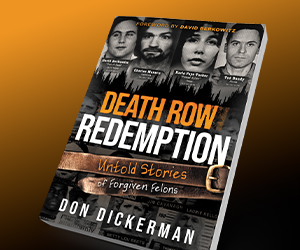
Don Dickerman has spent more than 30 years inside some of the most hopeless places on earth: death row cells. In his book Death Row Redemption, Dickerman doesn’t offer easy clichés. Instead, he presents the jarring and transformative reality of salvation, deliverance and supernatural healing in the lives of men the world has written off as monsters.
His ministry placed him face-to-face with notorious criminals—David Berkowitz, the “Son of Sam”; Mark David Chapman, who assassinated John Lennon; Ted Bundy, whose violence shocked a generation. The names alone are enough to spark revulsion. Yet behind prison bars, Dickerman witnessed God’s incomprehensible mercy. Hardened men who had destroyed lives and terrorized communities wrote letters describing how Christ had met them in their cells, forgiving their sins, setting them free, and healing wounds buried for decades.
What society considered impossible, the Spirit of God declared possible. Where the world demanded vengeance, God extended mercy.
It is one thing to believe God can forgive us. It is another to watch Him forgive someone we believe deserves hellfire. This has always been the stumbling block of grace. The Pharisees couldn’t fathom why Jesus welcomed tax collectors and prostitutes to His table. Jonah ran from his assignment because he feared God would extend mercy to Nineveh’s killers. And even now, many of us secretly prefer a God who draws a line somewhere just past our own sins.
But the gospel is offensive in its fairness. It levels humanity to the same desperate condition: “all have sinned and fall short of the glory of God” (Rom. 3:23). And it offers the same scandalous remedy: “the blood of Jesus Christ His Son cleanses us from all sin” (1 John 1:7). All means all—the murderer and the gossip, the addict and the self-righteous churchgoer, the inmate on death row and the suburban parent in a pew.
The stories Dickerman recounts remind us that redemption is not about human worthiness. It is about the Lamb who was slain, who bore the punishment for every crime, who drank the full measure of wrath so that any who call on His name might be saved.
Redemption is not only about forgiveness of sins; it is about deliverance and healing. Dickerman describes not just confessions of faith but supernatural transformations—men delivered from demonic oppression, hearts once seared by hatred softened by God’s love, minds once filled with violence renewed by the Spirit.
This is the Gospel in action. Jesus did not die simply to get us to heaven; He died to make us whole. For the prisoner, that wholeness may not erase earthly consequences. Many of Dickerman’s friends on death row died in execution chambers. Yet they stepped into eternity not as condemned criminals but as redeemed sons of God. That is a hope more powerful than steel bars or court verdicts.
For us outside those cells, the lesson is just as urgent. Our wounds may not be public headlines, but they still weigh us down—bitterness, fear, anger, shame. The blood of Christ is enough to heal those too. We don’t need to build walls of self-protection or bury our past hurts. Perhaps the greatest challenge Death Row Redemption offers is not to inmates but to us. Can we see even the vilest sinner as a candidate for grace? Can we trust the redemptive power of God more than our own thirst for judgment?
If salvation is possible on death row, then it is possible anywhere. Every story of redemption, whether in a prison cell or a quiet living room, is a testimony to the power of the cross. There is no chain too heavy, no past too broken. The cross proves the final truth—the mercy of God is deeper than the worst sin, and His redemption is stronger than death itself.
Don Dickerman has led a prison evangelistic ministry since 1974, bringing deliverance and healing to countless lives. Don’s ministry impacts both prisons and churches, sharing transformative messages of freedom and hope. His new book, Death Row Redemption, is available now at amazon.com.