


[responsivevoice_button voice=”US English Male” buttontext=”Listen to this Feature” buttoncolor:”blue”]
Genesis 3:7 recalls that when Adam and Eve fell for the original narcissist’s schemes, rather than crying out to their Father, “they sewed fig leaves together and made coverings for themselves.” Like Adam and Eve, when we fall prey to narcissistic abuse, our first inclination is to try to fix the situation on our own—usually in a way we believe will shield us from feeling exposed. The problem with this approach is that it lands us in one of the four traps the enemy set out for us to begin with.
These traps are mindsets that prevent us from living in the freedom God has given us through Jesus. Imagine each trap as a deep hole dug by the enemy that he hid under a layer of leaves. The enemy uses narcissistic people to sway you from God’s direction for your life to try to get you to fall into one of his hidden traps. The issue with these traps is that we can get stuck in them for so long we start to identify ourselves by them.
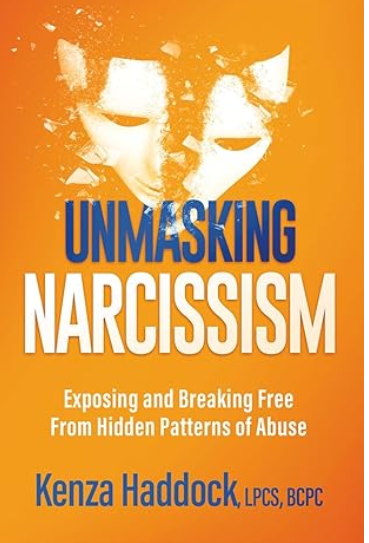
To pre-order Kenza Haddock’s new book, Unmasking Narcissism, visit Amazon.com.
The Trap of Self-Defeat
Lana, a 36-year-old patient, came into the office for an assessment following her discharge from an inpatient facility for attempting to take her own life. After going through her family history, it was clear to me that Lana was stuck in a self-inflicted destructive cycle. Her chart was packed with disorders for which she met the clinical criteria—disorders that had become labels she wore in addition to the ones put on her growing up. During her childhood and teenage years, Lana’s dad served in the military. His absence created added stress on her mom. Lana described her mom as very critical of her and said her mother often told her that she reminded her of her father, “and not in a good way.”
Lana and her mother didn’t have much in common. For example, Lana described herself as a “feeler,” in contrast to her mom, whom she described as more of a “thinker.” Throughout the years, Lana tried her best to get her mom’s approval, but it seemed that every time she tried, her mother would raise the bar higher, eventually convincing Lana that she could never measure up. When Lana was five, her mom gave birth to a baby boy. Initially Lana was so happy to have a baby brother. However, at around age eight, Lana began to feel resentment toward her baby brother because it seemed as though her mom loved him more, paid attention to him more, and cared for him more.
As a teenager, when Lana developed the courage to share her feelings with her mother, she responded with, “Why are you so jealous?” and, “You’re just being dramatic,” along with other statements insinuating that Lana’s feelings were mere figments of her imagination. As the years went on, her mom’s favoritism toward her brother was even more apparent. As a coping mechanism, Lana resorted to denying her need for her mother’s love and met that need through self-destructive measures. She cut herself to numb her pain. She tried wearing crystals to manifest good energy in herself. She tried drinking, partying, anything to fill the void she had deep within her heart, to no avail.
As she became older, Lana found herself attracted to men who treated her the same way her mom did. Her relationships, one after another, wouldn’t last because it seemed as though each man she was romantically involved with refused to prioritize her. The one time Lana met someone who treated her with kindness and gentleness, Lana pushed him away because the way he treated her didn’t match her ingrained beliefs about herself—that she was unworthy, unlovable.
During her time at the mental health facility, Lana gave her life to Jesus, yet she continued to experience symptoms of anxiety and depression. “If this Jesus is supposed to give me freedom, why do I always feel tormented? Why won’t He stop my panic attacks? Why won’t He help me?” she cried out as tears rolled down her cheeks.
Lana’s life was marked by a trap she had fallen into from narcissistic abuse—in this case, by an authority figure, her mother. Even as an adult, Lana continued to believe the words once spoken over her by her narcissistic parent, giving the enemy a foothold to induce more destructive thoughts and leading her to a life of chaos.
Filled with shame and convinced she could never amount to anything, Lana alternated between denying her need for love and seeking out love using unhealthy measures. Even in instances when someone tried to love her, because that person’s behavior didn’t match how she felt about herself, Lana pushed them away.
Stuck in a continuous cycle of self-defeat, Lana’s life was marked by chaos, unstable relationships, and mood swings. She sabotaged good opportunities that came her way because she felt unworthy of them. Throughout counseling, Lana narrowed down her thought process to “If my mom/dad didn’t love me, then I must be unlovable. And because I am unlovable, when people get close to me, they will leave me.”
Within a few months Lana’s depression dissipated, her anxiety was gone and her panic attacks diminished by 90%. I say 90% because the devil always looks for opportune times to come after us, but when Lana feels an attack coming on, she now knows how to take authority over it.
The Trap of Rebellion
Katrina, a 47-year-old patient, came into the office with symptoms of dysthymia, another word for stubborn depression that just won’t go away. This type of depression comes from feeling unsatisfied with life. She also experienced panic attacks that would come on all of a sudden. Katrina was a successful attorney, married, with four children. On the outside her life reflected many people’s dream lives, but behind closed doors it was imploding.
Growing up in a home where her father constantly put her and her mother down, Katrina made a vow to herself early on that she would never let a man treat her the way her dad treated her. And that vow, she held to. Katrina worked hard to put herself through law school. Years later she married and started a family. Throughout her marriage and parenting, Katrina and her husband struggled with Katrina’s constant need to control, not allowing her husband to lead the home. Katrina also struggled with undermining what her husband said to their children. As a result, he would often feel disrespected and shut down. That caused Katrina’s anxiety to skyrocket and eventually led her to mimic her dad’s behaviors—the very behaviors she grew up hating about her father.
Katrina was stuck repeating a cycle she had run from for so long, causing her to despise herself. Her problem was that she longed for intimacy, but the wound from her father was still very much alive. It created anxiety related to intimacy with the very person she’d said, “I do,” to. In fact, Katrina would often treat her husband with the same loathing she carried in her heart toward her father. And she didn’t know how to stop it.
Meanwhile, at work Katrina caught the attention of her coworker Ross. Gregarious and charming, Ross would consistently compliment Katrina’s work, acknowledging her skills and dedication. At times Ross even went beyond professional compliments, commenting on her personality and looks. Katrina felt flattered by the attention. “At least someone appreciates me around here,” the enemy whispered in her mind, using her voice. “Look at Ross. He’s not intimidated by a strong, determined woman like me. That’s because he has it together, unlike the loser I have at home, who can’t even seem to cut the grass when I ask him to!”
One day after Katrina and her husband argued about him forgetting to run an errand she had asked him to do for the thousandth time, the enemy whispered, “Look at the way Ross carries himself. That’s the type of man I deserve. And out of all the staff, he sees me!”
As time went on, Ross’ compliments became more frequent and personal. He started inviting Katrina to after-work events and lunches, often finding ways to be alone with her. Deep down, Katrina knew something was wrong. But she struggled with denying her need to be loved when someone was offering the very thing she yearned for.
You see how the enemy entered Katrina’s life? Her unresolved resentment toward her father caused her to guard herself against the person she was “one” with. Her need to feel loved, however, didn’t go away, so the enemy presented an alternative, a less threatening alternative: Ross. Her brain didn’t associate him with a perceived threat in the same way it connected her husband to her father.
Katrina’s hunger for an emotional connection made her vulnerable to the enemy’s attack. The compliments she received, especially from someone she esteemed as important, felt good. Katrina gave in to Ross’ flattery. Her interactions with him soon turned into him asking her to accompany him on a business trip. Katrina knew the temptation she was putting herself in, but rather than escaping out of temptation (1 Cor. 10:13), she fell right into the trap the enemy had set out for her. “After all, it’s just a business trip,” the enemy whispered in her mind.
A few business trips later, Katrina had inappropriate encounters with Ross, who by the way was also married and had no intention of leaving his wife. You see, Ross viewed Katrina as someone who was there to entertain him. A narcissistic peer, like Satan, doesn’t have a conscience. He sees those in relation to him as able bodies to be used at his disposal. When Katrina met with Ross to talk to him about how guilty she felt, Ross denied responsibility and reminded Katrina that she was an adult who knew what she was getting into. He told her it was not his responsibility to babysit her emotions—reflecting his master, Satan’s behavior. He will tempt you over and over until you fall, and when you do, he will accuse you and condemn you for the very thing he tempted you to do.
As part of God’s protective love toward us, He convicts us when we act in a way that contradicts who we are in Him. As a result of her inappropriate encounters, Katrina felt tormented for weeks. During those times, the enemy whispered in her mind, “Don’t tell your husband now; what’s done is done,” to try to keep her bound. Then when she kept silent, he whispered, “How can you call yourself a Christian and do what you did?”—accusing her of the very thing he tempted her to do. At night he’d whisper, “What is everyone going to think of you when this comes out?”—using her weakness, fear of ridicule, against her so she would stay bound in her sin.
Katrina understood that when you belong to God, He will not let you rest in keeping your sin a secret, because God knows that unexposed sin gives a foothold to the enemy of your soul. To eradicate sin, you have to expose it so you can begin healing, which includes understanding what led you down that path to begin with.
After countless sleepless nights, Katrina finally came clean to her husband. She and her husband worked on their marriage with the help of a Christian counselor.
The Trap of Over-Accommodating
Elizabeth, a 58-year-old patient, came into counseling because of ongoing panic attacks she had struggled with off and on for years. She had been married for 34 years, and recently she and her husband had been arguing over the fact that she constantly dropped everything for her daughter. Whenever I treat someone, regardless of their age, I like to explore their history from as early as they can remember, and as the patient recalls their story, I pray for discernment and a word of knowledge.
In Elizabeth’s case, she was raised in a loving home. Her parents provided her with a steady upbringing. The only thing that stood out was that she lost her mother not long after she and her husband were married. Elizabeth mentioned that she was so excited to become a parent. In raising her daughter, determined to be the best mom she could be, Elizabeth often gave in to her daughter’s requests, basking in the excitement of being a mother. From early motherhood Elizabeth got in the habit of giving in to most of her daughter’s requests, chalking it up to, “You have to choose your battles,” and, “They’re only little once!”
As Elizabeth’s daughter became older, she never seemed to get the hang of adult responsibility. She’d often call her mom, who would come to her rescue. This pattern created financial hardship in Elizabeth and her husband’s life. Elizabeth would often tell her husband, “Well, you never stop being a mom,” to excuse herself, dropping everything to help her reckless daughter. Whenever Elizabeth did stand up to her daughter, her daughter would excommunicate her, causing Elizabeth to become depressed and eventually give in. It wasn’t until Elizabeth began to cash in her retirement to help her daughter that she sought counseling.
Through counseling Elizabeth was able to make the connection that around the time when she had her daughter, she also lost her mother. Her life was so busy she never grieved the loss of her mother, and instead she turned to her daughter for comfort to fill that void and to keep herself from feeling the turmoil within. She focused on becoming the best mom she could be for her daughter. Elizabeth was able to realize that the anxiety she felt from her daughter’s threats to withdraw her love was due to the fact that her daughter had become her source of comfort since her mom’s passing. Within months she was able to set boundaries with her daughter, heal her marriage and reclaim her freedom.
The Trap of Arrogance
I wish I could tell you that 26-year-old Lilly was a patient. Unfortunately, a person who fits this characteristic doesn’t seek counseling because they’ve convinced themselves that everyone else is the problem. Lilly was raised by an emotionally healthy father and a mother who over-accommodated her. On a side note, a narcissist and a person stuck in the trap of over-accommodating often have a way of finding each other, whether in a romantic relationship or, as in this case, a parent-child relationship. This is because the narcissist’s motto is “You’re here to meet my needs,” while the over-accommodating party’s motto is “I’m here to meet your needs.”
From a young age, Lilly learned how to get her mom to do what she wanted her to do. She wasn’t a fan of her dad, however, because he saw right through her. Enticed by Satan, the author of chaos, Lilly would often pit her mom against her dad, resulting in arguments and friction in the home. Lilly would also alternate between using charm and guilt-trip methods, knowing her mom would oblige her requests.
As Lilly got older, she became more dissatisfied with how the world operated. She felt that her teachers and, later on, her employers needed to project the same understanding her mom did growing up. As a result, Lilly couldn’t keep a job, which led her to rely on her mom to help her. Lilly’s love life was marked by a series of failed relationships, one after another. Lilly felt that her boyfriends were supposed to compliment her, acknowledge her, encourage her, and be a constant reminder of how special she was. When they failed to do so, she felt angry and offended and displayed emotionally explosive outbursts—followed by breaking up with them and looking for (and finding) someone who did.
One day when Lilly’s mom finally stood her ground, Lilly was taken aback at her mother’s audacity to say no to her. After all, she seldom said no growing up. Lilly blamed her father for her mom’s boundaries. And when her attempts to turn them against one another failed, she excommunicated her mom until she needed her again.
Don’t fall for the enemy’s tricks to try to get you to earn your value by over-accommodating, prove your value by rebelling or acting in arrogance, or make you believe you’re unworthy through self-defeat. All those are lies because you are a child of God, and in Christ, Your Father has declared you valuable.
People and names in this book are composites created by the author from her experiences as a mental health professional. Names and details of their stories have been changed, and any similarity between the names and stories of individuals described in this book and individuals known to readers is purely coincidental.
Kenza Haddock, LPCS, BCPC, is a certified clinical trauma professional specializing in narcissistic abuse recovery. A licensed counselor in South Carolina, she co-founded the #healSC campaign. Kenza and her husband run South Carolina’s fastest-growing mental health practice, and she speaks at conferences, churches and media outlets. Her new book, Unmasking Narcissism, is available now at amazon.com.