

If you grew up in church like I did, you’ve probably heard some version of this: “Be careful with money; it’s dangerous.” “It’s easier for a camel to go through the eye of a needle than for a rich man to enter heaven.” “Jesus was poor, so you should be too.” Then there’s the ultimate stain on a preacher’s reputation: being labeled a “prosperity gospel” preacher. For many, that title alone cancels out everything else a person says.
But here’s where I’ve always found myself confused: If prosperity is such a bad word, then why does God say it so much throughout the Bible?
I mean, if prosperity were as spiritually toxic as we’ve been led to believe, God would have a lot of repenting to do. The word is all over Scripture.
From Genesis to Revelation, prosperity isn’t just mentioned, it’s modeled. Abraham was blessed. Isaac was blessed. Jacob, Joseph, David, and Solomon were all blessed. Entire nations were blessed because of the covenant God had with His people.
So how did we get here? How did we become so afraid of a word that God clearly isn’t afraid of?
Let me be clear: I’m not here to defend the prosperity gospel, however you want to define it. I’m not here to justify the abuses, the manipulation, the greed, or the seed-offering scams. Trust me, I’ve seen the clips and heard the stories. I’ve walked with people who were burned by the lie that you can buy a miracle from God if you just “sow a significant seed.” I hate that distortion.
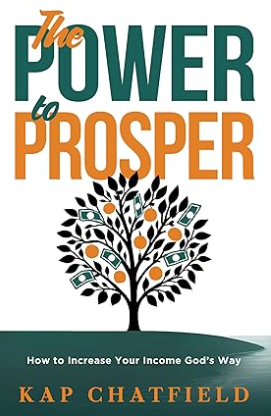
To order Kap Chatfield’s new book, The Power to Prosper, visit Amazon.com.
What I refuse to do is let the enemy twist a promise of God into something the church becomes ashamed of. While we can criticize the prosperity gospel, we cannot deny the prosperity of the gospel.
In my ten years of ministry, I’ve learned something about how the enemy operates. Satan doesn’t create anything. Jesus referred to him as the thief who comes only to steal, kill, and destroy. That’s exactly what he does: He counterfeits and perverts. The things he goes after the hardest tend to be the most valuable in the kingdom of God. Unfortunately, whenever he touches something, Christians want to throw the whole thing away.
Think about it. The church rejected deliverance ministry because some people made it weird. We rejected speaking in tongues because some operated in it without order, and others falsely taught that if you don’t speak in tongues, you’re not even saved. We rejected the prophetic because some words proved inaccurate or plain wrong. In each case, we overcorrected, silenced the Spirit to maintain safe services, and threw out the gift to avoid the abuse.
With prosperity, we did the same thing. We let the enemy rob us of a covenant promise. We forgot that it was God, not culture, who created the concept of blessing. We forgot that it was God who made Abraham rich, God who gave Joseph a divine strategy for economic survival, God who filled Solomon with wisdom and wealth, and God who “gives you power to get wealth” (Deut. 8:18). Prosperity didn’t originate in a TV preacher’s green room. It originated in the heart of a Father who loves to take care of His kids.
Because of a few misused verses and a lot of misbehaving preachers, we’ve made prosperity a curse word in the church. We whisper it like it’s taboo. We distance ourselves from it so we don’t look greedy. We spiritualize poverty and call it humility. As a result, we’ve created an entire generation of believers who love Jesus but live powerless, broke, and dependent on the very world system God called them to rise above.
That’s not holiness. That’s bondage.
Let’s clarify something theologically: God doesn’t want us enslaved to Egypt while calling it contentment. He never called His people to beg Pharaoh for provision. He called them to walk in covenant.
This is where it gets personal for me. For years, I wrestled with this tension. I felt guilty for wanting more. I wondered whether it was wrong to build a business, make money, or dream bigger. I didn’t want to be “that guy”—flashy, self-promoting, obsessed with materialism.
I couldn’t shake the question: If God owns everything, why are His people living like beggars?
I remember creating videos and content and wondering whether I should even mention anything about giving, finances, or tithing. I’d post a clip about faith and get cheers. I’d post something about God wanting to bless people financially, and suddenly, the comments would erupt into a war zone. It seemed as though people were literally manifesting demons just because I said the word prosperity while quoting Scripture!
Here’s the irony: The same people who criticize prosperity theology often message me privately to ask for prayer over their finances. So which is it? Does God care about our financial well-being or not? Is He a good Father or a distant one? Does He want us to have what we need to fulfill our assignment, or must we figure it out on our own?
I’ve learned that most people don’t reject prosperity because of Scripture. They reject it because of bad, man-made doctrine. They saw some preachers abuse the promises of God (knowingly or unknowingly), and instead of getting clarity, they reacted emotionally. They clung to the phrase “prosperity gospel is heresy,” recoiling every time the word prosperity was mentioned.
They overcorrected, embraced struggle, and treated poverty as a badge of honor. In doing so, they surrendered territory; God never told them to give up.
Prosperity—God’s prosperity—means thriving in every area of life. Yes, it includes money, but money is the fruit on the tree, not the root that produces it. God’s definition of prosperity isn’t necessarily having a yacht and a Rolex. There’s nothing wrong with those things, but that’s not the point. The point is having more than enough to do everything God’s called you to do, with enough left over to bless everyone connected to you.
God has no problem lavishing His kids with material blessings. In fact, I’d argue that kingdom prosperity should almost feel embarrassing because we don’t deserve it. Jesus’ first miracle was turning water into wine, and it wasn’t a miracle of utility. It was a miracle of luxury.
That’s the kind of Father we serve: not insecure about blessing His children, not worried about looking greedy, not ashamed of giving good gifts. He’s a good Father, and good fathers rejoice when their kids flourish, not when they’re broke.
We’re going to reclaim the word prosperity. Not for greed’s sake but for covenant’s sake. It’s time to stop apologizing for wanting to build, grow, lead, multiply, create, give, and fund the end-time revival. It’s time to stop confusing poverty with piety and remember that God is a good Father who wants His kids walking in abundance, with open hands and full hearts, ready to bless everyone around them.
So let’s say it boldly and without shame: Prosperity is not a curse word. It’s a promise from God.
If we’re going to reclaim prosperity, we must first clear the rubble and uproot the lies that have choked the church for too long. We must expose every false belief that’s kept God’s people broke, fearful, and spiritually paralyzed. You can’t walk in a promise you’re still suspicious of, and you can’t steward what you secretly resent. So, let’s take a hard look at the lies and replace them with the truth.
Lie #1: Money buys miracles.
This is probably one of the most damaging distortions in Charismatic circles. Somewhere along the way, people were led to believe that if you just “sow a seed,” you can force God’s hand and that if you give a certain amount, He owes you a breakthrough, particularly in the areas of healing and deliverance. I know a person who was duped into believing that if she sowed her entire inheritance, God would heal her mother of multiple sclerosis. She sowed the inheritance, and her mother’s healing never manifested.
Whoever taught her that wasn’t teaching faith; they were either ignorantly teaching heresy or outright manipulating her. God doesn’t respond to bribes; He responds to faith. You can’t buy a miracle, and anyone who told you otherwise lied to you.
Yes, giving is biblical, and yes, generosity unlocks blessing. Sowing and reaping financially is a biblical principle, but a seed only bears fruit of its own kind. In the same way you can’t sow an apple seed and expect an orange tree to come out of the ground, you can’t give to God financially and expect to reap a miracle. There’s no biblical precedent for that.
When we give to God with a cheerful heart, He does bless us, but His blessing isn’t transactional; it’s relational.
Lie #2: God never blesses materially.
I’m not sure what Bible people are reading when they say this, but it’s not the one I’m holding. From Genesis to Revelation, God’s covenant with His people consistently includes material blessing. Abraham was made “very rich in livestock, in silver, and in gold” (Gen. 13:2). Isaac sowed in famine and reaped a hundredfold, and Solomon was the wealthiest king of his time, with wealth coming directly from the wisdom God gave him. The early church shared resources so powerfully that “there was not a needy person among them” (Acts 4:34, ESV), and even in eternity the streets are paved with gold.
Lie #3: Money is evil.
This is one of the most misquoted verses in the entire Bible and an all-time classic lie. Scripture doesn’t say that money is the root of all evil. It says, “The love of money is a root of all kinds of evil” (1 Tim. 6:10, emphasis added). That’s a huge difference.
Money is neutral; it’s a tool that takes on the character of the person using it. A wicked person uses money to exploit others. A righteous person uses money to build hospitals, plant churches, rescue orphans, and feed the hungry. God created gold and called it good, and designed Eden with resources embedded in the soil. Jesus Himself said we should use “unrighteous mammon” to make an eternal impact and win friends for eternity (Luke 16:9).
If money were evil, Jesus wouldn’t have taught so much about it, God wouldn’t give us instructions on how to steward it, and the church would have no business asking for it. The truth is, money in the hands of a righteous person can fund the gospel, break chains, and advance the kingdom. The issue isn’t the money; it’s whether the money has you. Money is not evil; it’s essential!
Lie #4: Prosperity is just an American idea.
This one makes me laugh. As if Abraham, Isaac, Jacob, Joseph, David, Solomon, and Jesus Himself were all raised in the American Dream. The idea that prosperity is a Western or capitalist construct is not only ignorant but unbiblical. Prosperity didn’t start in Dallas or Los Angeles; it started in Eden. The garden was filled with gold, fruit-bearing trees, and rivers that nourished the land.
Throughout Scripture, we see God prospering people from the Middle East, Africa, and Asia long before America was ever a nation. This promise was never limited by geography; it was always about covenant.
Lie #5: The church just wants your money.
Let’s be honest: Sometimes this one is true. There are ministries that have mishandled finances and churches that have guilted people into giving while lacking accountability and transparency. Some leaders have manipulated people emotionally for financial gain, and that’s wrong. However, just because some have misused funds doesn’t mean the entire church is corrupt, nor does it mean you should withhold your tithe and offerings out of bitterness.
The church doesn’t need your money because it’s desperate. God doesn’t want your money because He needs it; He owns the cattle on a thousand hills. The church invites your giving because giving is how God matures you, how you break agreement with the spirit of mammon, and how you partner with the mission of heaven. When the church teaches on finances with biblical clarity and kingdom purpose, it’s not about extracting from people but equipping them to live in covenant blessing.
Jesus talked more about money than heaven and hell combined because He knew that where your treasure is, your heart is also. God wants your money because He wants your heart. Teaching people to tithe, to be generous, and to trust God with their finances isn’t manipulation; it’s good shepherding.
The church isn’t trying to take something from you; it’s trying to help unlock something for you. A healthy church doesn’t just take offerings. It teaches people how to walk in financial freedom so they can fund their assignment and live a life of generosity without fear.
If you’ve believed any of these lies, you’re not alone. So have I, and so has almost every believer at some point. The good news is that you don’t have to stay bound by them. You can choose today to renew your mind, align your faith with the full counsel of Scripture, and reclaim the covenant promises Jesus paid for.
Kap Chatfield is a Christian content creator, filmmaker, pastor, speaker, and coach. He has directed two feature-length documentaries (Acts, 2019 and The Time Is Now, 2021). He has amassed over 1 million subscribers on YouTube. He is the Online Pastor of Love Church in Omaha, Nebraska. He is married to Joy Chatfield and together they have four children. His new book, The Power to Prosper, is available on Amazon.com.