
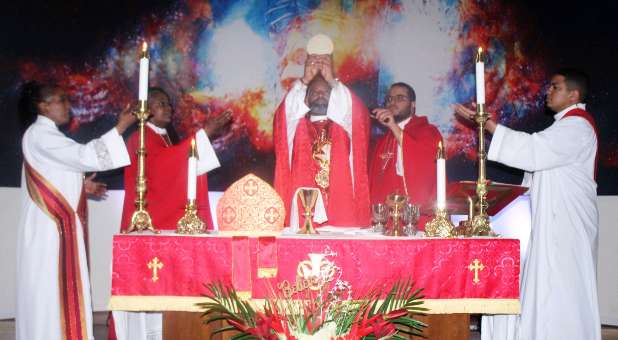
Every service at The Cathedral at the Gathering Place begins with an incense-filled procession of the crucifer and the Gospel, followed by the singing of “Lift Every Voice and Sing,” also known as the black national anthem, before the Rev. Emilio Alvarez, in full vestments, leads the congregation through the collect, Scripture readings and, after the sermon, the Eucharist.
From the ritual smoke to the sharing of the bread, the experience would strike most cradle Pentecostals as utterly foreign. “For the first 15 minutes, you’d think you were in a Roman Catholic church,” Alvarez told Religion News Service. “But when I get up to preach, you’d swear we were Baptist.”
Alvarez’s church is one of roughly two dozen in the Union of Charismatic Orthodox Churches, a 5-year-old group of mostly black Pentecostal churches in the Northeast and Australia dedicated to recovering the classical spirituality and theology of the early church mothers and fathers. They are also part of a broader trend in which “low” or “free” church Christians, raised on contemporary worship services with praise bands and dim lights, are seeking out “high church” traditions replete with sacramental rituals and ancient liturgy.
Chris Green grew up attending an independent Pentecostal church in rural Oklahoma that was “conservative in every possible way.”
“The service was about that altar call,” said Green. “It became something where I felt very manipulated—like we were trying to make every service mean something by generating a kind of energy that would create an intense joy or sorrow. … It felt completely hollow.”
Today, Green, 43, is ordained in the Communion of Evangelical Episcopal Churches, a network of churches that celebrates the Eucharist far more regularly than the Pentecostal congregations of his youth. Green is also a canon theologian for the CEEC and was recently a professor of theology at Southwestern University in Lakeland, Florida. As a member of The Order of Saint Anthony, a lay order in Tulsa, Oklahoma, he daily prays the morning and evening “offices” from the 1979 Book of Common Prayer.
Green is typical of the liturgical seekers Winfield Bevins wrote about in his 2019 book Ever Ancient, Ever New. Bevins, a North Carolina pastor affiliated with the Asbury Theological Seminary, conducted an ethnographic study of 200 young adults who had recently begun worshipping in a formal liturgical style. He calls what’s happening a “New Great Awakening” and “spiritual revival movement that’s drawing people back to ancient traditions.”
“It begins with a dissatisfaction with the state of the modern church, whether liberal or conservative,” Bevins told RNS in a recent interview. “Some leave the church, and you get the rise of religious nones. However, there’s this growing number that have decided, rather than leave the church, they want to go back to the roots and by going back to the roots, they are experiencing spiritual renewal.”
Bevins said the trend can be traced back to the mid-1980s, when Robert Webber was one of the first to call attention to it in his 1985 book, Evangelicals on the Canterbury Trail, and Thomas Oden’s embrace of early Christian writings inspired evangelical interest in “paleo-Orthodoxy.” In the 2000s, Mark Galli’s Beyond Smells and Bells built on Webber’s work by exploring why many Christians found liturgy attractive.
Since the turn of the century, the movement has picked up momentum and has caught up young adults born as late as the 1990s. In their book Back-Pocket God: Religion and Spirituality in the Lives of Emerging Adults, Richard Flory and Melinda Denton write that of 3,000 young conservative Protestants who participated in a National Study of Youth and Religion over a decade, 5% switched to a mainline denomination. These cradle evangelicals, they found, make up about one-third of mainline denominations—Presbyterians, Lutherans, Methodists and Episcopalians—whose rites usually involve the reciting of creeds and set prayers.
Greg McCollum, a 24-year-old living in Ann Arbor, Michigan, has found himself more satisfied by the Episcopal Church’s relatively staid liturgy than the evangelical worship he grew up in. Like Green, he felt alienated by services built around individual passion. “I had friends who were very emotionally engaged in those worship services in a way that never really got me,” said McCollum. “In a way, I felt I was doing something wrong if I wasn’t being emotionally churned.”
“The more traditional churches seem more fresh to me,” McCollum said.
McCollum also found a congregation that matched his attitudes about sexuality and gender. “In my experience, the Episcopalian church has been far and away the most welcoming of LGBTQ Christians.”
Indeed, mainline Christianity’s openness can be a bigger draw for some than high church services. Rachel Held Evans is a notable example of this, as described in her book Searching for Sunday.
“I didn’t say, oh, I need to find a church with robes,” said Rhea Williams, a young professional in Washington, D.C., who grew up Pentecostal and now attends a progressive Baptist church that integrates high church elements into its worship.
“I was looking for an affirming church, for one that wasn’t abusing the Bible and that was shaped by nonwhite theology.”
However, some who have left the low-church experience for more high-church traditions are not as comfortable with mainline churches’ liberal socials views or feel the lack of emphasis on traditional Christian doctrines such as hell or the infallibility of Scripture is a leap too far. Instead, they have made new spiritual homes in fledgling high church denominations that employ ritualistic “smells and bells” while welcoming traditional doctrinal positions.
In this way, the movement toward liturgy is evidence of the ever-shifting nature of American religion. Just as Alvarez’s church incorporates black hymns into its formal service, Americans are finding ways of incorporating Pentecostalism’s charismatic, or Holy Spirit-driven, spirituality—the postwar phenomenon that is now the most dominant Christian force across the globe—into older forms.
Chris Green’s CEEC, founded in the early 1990s, merges charismatic spirituality with evangelicalism’s anchor in Scripture and Anglicanism’s sacramental vision of connecting to God.
But it also answers a deeper need. The contemplative language and formal structure of the Anglican liturgy, according to the Rev. Ed Gungor, a bishop in the CEEC, has the ability to buoy those suffering grief or spiritual lows, which evangelical worship, despite its emotion, often doesn’t.
“There’s something about saying a creed that isn’t sexy and it’s not exciting, and yet at the same time it creates space for the parts of our lives that aren’t so sexy or wonderful,” said Gungor. “That kind of worship can bear pain and disappointment and heartbreak and brokenness, instead of making you feel like you need to put on your best and your heart has to be totally engaged.”
For decades of the last century, many Americans, freed from the stained glass and archaic hymns of their childhood faiths, went in search of churches that felt more authentic and relevant to their suburban lifestyles. They landed in “seeker sensitive” churches with an indoor-concert vibe and plush campuses with coffee shops and gyms.
But seeker churches, said the Rev. Tish Harrison Warren, can sometimes foster a shallow discipleship whose roots “aren’t deep enough to withstand the withering effects of modernity and skepticism, the suffering we all experience in life and also, our global and national conflicts around faith and race and meaning.”
Harrison Warren, who grew up Baptist, is now a priest at a Pittsburgh church affiliated with the Anglican Church of North America, a group of about 900 churches that split from the Episcopal Church over doctrinal matters. Traditional liturgy, she said, provides rootedness by connecting to the way Christians have worshipped for thousands of years. It is also, she observed, simply beautiful.
The focus on ancient rites above all seems to allow for a more ecumenical Christianity, one that emphasizes the importance of church creeds while holding other doctrines more loosely.
“For me, there wasn’t a big theological decision that went into the switch (to formal liturgy). It was more needing a richer and sturdier expression of Christian faith to be a part of,” said Katelyn Beaty, an author and editor who grew up evangelical and currently attends an Episcopal church.
Rites based in ancient church history can also dissolve the differences that divide Americans in and out of church. Beaty described an Episcopal church she attended in Chicago: “Our priest emphasized essentials, and would say repeatedly that all our divisions fall away at the foot of the cross. There were strong theological and political differences represented in the congregation, but the people there had chosen to stay together as one body. … If the church falls neatly along the same political divisions, then is the church really that different from the world?”
© 2020 Religion News Service. All rights reserved.
