
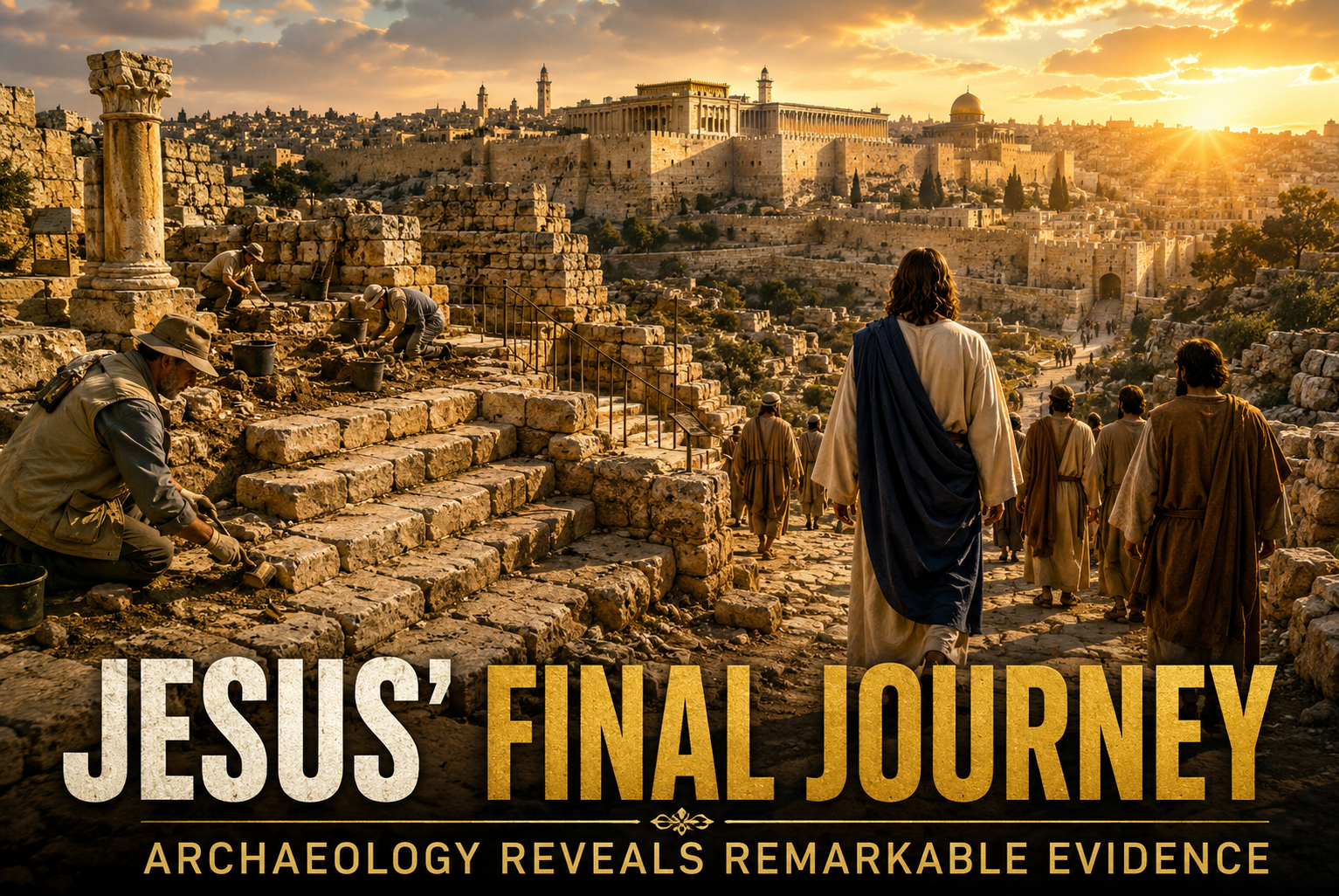
The final days of Jesus Christ are more than history—they are the foundation of the gospel. But what if believers could literally stand where many of those events unfolded?
In a powerful TBN special, renowned Israeli archaeologist Dr. Shimon Gibson walked viewers through Jerusalem and its surrounding region, highlighting archaeological discoveries that he says provide compelling historical support for the Gospel accounts of Jesus’ final journey to the cross.
“Jesus had this mission which would eventually end up in Jerusalem and beyond,” Gibson says as the journey begins along the Jordan River.
Rather than attempting to replace faith with archaeology, Gibson explains that physical evidence helps illuminate the biblical narrative.
“You talk about physical evidence. You talk about archaeology,” the program’s host, Matt Crouch, observes before Gibson begins retracing the route from Jesus’ baptism to His crucifixion.
The expedition begins near the Jordan River, where Gibson explains why many scholars believe Jesus was baptized at a location identified in John’s Gospel as Bethabara.
According to Gibson, the site carried profound biblical significance, serving as the crossing point into the Promised Land under Joshua and connecting with the prophetic ministry of Elijah and John the Baptist.
To order Dinesh D’Souza’s new book, The Stones Cry Out, visit Amazon.com.
As the journey continues, Gibson points to pottery fragments and archaeological remains that reveal ancient encampments where thousands gathered to hear John the Baptist preach.
“When Jesus comes, something special happens,” Gibson says. “Jesus had this mission which would eventually end up in Jerusalem and beyond.”
Perhaps the most striking portion of the documentary comes inside Jerusalem itself.
Standing on excavated first-century steps outside what Gibson identifies as Herod’s palace—the Roman Praetorium where Pontius Pilate presided—he makes a remarkable claim.
“There are very few places in Jerusalem where you can actually point to the paving stones and say … this is the place that Jesus stood,” Gibson says.
This archaeological evidence aligns closely with the Gospel of John, which describes Jesus being brought to a stone pavement near the governor’s headquarters before His sentencing.
He argues that excavations revealing the ancient gate, stone pavement and surrounding topography provide unusually strong historical support for the biblical account.
The journey concludes at the Church of the Holy Sepulchre, where Gibson explains why archaeological excavations support the traditional location of both Golgotha and Jesus’ tomb.
“I can prove it archaeologically,” Gibson says, explaining that excavations uncovered evidence showing the area was outside Jerusalem’s city walls during Jesus’ lifetime, matching the Gospel accounts of the crucifixion.
Yet Gibson is careful to note that archaeology has limits.
“I think for many believers the fact that these things took place in Jerusalem is the most important thing,” he says. While many Christians desire increasing historical precision, Gibson says archaeology ultimately serves faith by helping believers better understand where these life-changing events unfolded.
The empty tomb, after all, remains the centerpiece of Christianity.
Archaeology may uncover stones, roads and ancient structures, but the greatest evidence for believers is the risen Christ, whose resurrection forever changed history.
Abby Trivett is a writer and editor for Charisma Media and has a passion for sharing the gospel through the written word. She holds two degrees from Regent University, a B.A. in Communication with a concentration in Journalism and a Master of Arts in Journalism. She is the author of the newly released book, The Power of Suddenly: Discover How God Can Change Everything in a Moment. For interviews and media inquiries, please contact [email protected].
