
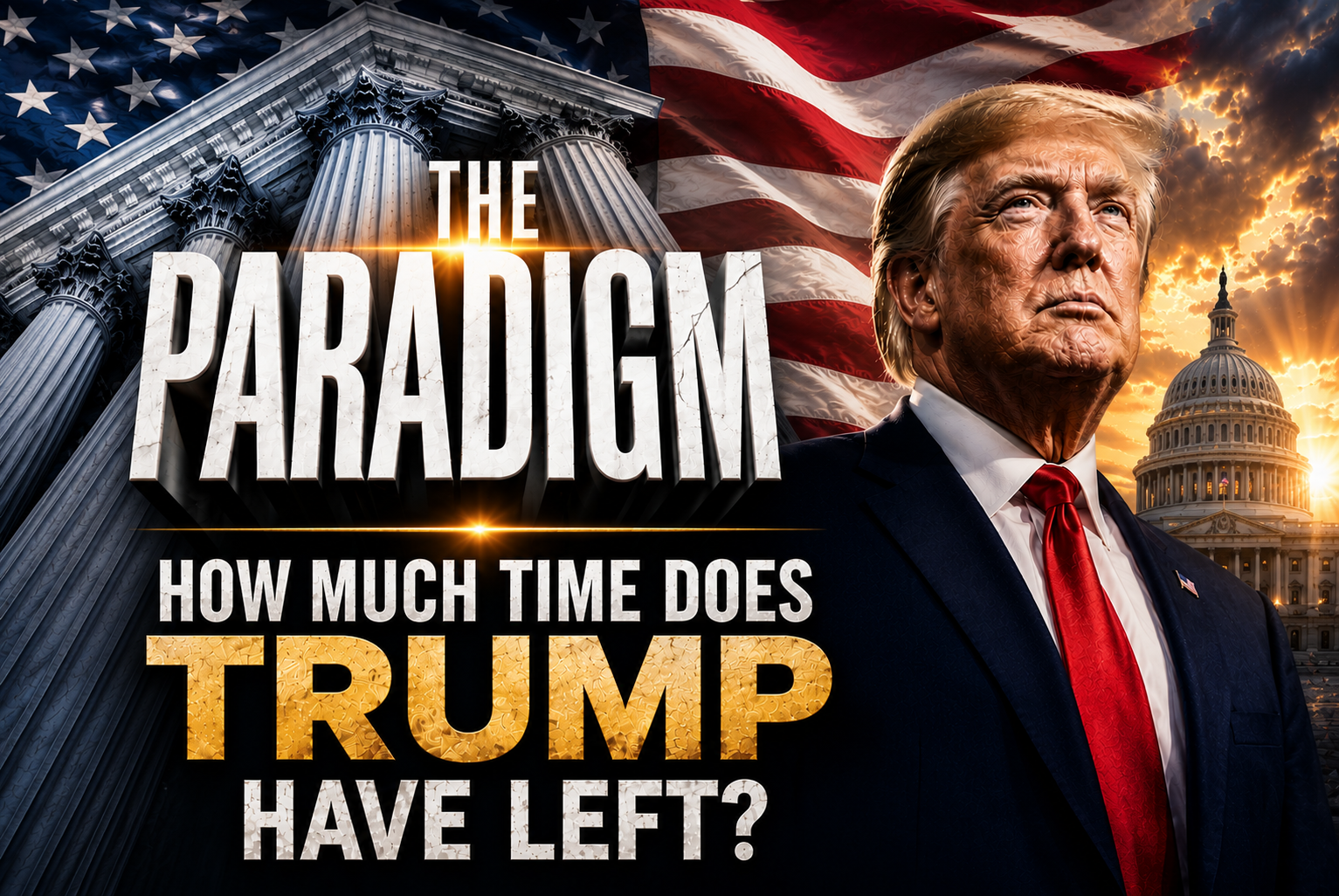
How much time does President Donald Trump have left on America’s political stage? And what happens to America after Trump?
Those questions continue to dominate headlines and political conversations across the nation. Yet bestselling author and prophetic voice Jonathan Cahn believes the answers may not be found in campaign strategy, polling data or political analysis alone. Instead, he points back thousands of years to an ancient biblical pattern first unveiled in his bestselling book The Paradigm—a template he believes continues to unfold with remarkable precision in modern American history.
When The Paradigm was first released, many of the political developments Cahn discussed had yet to unfold. In the years since, the #1 New York Times bestselling author has repeatedly revisited the book’s central thesis, contending that the biblical framework it presents continues to offer insight into America’s political landscape. Most recently, he pointed back to The Paradigm while discussing questions surrounding President Donald Trump’s place on the national stage and what may lie ahead for the nation.
However, the discussion is about more than politics.
“This is not that it’s prophesying this,” he says. “It’s that it’s the Word of God. And the Word of God is amazing and touches everything… God, who gives the Word… could He weave what is happening in the world into the Word? Could He give us revelation?”
That question forms the foundation of The Paradigm.
A Biblical Template
Cahn begins with ancient Israel during a period of spiritual decline. Although Israel had once known the Lord, the nation increasingly embraced compromise and idolatry. He believes America has experienced a similar cultural trajectory.
“Israel was a nation that was falling from God,” Cahn says. “America in its mainstream culture has been falling away from God as well for decades.”
According to Cahn, this shared backdrop provides the context for understanding what he describes as recurring historical patterns. In The Paradigm, he compares several modern American political leaders with biblical figures—not to suggest they are identical individuals, but to argue that their public roles and historical circumstances follow recognizable biblical templates.
Among the first examples he discusses is King Ahab. In Scripture, Ahab presided over a deeply divided nation and was associated with spiritual compromise, cultural conflict and political scandal. Cahn argues that Bill Clinton’s years on the national stage reflect several of those same characteristics.
He points to the length of Clinton’s national political career—from his election as governor of Arkansas through the conclusion of his presidency—as well as the timing of the scandal that came to define his administration. Cahn believes those chronological parallels closely resemble the biblical account of Ahab’s reign.
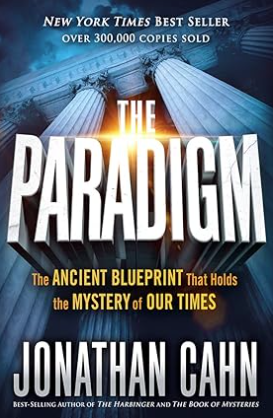
To order Jonathan Cahn’s New York Times bestselling book, The Paradigm, visit Amazon.com.
He also discusses Hillary Clinton’s public role, noting that in The Paradigm, he drew comparisons between her influence during Bill Clinton’s presidency and Queen Jezebel’s prominence alongside Ahab. Cahn argues that the length of Hillary Clinton’s independent political career also reflects patterns found in the biblical narrative.
Continuing the Pattern
Building on that framework, Cahn turns to Barack Obama.
In The Paradigm, he identifies Obama with Ahab’s son, Joram, describing him as a political successor who advanced many of the same cultural and governmental priorities.
Cahn marks Obama’s emergence onto the national stage with his widely celebrated address at the 2004 Democratic National Convention, arguing that his years in national leadership parallel the 12-year reign attributed to Joram in Scripture.
He then connects President Joe Biden with the biblical King Jehoram, emphasizing what he sees as continuity between the Obama and Biden administrations.
“Jehoram follows in Joram’s footsteps,” Cahn says. “So, Biden follows in Obama’s footsteps with policy.”
These comparisons are intended to illustrate what he believes is a broader biblical pattern rather than isolated historical coincidences.
Why Trump Occupies a Unique Place
Perhaps the most discussed aspect of The Paradigm today concerns Donald Trump.
While the original book introduced the biblical framework, Cahn has since revisited the material, explaining why he believes Trump’s political career corresponds with Jehu, the military commander who unexpectedly became king during one of Israel’s most turbulent periods.
“Jehu was not a politician. He was a fighter,” Cahn says. “Donald Trump—not a politician, he’s a fighter.”
He also points to Jehu’s bold and unpredictable personality.
“Jehu was wild, impulsive. You never knew what he was going to do next or say next. Donald Trump—wild, impulsive, never know what he’s going to say next or do next.”
Cahn further notes that in his interpretation, the biblical account of Jehu’s rise to power parallels Trump’s emergence as a presidential candidate in 2016, particularly in light of Hillary Clinton’s role as his principal opponent.
“When Jehu rises to power,” Cahn says, “the wife of King Ahab stands in his way and opposes him and defies Jehu… So, in the rise of Donald Trump to the presidency, Hillary Clinton… stood in his way, opposed him, defied him, contended against him.”
Revisiting the Timeline
One section of Cahn’s recent discussion revisits a timeline he associates with Jehu’s reign.
Rather than measuring Trump’s political career from his 2015 campaign announcement or his 2016 election victory, Cahn argues that Trump’s national presidential profile began with his Reform Party campaign in 2000. Using that starting point, he observes that the period extending through the last full year of Trump’s current presidential term spans 28 years.
Cahn then points to 2 Kings 10, where Jehu’s reign is recorded as lasting 28 years.
“The time of Jehu, 28 years,” Cahn says. “The time of Trump on the national political stage… from the year 2000 to the year 2028 lands 28 years.”
Cahn emphasizes that he is not presenting this interpretation dogmatically.
“Are we going to get dogmatic? No,” he says. “But… here’s what the mystery in the template would appear to say.”
He likewise acknowledges that questions about future events ultimately remain in God’s hands, even as he argues that the biblical pattern is noteworthy.
The Message Beyond Politics
Although The Paradigm is often remembered for its political parallels, Cahn insists that its central message reaches far beyond elections or public office.
Looking back at Jehu’s reign, he observes that while the king confronted corruption and reversed many of the policies of the previous administration, Scripture records no enduring national revival. Eventually, Israel resumed its spiritual decline.
For Cahn, that historical outcome serves as a warning rather than a prediction.
“Does that have to be for America? No,” he says.
Instead, he argues that political change alone cannot produce lasting transformation.
“The answer was not the change of government, though God used it. It wasn’t politics, though God used it. The answer wasn’t even Jehu, though God used him. And the answer isn’t Trump, though God uses him.”
That leads to what Cahn presents as the heart of The Paradigm.
“The answer is only God, and the only way is revival,” he says. “Because if we change the government, but we don’t change the people by the power of God, the unchanged people are going to change the government back.”
Cahn concludes by urging believers not to place their ultimate hope in political movements or national leaders, but in spiritual renewal.
“We have to pray as never before for revival,” he says. “Work as never before, minister for revival, spread the Word of God for revival, and choose to actually live once and for all in revival.”
That is the enduring message of The Paradigm. While the book has generated years of discussion because of its historical and political parallels, he believes its greatest purpose is to call God’s people back to Him. The future of America will ultimately be shaped not by personalities or parties, but by whether the nation experiences genuine repentance and spiritual awakening.
“It is only revival that can save America.”
Prepared by Charisma Media Staff.
