
When a prominent Southern Baptist leader introduced me to his wife as a “reformed charismatic,” it made me see for the first time the perception some people have of me. I am reformed with a small “r,” charismatic with a small “c.” Many reformed preachers are unhappy with me, but charismatics have been very kind to me. In Jack Hayford’s Foreword to my book Holy Fire (Charisma House) he acknowledged that I am reformed in theology but still wrote a thirteen-page endorsement.
When I contemplated retirement after twenty-five years at Westminster Chapel, I suddenly panicked. I wondered whatever I would do back home in America, realizing hardly anybody knew me. I can testify that I suddenly heard these words, “Your ministry in America will be to charismatics.” I could not imagine how this could be fulfilled, but thanks to Steve Strang, over twenty of my books have been published by Charisma House. Paul Crouch interviewed me on TBN regarding my relationship with Yasser Arafat, Jack Taylor and Charles Carrin opened doors to me. Ninety percent of my ministry has been to charismatics since returning to America.
Although I feel like an outsider, I am greatly indebted to the Charismatic Movement. I have not earned the right to speak to charismatics, but Steve Strang has been a close friend. He has not only opened doors to me but has been used of the Lord to advise me regarding physical exercise. John Paul Jackson told me when I was 67 years old, “You will live to a ripe old age, but if you don’t get in shape physically, you won’t be around to enjoy it.” Because of John Paul’s accuracy with his prophetic words to me, I was shaken rigid to my fingertips. Steve gave me a list of physical exercises, including getting a trainer, and I am as healthy today as I was twenty years ago. I still do twenty-one push-ups daily. I am now 90 and call it getting “Stronger with Strang.”
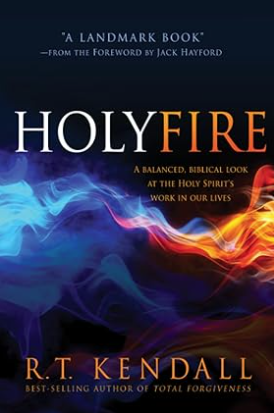
To order R.T. Kendall’s book, Holy Fire, visit Amazon.com.
If I thought that charismatic ministers would listen to me, I do have some concerns. First, I am convinced that most charismatic Christians need a good dose of the teaching of the sovereignty of God. The sovereignty of God is His prerogative to do whatever He chooses to do with whomever He wills. God said to Moses, “I will have mercy on whom I will have mercy, I will be gracious to whom I will be gracious” (Exod. 33:13). Paul repeated this in Romans 9:15. Every single charismatic preacher who has kindly invited me to preach for them in the last twenty years will confirm this, that I have never worn my reformed theology on my sleeves. My message to charismatics has centered on total forgiveness, the anointing and the importance of not grieving the Holy Spirit (Eph. 4:30). My DNA is Word and Spirit, meaning that we need both the Word and the Spirit simultaneously if we want to restore the honor of God’s name.
John Paul Jackson prophesied before he died that the key to the next great move of God on the earth will be the book of Romans and especially Romans 4. If he got that right, it means that there will be a return to the Gospel like in Martin Luther’s day, namely the teaching of justification by faith alone. My own experience with charismatics has been that many do not understand this teaching. That we are saved by faith plus nothing: faith in the blood of Jesus alone. It is what turned the world upside down in the sixteenth century. It is what John Wesley taught in the eighteenth century and also what Jonathan Edwards taught that led to the New England Great Awakening. My observation has been that a surprising number of charismatic Christians lack personal assurance of salvation. This is not good. People ought to know whether they are saved or lost!
My honest worry is that so many charismatics I have met do not know their Bibles. I have (sadly) good reason to believe that many charismatic preachers do not have strong prayer lives. According to a poll a few years ago, most church leaders in America (charismatic and non-charismatic) spend only four minutes a day in their private quiet time daily. Martin Luther prayed two hours a day. John Wesley prayed two hours a day. Where are the Luther’s today? Where are the John Welsey’s?
So, reader, how much do you pray?
Here is what the sovereignty of God will do for you. It will help set you free from trying to make things happen. It will make you realize that only God can turn the water into wine. It will stop you — if you are tempted along this line — from trying to snap your finger and expect God to jump. It will keep you from thinking that God owes us something. It will lead us to pray like the leper, “Lord, if you are willing, you can make me clean” (Matt. 8:2). The leper knew his place. He knew that God did not have to heal him. The practice of the sovereignty of God will remind us to ask for mercy first when we come boldly to the throne of grace (Heb. 4:16). We never outgrow the need of asking for mercy. The teaching of the sovereignty of God will restore a sense of the awe of God. There is no fear of God in the nation. There is lack of the fear of God in the church. What gave us a sense of outrage twenty years ago we now accept without much concern. We are asleep. We don’t know we were asleep until we wake up. We do things in our sleep we would not do if awake.
Open Theism
I will mention one other thing that I believe is very alarming. It is accepting the teaching of open theism. Many readers may not know what this is. But it was introduced to the Charismatic Movement several years ago. Open theism is based upon the premise that God is necessarily open to us for input. The teaching is that God does not know the future but looks to us for help to know what to do next. Imagine that! A God who does not know the end from the beginning, as Isaiah put it (Isa. 46:10). St. Augustine said that a God who does not know the future is not God.
If you don’t know whether you are an open theist, here is a list of practices that emanate from this faulty teaching. You may have absorbed this teaching without realizing it. Open theism centers largely on the concept of prayer. So far, so good. According to the Bible, the purpose of prayer is to discover what the will of God is, then pray for this. If we ask anything according to God’s will, he hears us (! John 5:14). But open theism says the purpose of prayer is to change God’s will, that if your motivation to pray is not to change God’s will, you are wasting your time! This kind of thinking is a dead giveaway that open theism is man-centered.
As for praying for healing, it you are not healed it is your fault, say some. It is due to your lack of faith. This teaching has driven many conscientious Christians to despair, sending them on a guilt trip that never ends. Never once did Jesus condemn a person for not being healed. One leader said, “If the Apostle Paul had my faith he would not have had his thorn in the flesh.” This is a denial of Paul’s claim to be a pattern and example. This is putting himself above the Bible, generally, and Paul, particularly. Some open theists say that the early martyrs who died for their faith died because of the failure of the church to pray, that Stephen (Acts 7:60) should not have died. This, dear reader, is how far people who embrace open theism depart from Holy Scripture. It is the polar opposite to Paul’s teaching of the sovereignty of God. Some go too far as to say that God changes His plans every day, depending on how we prayed the day before.
The common denominator of charismatics fifty years ago was the gifts of the Holy Spirit. Today it is prosperity teaching. In the Lord’s Prayer, Jesus said we should pray, “Your will be done on earth as it is in heaven.” The church for centuries interpreted this to mean that since there is no rebellion in heaven — with the angels and the sainted dead, we should be sure there is no rebellion in our hearts. Open theists teach that since there is no sickness in heaven, there should be no sickness on earth. But there is no death in heaven either!
I would go to the stake for what I have written in this article. Thank you, Charisma, for publishing this.
R.T. Kendall was the pastor of Westminster Chapel in London, England, for 25 years. Born in Ashland, Kentucky, he was educated at Southern Baptist Theological Seminary (Master of Divinity) and Oxford University (doctorate). Kendall is the author of more than 60 books, including Total Forgiveness; Holy Fire; Pigeon Religion: Holy Spirit, Is That You?; The Sensitivity of the Spirit; Grace; and The Anointing: Yesterday, Today, Tomorrow.
