Historic Temple Mount Discovery Shakes the Foundations of Jerusalem’s Past

The Temple Mount sits at the center of biblical prophecy, sacred history and future expectation. Scripture identifies it as the site of the First and Second Temples and foretells a Third Temple that will play a central role in the last days. Each archaeological discovery connected to the Mount adds weight to that biblical narrative. A newly uncovered menorah pendant does precisely that.

A Historic Find in the Shadow of the Temple Mount

Archaeologists have uncovered a rare 1,300- to 1,400-year-old lead pendant engraved with a seven-branched menorah, found beneath the southwestern corner of the Temple Mount near the City of David.

“We’re talking about a little pendant… found in the southwestern corner of the Temple Mount Jerusalem,” Israeli tour guide Yoav Rotem said on CBN News. “This little pendant of a menorah… was someone was wearing for sure a Jew.”

The artifact dates to the Late Byzantine period, a time when Jews were officially banned from residing in Jerusalem.

Exceptionally Rare and Archaeologically Unmatched

The Israel Antiquities Authority says the pendant is extraordinarily rare.

“Research has identified pendants of glass and other metals decorated with a menorah, but we know of only one other pendant in the world bearing the symbol of the menorah, made of lead,” said IAA researchers Yuval Baruch, Filip Vukosavović, Esther Rakow-Mellet and Shulamit Terem.

The pendant is decorated identically on both sides, reinforcing its role as a deliberate expression of Jewish identity.

Proof Jews Never Stopped Coming to Jerusalem

Despite imperial bans, the evidence is unmistakable.

“This is maybe the game changer,” Rotem said. “It’s actually showing us maybe a Jew who visited Jerusalem or was living in Jerusalem back then.”

IAA researcher Yuval Baruch said the pendant proves that Jews continued traveling to Jerusalem even when forbidden. Wearing it under such conditions, he said, “is not only the essence of a personal commitment to one’s religious faith … but it also attests that during periods when imperial edicts were issued prohibiting Jews from residing in the city, they did not stop coming there!”

The use of lead further supports its significance. “There is a strong basis to this contention, because lead was considered a common and particularly popular material for making amulets at that time,” Baruch added.
Order Jonathan Cahn’s Newest Book, “The Avatar” on Amazon.com!

The Menorah as a Declaration of Faith and Identity

The menorah predates the Star of David as Judaism’s primary symbol, rooted in the Tabernacle and the Temple itself.

“Right before the second temple was destroyed, we start seeing it in archaeology as the main and almost the ultimate emblem of saying, ‘Hey, I am a Jew,’” Rotem explained.

He said the pendant carries that same message forward. “It’s saying, ‘I am a Jew. I’m here in my homeland, in my holy city, next to the place where the temple will rebuild.’”

Archaeology, Prophecy and What Comes Next

The pendant is now on public display during Hanukkah, a season centered on the rededication of the Temple and the triumph of light. That timing is hard to ignore.

As discoveries like this continue to emerge around the Temple Mount, they reinforce what the Bible has stated all along: Jewish connection to this site never ended. With growing interest among Jews to worship once again on the Temple Mount and increasing archaeological confirmation beneath its surface, the convergence of history and prophecy is becoming impossible to dismiss.

Each artifact pulled from the ground strengthens the case that the Bible is not only spiritually authoritative, but historically reliable and prophetically precise.

James Lasher, a seasoned writer and editor at Charisma Media, combines faith and storytelling with a background in journalism from Otterbein University and ministry experience in Guatemala and the LA Dream Center. A Marine Corps and Air Force veteran, he is the author of The Revelation of Jesus: A Common Man’s Commentary and a contributor to Charisma magazine.
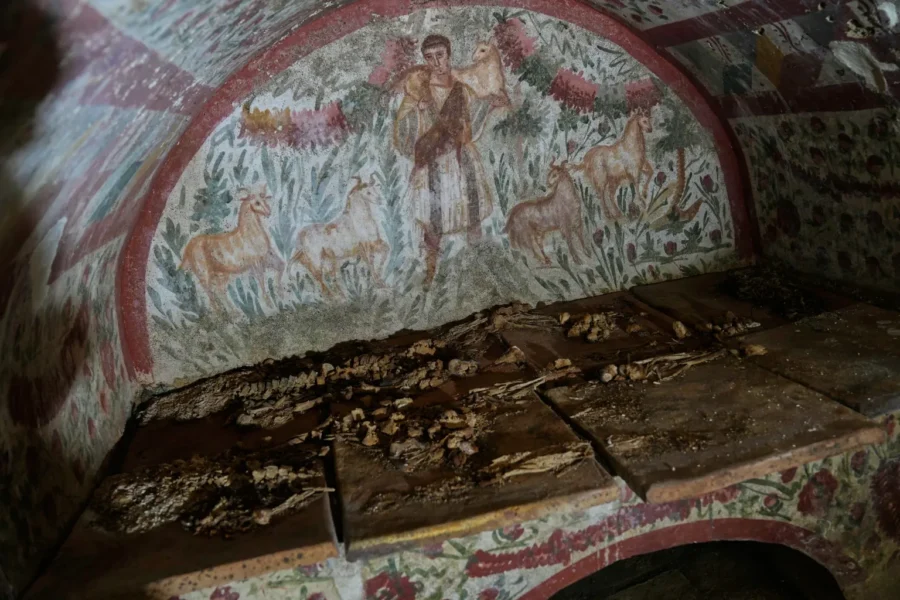


Ancient Fresco Reveals Roman-Era Image of Jesus as the Good Shepherd

Archaeologists have uncovered a rare early Christian fresco depicting Jesus in Turkey, a discovery experts say sheds new light on how Christ was portrayed during the Roman era and underscores the deep historical roots of Christian belief.

The fresco, found in an underground tomb near Iznik, was discovered in August and is being hailed as “one of the most important finds from Anatolia’s early Christian era,” as reported by The New York Post. Iznik is the ancient city of Nicaea, where the Nicene Creed, a foundational statement of Christian faith, was adopted in A.D. 325.

AP: The artwork portraying Jesus is regarded as one of the most well-preserved examples of early Christian art ever found in Anatolia.

The artwork dates back to the third century, when Christians were still persecuted under Roman rule. It depicts a youthful, clean-shaven Jesus dressed in a toga and carrying a goat on His shoulders, an image known as the “Good Shepherd.”

According to researchers cited by The Associated Press, it is a rare example of Jesus being portrayed with Roman attributes in Anatolia.

The lead archaeologist on the project stated that the fresco may be the “only example of its kind in Anatolia,” underscoring its historical and theological significance for understanding early Christian art and identity.

Order Jonathan Cahn’s Newest Book, “The Avatar” on Amazon.com!

The discovery has taken on added significance following a recent visit to Iznik by Pope Leo XIV, who traveled to the site during his first overseas trip as pontiff to mark the 1,700th anniversary of the Council of Nicaea.

While there, Eastern and Western Christian leaders gathered to pray and recite the Nicene Creed together, which the pope described as being “of fundamental importance in the journey that Christians are making toward full communion.”

James Lasher, a seasoned writer and editor at Charisma Media, combines faith and storytelling with a background in journalism from Otterbein University and ministry experience in Guatemala and the LA Dream Center. A Marine Corps and Air Force veteran, he is the author of The Revelation of Jesus: A Common Man’s Commentary and a contributor to Charisma magazine.


Harbinger in the Storm? Statue of Liberty Replica Comes Crashing Down

A towering replica of the Statue of Liberty collapsed during a violent storm in southern Brazil, sending debris crashing into a car park as high winds battered the region. The dramatic incident unfolded in the city of Guaíba, where severe weather left widespread damage but, remarkably, no injuries.

In video footage circulating online, “an 110ft replica of the Statue of Liberty came crashing down in Brazil after being struck by powerful winds,” as reported by Daily Mail. The outlet noted that “footage shows how the statue started leaning to one side as a storm tore through the city of Guaiba on Monday before it toppled into a car park and smashed into pieces.”


Local authorities said the collapse occurred around “3 p.m. yesterday at the height of the storm that ripped through the entire state of Rio Grande do Sul in southern Brazil.” Cars were seen pulling away moments before the fall, and officials confirmed that “no injuries were reported.”

The statue had been installed in the parking lot of a retail megastore and stood roughly 110 feet tall. Store officials said “only the upper section of the statue, which measured around 78ft, was damaged.” By comparison, “the original Statue of Liberty in New York City stands at around 305ft.”

Following the collapse, “the car park was immediately cordoned off to protect customers and staff,” according to authorities. The megastore’s operator said the replica had been in place since 2020 and “had the required certification,” adding that “specialist teams had been sent in to remove debris.”

Order Jonathan Cahn’s Newest Book, “The Avatar” on Amazon.com!

Guaíba Mayor Marcelo Maranata praised emergency crews for their swift response, saying local teams worked alongside state civil defense officials to secure the area and prevent further damage.

The collapse came amid extreme weather across Rio Grande do Sul, where the region experienced “wind gusts of up to 90 kilometres per hour.” Officials had issued “a severe weather warning for strong winds and heavy rain” hours earlier. Elsewhere in the state, storms caused power cuts, damaged roofs, fallen trees and flooding in nearby towns, including Lajeado.

As images of the fallen symbol spread, the incident has prompted broader reflection beyond the storm itself—begging the question of whether this striking collapse could be a harbinger of things to come for Brazil, a nation grappling with allegations of corrupt, rogue judges and rising authoritarianism at the highest levels of government.

James Lasher, a seasoned writer and editor at Charisma Media, combines faith and storytelling with a background in journalism from Otterbein University and ministry experience in Guatemala and the LA Dream Center. A Marine Corps and Air Force veteran, he is the author of The Revelation of Jesus: A Common Man’s Commentary and a contributor to Charisma magazine.


New Data Reveals Troubling Trends in Netflix’s Children’s Programming

Streaming platforms like Netflix have rapidly replaced traditional television and movie distribution, placing unprecedented influence in the hands of a few tech-driven companies. For parents, that shift has created new challenges, particularly as children increasingly consume content through tablets, phones and smart TVs with minimal supervision. What once felt like safe, family-friendly programming is no longer guaranteed, and critics warn that parents often have little visibility into the messages shaping their children’s worldview.

Those concerns were front and center in a recent CBN News video featuring Tré Goins-Phillips and Billy Hallowell, who analyzed new research from Concerned Women for America examining children’s programming on Netflix. The report reviewed 326 series rated TV-G, TV-Y and TV-Y7 and found that 41% included LGBTQ characters, themes or messaging. Even more concerning, 21% of TV-Y-rated content, typically geared toward preschool-aged children, contained similar material.

“I think parents have made it very, very clear on these issues where they stand,” Hallowell said. “The challenge that we have is that a lot of people put their kids in front of a tablet, a phone or their TV, and they go and do work. They do the things they have to do because people are busy and they don’t realize maybe that this is what is going on.”

Numbers raise concern beyond representation

Hallowell said the scale of the findings goes far beyond what could reasonably be considered representation, even by secular standards.

“If these numbers are true and accurate based on what this study is purporting, you have a situation where even if your goal is to say, ‘Oh, we’re trying to reflect the population,’ 41% is a percentage so high that it goes leaps and bounds beyond what you would even do if you felt that that was the right thing to do,” he said.

From a Christian worldview, Hallowell described the findings as troubling for children still forming their understanding of the world. “I don’t want to put children in front of something that’s going to add to any confusion in their lives that’s going to indoctrinate them in any way towards something that would be negative for them or counter a biblical worldview,” he said.

Order Jonathan Cahn’s Newest Book, “The Avatar” on Amazon.com!

Ratings system criticized as misleading

Goins-Phillips pointed to what he described as a broken ratings system as a major part of the problem. Penny Nance, president of Concerned Women for America, has argued that the system “doesn’t work” because networks and streaming platforms effectively rate their own content.

According to Goins-Phillips, Nance characterized the process as insidious, saying companies are “couching all of this content in these shows and then they’re giving it a TV-Y rating or a TV-Y7 rating because it is predominantly geared toward kids,” allowing controversial material to be slipped into programming parents assume is safe.

Netflix acknowledges the trend

The discussion also highlighted Netflix’s own statements about its content strategy. In 2023, the company publicly described the year as a standout, noting that more than half of its new shows featured LGBTQ characters. About 60% of its new children’s content at the time also included LGBTQ themes or characters.

For Hallowell, that acknowledgment underscored that the issue is intentional. “This is not a bug in the system, it is part of the system,” he said, adding that Hollywood and media companies often operate within ideological silos disconnected from the broader public.

“People are saying, ‘No, no, no. We don’t like this. We don’t want to see this. We actually don’t want this in kids content,’” he said.

A growing issue parents cannot ignore

Goins-Phillips framed the trend as more than a cultural or political issue, characterizing it as spiritual. Citing Isaiah 42:6-7, he said the passage illustrates how confusion and darkness take hold, particularly among children. “I think it shows that Satan is working as hard as he can to confuse people and to keep them in darkness, to keep them in bondage,” he said.

Hallowell concluded by urging Christians to respond not only with concern but with prayer and engagement. “We’ve done a lot of complaining and rightfully so about Hollywood and media and universities and education and all these things,” he said. “Are we actually praying?”

As streaming platforms continue to dominate entertainment and shape young audiences, the concerns raised by CBN News suggest the issue is not fading but expanding. With children spending more time in front of screens, parents face increasing pressure to actively monitor what their children watch, ensuring they are not being raised on messages rooted in confusion and deception.

James Lasher, a seasoned writer and editor at Charisma Media, combines faith and storytelling with a background in journalism from Otterbein University and ministry experience in Guatemala and the LA Dream Center. A Marine Corps and Air Force veteran, he is the author of The Revelation of Jesus: A Common Man’s Commentary and a contributor to Charisma magazine.


What’s Beneath the Bermuda Triangle May Be Fulfilling End-Times Prophecy

A growing number of scientific discoveries are forcing researchers to confront a humbling reality: Earth is far less understood than previously assumed. From the depths of the Atlantic Ocean to the ancient stones of Egypt, what lies beneath the surface is challenging long-held models of geology, history and human understanding.

A recent study tied to the Bermuda Triangle region is the latest example. Scientists analyzing seismic data believe they have identified a massive subsurface structure beneath Bermuda that is “unlike anything else on Earth.” According to the research, an anomalous rock layer more than 12 miles thick sits beneath the island, lighter than surrounding material and acting as a buoyant support system that has kept Bermuda from sinking for more than 30 million years.

“But in Bermuda, there is this other layer that is emplaced beneath the crust, within the tectonic plate that Bermuda sits on,” seismologist William Frazer said in remarks reported by Live Science.

The discovery challenges standard assumptions about what exists beneath oceanic crust and raises new questions about how ancient volcanic activity may have permanently altered Earth’s internal structure. Researchers suggest that mantle material became embedded within the crust, forming a raft-like foundation that holds the island aloft.

At the same time, researchers in Egypt are making similarly striking claims about what lies beneath the Giza Plateau.

Using advanced radar and imaging techniques, teams have reported detecting vast underground anomalies beneath the pyramids. These findings are being described as deep vertical shafts, large subsurface chambers and expansive structural formations extending far below the known burial complexes.

Some researchers have gone so far as to describe the formations as evidence of an extensive subterranean system beneath the pyramids, far deeper and more complex than previously documented.

While the claims differ in scale and context, the pattern is striking. At two of the most symbolically significant locations on Earth, scientists report massive hidden structures beneath the surface that were not anticipated by conventional models.

Order Jonathan Cahn’s Newest Book, “The Avatar” on Amazon.com!

The significance of these discoveries extends beyond geology and archaeology. They echo a verse written more than 2,500 years ago.

In Daniel 12:4, the prophet records a message delivered for the last days: “Many shall run to and fro, and knowledge shall increase.”

For centuries, that statement was interpreted primarily in terms of travel and education. Today, it is unfolding in ways we never could have envisioned. Knowledge is not merely increasing horizontally through information sharing, but vertically, penetrating deep into the earth, the seas and ancient foundations once thought unreachable.

The Bermuda study relied on seismic waves from hundreds of earthquakes to generate images down to 31 miles beneath the surface. The pyramid research employs modern imaging technologies capable of detecting voids and structures beneath stone and sand. These are not surface-level discoveries. They are revelations of what has been hidden since antiquity.

Daniel’s prophecy does not suggest that increased knowledge would lead humanity to wisdom or peace. In fact, the surrounding passages emphasize confusion, astonishment and the sealing and unsealing of understanding at the end of the age. Knowledge would expand rapidly, but interpretation would lag behind revelation.

That tension is visible today. Scientists are uncovering massive structures beneath the earth, yet openly admit they do not fully understand their origin or purpose. “The origin of this layer isn’t immediately clear,” the Bermuda researchers acknowledged, even as the structure itself defies existing geological frameworks.

Scripture consistently portrays the last days as a period when hidden things are revealed. The earth gives up its secrets, the depths are searched, and foundations once unseen come into view. These moments are not presented as proof of human mastery, but as reminders of limitation.

The discoveries beneath Bermuda and the pyramids are not signs to fear. They are signs to consider. They demonstrate that prophecy does not always fulfill itself in ways we anticipate. What Daniel foresaw was not simply faster communication or broader education, but a profound unveiling of reality itself.

As modern science peers beneath oceans and monuments, uncovering structures no one imagined, an ancient prophecy continues to unfold quietly, precisely and without spectacle.

Knowledge is increasing. The question, as Scripture has always framed it, is whether understanding will follow.

James Lasher, a seasoned writer and editor at Charisma Media, combines faith and storytelling with a background in journalism from Otterbein University and ministry experience in Guatemala and the LA Dream Center. A Marine Corps and Air Force veteran, he is the author of The Revelation of Jesus: A Common Man’s Commentary and a contributor to Charisma magazine.


Khloé Kardashian Is Talking About Jesus, and It Exposes a Spiritual Crossroads

When someone from one of the most influential families in American culture begins speaking openly about Jesus Christ, it deserves attention. Khloé Kardashian’s recent podcast episode, which centered on faith, prayer and spirituality, reflects a growing hunger many people feel right now. There is a desire for meaning, stability and truth beyond what culture and media can offer.

Khloé does not speak about faith as a branding exercise. She talks about it as something deeply personal, something that has sustained her through grief, trauma and darkness. “I’m a child of God, and I believe in God and that Jesus is the Son of God,” she says. “That’s my belief system. And it’s something that gets me through every day, good or bad.”

That confession alone stands out in a cultural moment where faith is often sidelined or mocked.

Prayer as Relationship, Not Ritual

Throughout the episode, Khloé describes prayer as relational rather than formal. “Prayer can just be how I’m talking right now,” she says. “You just say, ‘Dear Heavenly Father,’ and the rest can be loose and conversational.”

She credits faith with pulling her out of despair. “Faith is the reason why I’m out of all of the dark holes I’ve been in in life,” she says. “It’s literally saved my life.”

She also speaks of gratitude in hardship and of teaching her children to pray, especially in moments of fear. “That’s my job as a mom,” she explains, describing how prayer has brought peace to her children in difficult moments.

These reflections reveal a genuine desire to know God and to pass faith on to the next generation.

Why Influence Brings Spiritual Responsibility

When a public figure speaks openly about faith, the impact reaches far beyond personal testimony. Millions listen, and many take cues from what they hear. Scripture repeatedly warns that spiritual influence comes with spiritual opposition.

The Bible teaches that deception rarely begins with outright rejection of Jesus. It often starts with minor distortions that pull believers slightly off course. The apostle Paul warned that “even Satan disguises himself as an angel of light” (2 Cor. 11:14).

Khloé’s story shows why belief alone is not enough. Faith must be rooted, taught and guarded.

Order Jonathan Cahn’s Newest Book, “The Avatar” on Amazon.com!

Where Sincerity Drifts From Scripture

Throughout the episode, Khloé blends biblical language with ideas that do not align with Scripture. She frequently refers to trusting “the universe,” saying she believes “the universe is God controlling.” The Bible draws a clear distinction between the Creator and His creation. God made the universe and rules over it. He is not synonymous with it.

She also speaks about talking to angels and to her deceased father, describing prayers to “guardian angels” for guidance. While Scripture affirms the existence of angels, it never instructs believers to pray to them or seek their direction. The Bible teaches that there is “one mediator between God and mankind, the man Christ Jesus” (1 Tim. 2:5).

Khloé also says, “There’s no wrong way to pray.” God welcomes honest prayers, including those spoken in grief or anger. Jesus Himself taught His followers how to pray and to whom to pray. Prayer is not undefined spirituality. It is communion with the Father through the Son by the Holy Spirit.

She speaks warmly of all religions as fundamentally similar and encourages exploration of every belief system. Christians are called to love all people and respect others, but Scripture does not teach that truth is interchangeable. Jesus did not present Himself as one option among many. He said, “I am the way, and the truth, and the life. No one comes to the Father except through me” (John 14:6).

The Missing Piece: Discipleship

None of these concerns negate Khloé’s sincerity. They highlight something Scripture emphasizes again and again. Sincerity is not the same as discipleship.

The Bible does not call believers merely to feel faith. It calls them to be taught, corrected and grounded in truth. Without discipleship, faith drifts toward emotion and cultural spirituality. With discipleship, faith becomes anchored in Scripture and strengthened through discernment.

Khloé herself points to the power of example when she speaks about her father. She recalls watching him read the Bible every morning, not because of what he said, but because of what he did. That is discipleship modeled through faithfulness.

A Call to Prayer and Spiritual Covering

Khloé’s openness about Jesus places her in a spiritually contested space described in Scripture. The enemy’s aim is not always to destroy faith outright, but to distort it just enough to weaken its power.

A Jesus shaped by culture rather than Scripture is not the Jesus revealed in the Word of God.

The proper response to Khloé Kardashian’s testimony is not cynicism or uncritical praise. It is prayer.

  • Prayer that God would protect her from deception.
  • Prayer that the Holy Spirit would lead her into truth.
  • Prayer that her faith would be rooted in Scripture rather than shaped by culture.
  • Prayer that mature believers would disciple and walk alongside her.

Scripture urges believers to “pray for all people” (1 Tim. 2:1). That includes public figures navigating faith under intense influence and scrutiny.

Khloé’s story reminds us of both the beauty of turning toward Jesus and the danger of walking without discipleship. It is a reminder that faith must be taught, guarded and grown.

Pray for Khloé Kardashian. Pray that her walk with Jesus deepens. Pray that she comes to know Christ not as the world redefines Him, but as He is revealed in the living and active Word of God.

To watch the full podcast episode, click here (editor’s note: mild language).

James Lasher, a seasoned writer and editor at Charisma Media, combines faith and storytelling with a background in journalism from Otterbein University and ministry experience in Guatemala and the LA Dream Center. A Marine Corps and Air Force veteran, he is the author of The Revelation of Jesus: A Common Man’s Commentary and a contributor to Charisma magazine.


Comedian John Crist Pulls Back the Curtain on Fake Media Conflict

Media outrage sells certainty. It presents clear villains, clear heroes and constant conflict. What it rarely offers is truth. For Christians, that distinction matters, because misplaced trust does more than misinform—it quietly redirects faith away from Christ and toward spectacle.

Comedian and podcast host John Crist recently offered an unfiltered look at this reality after attending a Nashville gathering hosted by Tucker Carlson. Speaking on his Net Positive podcast, Crist described a setting that sharply contradicted the divisions audiences are conditioned to expect.

Among those present, Crist said, were Carlson, Candace Owens, Marjorie Taylor Greene, members of Turning Point USA, entertainers and comedians.

“I hate to say this out loud… everybody friends,” Crist said. “Everybody friends.”


Crist’s observation was not praise. It was exposure. Figures portrayed online as locked in constant ideological warfare were casually interacting in the same space, undercutting the credibility of the narratives audiences consume daily.

“You’d think they should be fist-fighting in the center of this party,” Crist said. “Yeah, everybody: ‘You want a drink?’”

Crist explained that the experience forced him to confront how often public conflict is exaggerated—or outright manufactured—for attention, engagement and influence.

The dynamic, he said, mirrors what has long existed in Washington, D.C., where political opponents project hostility while maintaining private familiarity.

“We saw the Democratic majority leader and the Republican, they’re at dinner,” Crist said. “I go, yeah, everybody friends.”

Crist reduced the phenomenon to its most straightforward explanation.

“They’re entertaining,” he said. “That’s how they are. That’s what their thing is.”

“I think just a lot of it is business,” he added.

Order Jonathan Cahn’s Newest Book, “The Avatar” on Amazon.com!

That admission cuts across ideological lines. Conservative media, progressive media and everything in between operate on incentives that reward outrage and division. What appears authentic is often strategic. What feels urgent is usually curated.

The implication is unavoidable. Scripture never instructs believers to anchor their worldview to media ecosystems or political personalities. It warns against deception and calls for discernment. Trusting media—whether secular or conservative—to deliver truth without distortion is a losing proposition.

Crist’s remarks do not expose a single party or platform. They expose the system itself. What is marketed as reality is often performance, and what is framed as conviction is frequently commerce.

Faith grounded in media narratives will always be unstable. Faith grounded in Jesus Christ is not. Discernment begins when believers recognize the difference and refuse to confuse spectacle for truth.

The media will continue to manufacture conflict. Christ does not.

James Lasher, a seasoned writer and editor at Charisma Media, combines faith and storytelling with a background in journalism from Otterbein University and ministry experience in Guatemala and the LA Dream Center. A Marine Corps and Air Force veteran, he is the author of The Revelation of Jesus: A Common Man’s Commentary and a contributor to Charisma magazine.


O Canada: Of Course Quebec Is Removing the Crucifix at Christmas

No one should be surprised.

Quebec City’s decision to remove the crucifix from its council chamber is not an isolated bureaucratic choice. It is the latest chapter in a long, deliberate effort to purge Christianity from public life while dressing that effort up in the language of “neutrality,” “inclusion” and “secularism.”

According to the CBC, “the crucifix hanging in Quebec City’s council chamber is set to be removed in accordance with the principle of separation of church and state.” The stated justification is familiar, predictable and revealing.

What, exactly, threatens secularism more than Jesus Christ, who declared Himself “the way, the truth and the life”?

Secularism That Targets One Faith

The resolution, which city council members are expected to approve, asks that the crucifix be removed and “preserved in the city’s collection of ethno-historical objects.” In other words, Christianity is acceptable as a museum artifact, but not as a visible moral or spiritual presence.

The CBC reports that Quebec City’s advisory commission for an inclusive city concluded “the presence of the crucifix no longer appropriate and that the council chamber must promote religious neutrality as a democratic and inclusive space.”

That word — neutrality — is doing a lot of work.

Because in practice, neutrality rarely means removing all belief systems from public life. It means removing Christian symbols while secular ideology fills the vacuum without challenge.

History Isn’t the Issue. Christ Is.

The commission traced the crucifix’s history, noting that “the first crucifix was hung in the council chamber in 1936,” removed in the 1970s, then reinstalled years later. The current crucifix was sculpted by artist Jacques Bourgault.

Former mayor Régis Labeaume recognized the deeper implications when the issue surfaced in 2019. At the time, he argued the crucifix was “a heritage object and was against the idea of erasing all religious symbols in the name of secularism.”

That position no longer holds sway.

Mayor Bruno Marchand has since “rallied behind the position of the committee,” aligning the city with a broader provincial push to reinforce laicity, or state-enforced secularism.

But this is not really about heritage. And it is not truly about law.

It is about discomfort with Christianity itself.

Order Jonathan Cahn’s Newest Book, “The Avatar” on Amazon.com!

Why Is It Always Christianity?

Governments across the Western world have quietly removed the word “Christmas” from calendars and public celebrations, replacing it with vague references to “holidays” or “winter festivities.” Yet Christian observances are the only ones consistently muted or reframed for the sake of “diversity and inclusion.”

Other religious expressions are accommodated, explained or even celebrated. Christianity is treated as dangerous, outdated or divisive.

Ask why.

The Bible answers plainly: “The world hates Me,” Jesus said. And if it hates Him, it will hate those who bear His name.

The CBC article notes that this vote comes as Quebec’s government has tabled Bill 9, “An Act respecting the reinforcement of laicity in Quebec,” which builds on previous secularism laws.

The direction is clear. The pressure will increase.

A Pattern, Not an Accident

In 2019, Quebec removed the crucifix that had hung for decades above the Speaker’s chair in the National Assembly’s Blue Room. Now, municipal chambers are following suit.

Each removal is justified as reasonable. Each is framed as administrative. Each is defended as inclusive.

But together, they form a pattern: Christianity must retreat from public view.

Jesus Christ does not fit neatly into a secular framework because He does not claim to be one option among many. He claims authority. Truth. Lordship.

That is what provokes resistance.

Expect More of This — And Worse

None of this should shock Christians.

Scripture is explicit that hostility toward Christ will intensify, not diminish, as history moves forward. The pressure to privatize faith, sanitize language and remove visible reminders of God from public life will only grow stronger.

Quebec’s crucifix is not just being taken down from a wall. It is being treated as something that must be contained, explained away and ultimately sidelined.

But history has shown that removing symbols does not erase truth.

And no resolution, vote or law can do what governments have been trying to do for centuries: silence the name that still divides the world.

James Lasher, a seasoned writer and editor at Charisma Media, combines faith and storytelling with a background in journalism from Otterbein University and ministry experience in Guatemala and the LA Dream Center. A Marine Corps and Air Force veteran, he is the author of The Revelation of Jesus: A Common Man’s Commentary and a contributor to Charisma magazine.


Is a Fourth Temple Hidden in Plain Sight Within Bible Prophecy?

Talk of Israel never really fades from the headlines. But lately, the focus has shifted beyond politics and war to something far more provocative: the renewed push toward temple worship and what it could mean prophetically.

In a recent Charisma Media interview, researcher and author Josh Peck explained why this moment deserves closer attention and why he believes the Bible points to events that are not symbolic but very real.

Peck’s argument is straightforward. Scripture means what it says.

A Literal Reading of Prophecy

One of the central questions Peck addresses is whether end-times prophecy should be taken metaphorically or literally. His position is unambiguous.

“I’m a literalist,” Peck said. “I take Bible prophecy literally.”

While acknowledging that Scripture contains poetry and symbolism, Peck noted that symbolic passages are usually explained within the text itself. When it comes to the temple, he said, the language leaves little room for abstraction.

“When it comes to the temple, it uses very literal language,” he said. “So I do believe that we are going to see, at least during the tribulation, a literal third temple of worship.”

Momentum Toward a Third Temple

Peck pointed to growing developments in Israel that suggest preparations are accelerating. From priestly training to sacred vessels, he said the groundwork is largely complete.

“Apparently, from what I understand, they have everything that they need to start it again,” Peck said, noting that the red heifer remains one of the final elements closely watched by prophecy observers.

He also tied the surge in global attention on Israel to a troubling parallel trend.

“The rise of antisemitism has been huge,” Peck said. “Which makes sense if God does have a future plan for Israel and if Satan knows that.”

Order James Lasher’s New Book, “The Revelation of Jesus” on Amazon.com!

The Often-Ignored Fourth Temple

While many prophecy discussions focus on a third temple, Peck said Scripture actually provides more detail about what comes next.

“What’s really interesting is in the Bible, there’s more about the fourth temple than there is about the third,” he said.

Peck pointed readers to Ezekiel chapters 40 through 48, which describe a future temple with precise dimensions and specific functions.

“It’s like a blueprint in text,” he said. “To me, that’s extremely literal language.”

According to Peck, this fourth temple will exist during the millennial reign of Christ, after the tribulation and the defeat of the Antichrist.

“This actually occurs during the millennial reign of Christ,” he said. “He’s going to rule on earth for a thousand years, and part of that rule is this temple.”

History, Expectation and Modern Parallels

Peck also referenced non-canonical writings such as the Dead Sea Scrolls, not as Scripture, but as historical evidence of ancient Jewish expectations.

“What the Dead Sea Scrolls tell us is that this was in the culture at the time,” he said. “They all expected a millennial reign of the Messiah and a future temple.”

He drew a sharp comparison between ancient religious leaders who reinterpreted prophecy and modern readers who do the same.

“When you spiritualize everything, you can really make the text mean whatever you want,” Peck said.

Why This Conversation Is Growing Louder

Peck believes the renewed attention on temples, Israel and prophecy is not accidental.

“I see all these things coming together,” he said. “And I do believe that that’s going to culminate first in a literal third temple.”

For viewers who want the full context, detailed explanations and deeper biblical discussion, the complete interview with Josh Peck is available in the video above.

James Lasher, a seasoned writer and editor at Charisma Media, combines faith and storytelling with a background in journalism from Otterbein University and ministry experience in Guatemala and the LA Dream Center. A Marine Corps and Air Force veteran, he is the author of The Revelation of Jesus: A Common Man’s Commentary and a contributor to Charisma magazine.


Jack Hibbs: End-Times Prophecy Is No Longer Optional

Bible prophecy is no longer a side topic for curious believers. It is unavoidable. Cultural confusion, moral collapse and global instability force Christians to confront questions Scripture already answers. The New Testament does not frame prophecy as speculation but as preparation. Ignoring it leaves believers exposed to deception, exactly as Scripture warns will happen in the last days.

That urgency is evident in a recent conversation led by Pastor Jack Hibbs, alongside Jeff Kinley and Todd Hampson of the Prophecy Pros podcast.

Together, they contend that end-times prophecy is essential for spiritual clarity, biblical confidence and faithful living in an era marked by confusion and compromise.

The Church Drifts From Equipping to Entertaining

The discussion challenges the modern church’s priorities. Rather than equipping believers with truth, many congregations soften doctrine to make faith more palatable. The result is a generation of Christians lacking discernment and spiritual grounding.

End-times prophecy functions as a corrective. Far from being divisive or distracting, it grounds believers in Scripture and forces engagement with what the Bible plainly says about the future.

Revelation Serves as the Capstone of Scripture

A major emphasis centers on the book of Revelation. Revelation is not an isolated or symbolic appendix but the culmination of the biblical narrative. It draws heavily from the Old Testament, making it impossible to understand apart from that foundation.

Avoiding Revelation does not protect believers. It leaves them without a coherent understanding of God’s plan and weakens confidence in Scripture as a unified whole.

Order James Lasher’s New Book, “The Revelation of Jesus” on Amazon.com!

Young Believers Seek Depth, Not Dilution

The discussion rejects the assumption that younger Christians cannot handle theology. When Scripture is taught clearly and honestly, young people respond with seriousness and conviction.

Teaching on judgment, accountability and future events produces sobriety, not fear. Shielding younger believers from difficult passages does not preserve their faith. It leaves them unprepared for reality and vulnerable to false teaching.

Israel Stands as the Central Prophetic Sign

The most definitive claim centers on Israel. Israel’s modern rebirth stands as the most significant prophetic marker of the current era. The establishment of the nation in 1948 represents a literal fulfillment that cannot be spiritualized away.

If prophecy fulfills precisely in the past, it fulfills precisely in the future. Scripture establishes a consistent pattern, and attempts to redefine Israel’s role disrupts the Bible’s prophetic framework.

Replacement Theology Undermines Biblical Coherence

Replacement theology fails to align with Scripture’s internal logic. The Bible repeatedly affirms that God’s promises to Israel remain intact and irrevocable. If those promises can be reassigned or nullified, then God’s covenant faithfulness itself comes into question.

Confidence in salvation, assurance and future hope remains tied to whether God keeps His word exactly as given.

Prophecy Functions as Evidence, Not Guesswork

Fulfilled prophecy provides evidence for Scripture’s reliability. Biblical predictions are specific rather than vague. Details surrounding the Messiah’s life, death and betrayal unfold exactly as written.

This precision establishes confidence that what has not yet occurred unfolds with the same faithfulness. Prophecy does not invite speculation. It demonstrates God’s sovereignty over history.

Readiness Requires Action

Complacency presents a serious danger. Assuming there is time to delay obedience contradicts Scripture’s warnings. Jesus cautions against servants who say, “My Lord delays His coming,” because that mindset leads to carelessness and compromise.

Expectation of Christ’s return sharpens obedience. It fuels evangelism, service and discernment rather than passivity.

A Call to Discernment

The message is unmistakable. Scripture warns that deception will increase in the last days, and prophecy exists so believers recognize the times and stand firm. We as Christians are called to take God at His word, study Scripture carefully, and guard ourselves against theological compromise.

The Bible does not reveal the future to confuse God’s people. It reveals it so we remain watchful, grounded and ready.

James Lasher, a seasoned writer and editor at Charisma Media, combines faith and storytelling with a background in journalism from Otterbein University and ministry experience in Guatemala and the LA Dream Center. A Marine Corps and Air Force veteran, he is the author of The Revelation of Jesus: A Common Man’s Commentary and a contributor to Charisma magazine.