7 Ways a Wife Injures a Husband Without Even Knowing It

I was talking to a man the other day. He’s injured. Not severely. He will survive. Hopefully. The wounds aren’t deep. Right now. But, he is injured.

It’s an emotional injury. Sometimes those are the worst kind of hurts.

The person doing the injuring: His wife. And she, most likely, doesn’t even know she’s doing it.

Surprised?

I’m not. It happens all the time. She’s probably injured too. And, he doesn’t even know he’s doing it to her. Marriages are made of two very different, imperfect people. Plus, we often injure most those we love the most.

My friend is newly married. Over the course of the last few months he’s began to realize how many things his wife is saying and doing that are causing him to pull away from her. He even recognizes his reaction as a defense mechanism. Rather than start a fight, he withdraws. And, he’s withdrawn to the point that he was willing to admit his hurt, which is difficult for any man to do. I was proud of him for being humble enough to ask if this was normal in a marriage.

It didn’t take long before I realized, however, this marriage is heading for disaster if they don’t address their issues soon. There’s a great chance she has questions about the relationship also. Thankfully, they’re in a great season to ask hard questions, learn valuable lessons and strengthen the marriage.

I should be clear. This is not a counseling blog. And, this couple needs counseling. Even though I have a degree in counseling, this is simply a blog where I want to help people. Mostly that’s by addressing leadership issues, but sometimes I address the issues dealing with relationships—families, marriage and children—because, those issues impact us and also our leadership.

Which lead me to this post—addressing the ways wives injure their husbands without even knowing it. It’s a little sarcastically written, partially because that was easier, partially because I can tend to be that way, but mostly because it hopefully illustrates harsher realities in a gentler way. (Again, I realize this works both ways. As a man, I feel most prepared to address this side of the issue. I’ll consider a companion post after I consult my wife.)

Here are 7 ways a wife injures her husband (without even knowing it):

1. Put him down in front of other people. Most men will not counter this type of humiliation in public…if ever. They will simply take it…and hurt. If they do eventually address it will be out of stored up resentment…maybe anger…and it won’t be pretty.

2. Go behind him when he tries to do something at home. Always show him how much better you can do things than he can do them. He will appreciate that. When he fixes the bed…make sure you show him the “correct way” immediately after he finishes. He will be reminded he doesn’t measure up to your standards.

3. Constantly badger him. If he doesn’t do what you want him to do …remind him. Again and again (Because that accomplishes what you want it to do).

4. Use the “you always” phrase … excessively. Because he “always” does and, best news yet, it helps build him into a man that always will.

5. Hold him responsible for your emotional wellbeing. He’s the reason you feel bad today and every other day you feel bad. So, make sure he knows it’s his fault. And, you don’t have to tell him. Subtly, just be in a bad mood towards him, without releasing him from guilt. He’ll take the hint and own the responsibility. He will think it’s his fault even if it’s not.

6. Complain about what you don’t have or get to do. He has a desire to fix things. He wants to be a provider. Every man does. Some attempt to live it out and some don’t. But, when he’s trying, doing the best he can and yet he feels he isn’t measuring up, he’s crushed. When you are always commenting on what other women have that you don’t, he carries the blame, even if you’re not intending it to be his.

7. Don’t appreciate his efforts. Want to injure a man? Refuse to appreciate the things he feels he does well. It could be work, a hobby or a trait, but he feels part of his identity in the things he does. When you don’t find them as “valuable” as he does, his ego is bruised.

The reality is a man’s ego—his self-confidence and sense of worth—is greatly tied to his wife, just as a woman’s is to her husband. We can be fragile people, some more than others.

Understanding these issues and addressing them—with a third party if necessary—will help build healthier, stronger and happier people and marriages.

I understand some women, especially the equally or more wounded women, are going to take offense to this post. I get that. I’m prepared for that … I think. All I can say is that you can’t measure my heart or my intention. As I said, I aim to help. You can’t address what you do not know. If you are guilty of any of these, the response is up to you. If not, well, thanks for reading to this point in the post anyway.

I’m praying this lands on ears that need to hear.

Ron Edmondson is a church planter and pastor with a heart for strategy, leadership and marketing, especially geared toward developing churches and growing and improving the kingdom of God.

For the original article, visit ronedmondson.com.


Why It May Be Time to Dig Out Those Old Prophetic Words

Have you ever received personal prophecy that just didn’t make any sense at all to your natural mind? Maybe it didn’t even bear witness to your spirit. Perhaps the prophetic promise was so exceedingly, abundantly above all you could ask or think that you dismissed it without even praying it through.

I believe in judging prophecy before receiving it as Holy Spirit-inspired truth, but as I explain in my book Did the Spirit of God Say That? judging prophecy isn’t always an exact science. Sure, if it violates Scripture, you should immediately toss it out the window. But sometimes you should just put your prophetic word in a drawer, so to speak, because it might begin to ring true years—maybe even decades—later.

That was certainly the case with Sarah, who laughed out loud—and then denied it—when she heard the Lord prophesy to Abraham that she would have a son (Gen. 18:10-12). It was also the case when Jacob heard Joseph’s prophetic dreams. Jacob actually rebuked Joseph for sharing a dream in which his brothers bowed down to the young lad.

When Wild Prophecies Are True

But sometimes even the wildest prophecies can be God’s truth. We know that despite Abraham and Sarah’s old age—and despite the fact that she was barren even in her younger years—the couple had their son of promise: Isaac. And we know that despite Jacob’s rebuke of his favorite son, his brothers bowed down to the young lad—eventually.

Here’s the scene: Joseph was 17 years old. Apparently he was a bit of a tattletale because the Bible says he brought a bad report of his brothers to Jacob (Gen. 37:2). Joseph’s brothers resented him because he was Dad’s favorite and he had his father’s special gift—a coat of many colors—to prove it. But it turns out Joseph was also prophetic. He had two prophetic dreams, both of which indicated that his brothers would bow down to him:

“So he told it to his father and his brothers; and his father rebuked him and said to him, ‘What is this dream that you have dreamed? Shall your mother and I and your brothers indeed come to bow down to the earth before you?’ And his brothers envied him, but his father kept the matter in mind” (vv. 10-11).

Dig Out Those Old Prophetic Words

Did you catch that? Even though Jacob rebuked Joseph, the Bible says he kept the matter in mind. In other words, he didn’t dismiss the prophecy as false. Jacob didn’t start warring with the prophetic word or praying it through or praising God for it. But he didn’t toss it in the circular file, either. He didn’t completely dismiss it.

So what does that mean for you? It may be time to dig some of those old prophetic words out of a drawer. And if you aren’t keeping a record of your prophetic words, you should start. When you receive a personal prophecy from a prophet—or when the Lord speaks to your heart or gives you a prophetic dream or vision—you should record it.

Unless you can judge it to be an erroneous prophecy—and many times you can, because if a prophecy breeds fear, seeks to control or manipulate you, or otherwise violates Scripture, you should bind the words spoken over you—then you should save the word because it may bring clarity later.

Do What Jacob Did

Some prophecies are like a heads up from God. It may not make any sense at the time, but later, when certain events begin to unfold in your life, that prophecy can serve as a confirmation that you are smack-dab in the middle of God’s will. When you first hear the prophecy, you may not be in a place to receive it or comprehend it. But it may bring assurance and comfort later in life.

Joseph went through horrible trials before his prophetic dreams came to pass. But when the famine hit Egypt and he was able to save the sons of Israel—which would become the nation of Israel—from perishing, it made perfect sense to Joseph.

Although his brothers eventually came to realize the prophecies were true, condemnation set in and they thought Joseph would repay the evil they did by selling him as a slave to the Ishmaelites and telling Jacob he was dead. But Joseph saw Romans 8:28 manifesting. He told his brothers, “Do not be afraid, for am I in the place of God? But as for you, you meant evil against me; but God meant it for good, in order to bring it about as it is this day, to save many people alive” (Gen. 50:19-20).

If God can take a tattletale boy who was sold as a slave and imprisoned for a crime he didn’t commit and raise him up as second to pharaoh in a prosperous land, then God can do anything. Nothing is impossible with God (Luke 1:37). So next time you receive a personal prophecy or a word, dream or vision directly from the Lord that’s not clearly false, do what Jacob did: Keep the saying in mind. Amen.

 You can download a sample chapter of Jennifer’s new book, The Making of a Prophet, by clicking here.

Jennifer LeClaire is news editor at Charisma. She is also the author of several books, including The Spiritual Warrior’s Guide to Defeating Jezebel and The Making of a ProphetYou can email Jennifer at[email protected] or visit her website at www.jenniferleclaire.org


10 Must-Dos for Middle-Aged Men

Some guys reach midlife, see more asphalt behind than in front, and panic. Midlife crisis mode. “The end is coming!” This doesn’t have to be you. Midlife can be a time for purpose, meaning, re-evaluation and new energy.

Here are 10 must-dos for middle-aged men to help them finish well:

1. Make health a priority. Diet, exercise and how we deal with stress all go a long way to determine midlife vibrancy. It’s no fun starting a big adventure only to stop after a mile. We know how to take care of our bodies; put that knowledge into practice.

2. Escape the rat race. The rat race puts extra stress on men already struggling with life. We need to escape from time to time. Take a spontaneous trip with your wife. Play hooky and spend the day having fun. Escape into your favorite music or novel. Reinvent. 

3. Regain your childlike joy. Behaving like a child isn’t always all bad! Avoid irresponsibility, but embrace childlike joy. In the eyes of child, the world has endless possibilities. Wake up with a gleam in your eye and joy in your heart. Determine to discover one new thing about the world every day.

4. Make a pilgrimage. Many men harbor a burning desire to explore, challenge limits, engage a quest and redefine who they are. What’s your ultimate pilgrimage? What does your soul want to experience? Answer that question and plan. 

5. Become a mentor. Success, mistakes, joy and heartbreak. Knowledge multiplies with experience. By midlife, it’s time to share. We can teach, volunteer, encourage and listen. The only skill necessary is the courage to step out.

6. Discover a deeper purpose. Sometimes life can grow stagnant, a repetitive loop in the same endless circle, disconnected and barely making do. Such thoughts can lead to depression, alcohol abuse, marital troubles and more. The first solution is to realize your need; that’s the most difficult part. Once that happens, vigorously seek God’s will.

7. Avoid tragic mistakes. There are many common pitfalls. Cheating, over-reaching financially, walking away from people or jobs we’re invested in, giving in to despair. But nothing destroys like cheating. Don’t even put yourself in a position to be tempted.

8. Take leadership responsibility. Wisdom comes with age and then the responsibility to share. There’s a place that needs your leadership right now. Find it and step up. 

9. Gain appreciation. We all fail when it comes to recognizing our blessings. In business, it’s imperative to take stock. The same goes for our personal lives. 

10. The past is past. We don’t reach midlife without trauma. Life shapes us. It can build character or destroy it, leaving bitterness and heartache. The past is a resource, but the future is where hope lives.

All Pro Dad is Family First’s innovative and unique program for every father. Their aim is to interlock the hearts of the fathers with their children and, as a byproduct, the hearts of the children with their dads. At AllProDad.com, dads in any stage of fatherhood can find helpful resources to aid in their parenting. Resources include daily emails, blogs, Top 10 lists, articles, printable tools, videos and eBooks. From AllProDad.com, fathers can join the highly engaged All Pro Dad social media communities on Facebook, Twitter, YouTube and Instagram.

For the original article, visit allprodad.com.


God Wants to Come to Your Rescue

Life can be hard. Broken relationships, unemployment, loss, grief, illness. As I parent two children with special needs, there are seasons in life where the health concerns, the doctor appointments, the therapy sessions, the delays, the sensory issues or the lack of understanding from friends and family overwhelm me.
 
Some days, it might even feel as if I’m coming undone.
 
It was hard when my daughter was born with Down syndrome. I knew that dealing with her diagnosis and medical issues was more than I could handle. My husband reminded me that if we could handle it on our own, we wouldn’t need God. So I asked Him to step in, because the seams holding me together were thin and worn out.
 
And He did. God stepped in and filled my heart with a new layer of love, acceptance, joy and peace.
 
I often have to ask God to step in, and each time He works a little bit more in my heart. Each time, I understand better what it means to love. I understand better the value of life and the pleasure that we bring to God simply by being and all the things that really matter. And I experience Him make things beautiful out of my brokenness.
 
So there is no giving up. Even though on the outside it often looks like things are falling apart, on the inside, where God is making new life, not a day goes by without His unfolding grace.
 
“These hard times are small potatoes compared to the coming good times, the lavish celebration prepared for us. There’s far more here than meets the eye. The things we see now are here today, gone tomorrow. But the things we can’t see now will last forever” (2 Cor. 4:17, MSG).
 
Maybe things won’t get easier as I care for my kids with special needs or as I struggle as a pastor’s wife or as I hurt over broken relationships. But one thing I do know for sure: God is making a new life in me. And each day I experience His grace. These hard times are indeed small potatoes, because God is good, and He is preparing a feast. Yes, indeed, there is far more than meets the eye as I do life. God is working in my heart, from the inside out.
 
So I will continue to ask God to step in and help me out when life feels overwhelming. I won’t give up because I know He is present, ready to extend His grace again and again. He is walking by my side.
 
And I dream of the day that He says to me, “Well done,” and I will sit down at the feast with Him and with my children, whose bodies will be fully restored. These seemingly hard times are small potatoes compared to the coming good times.

 Adapted from Ellen Stumbo‘s blog at ellenstumbo.comEllen is a pastor’s wife and she writes about finding beauty in brokenness with gritty honesty and openness. She is passionate about sharing the real—sometimes beautiful and sometimes ugly—aspects of faith, parenting, special needs, and adoption. She has been published in Focus on the Family, LifeWay, MomSense, Not Alone, and Mamapedia among others.


Heidi Baker: Finding Your Power in God’s Lavish Love

Lavish is an incredibly rich word. It means “over the top, more than you could imagine”—like when we read, “See what great love the Father has lavished on us, that we should be called children of God” (1 John 3:1, NIV).

No matter how great we are, we do not naturally deserve to be called sons and daughters of God. Even if we achieved academic honors in school, the highest promotions in our jobs and every other qualification this world could possibly offer, we would never merit such a gift. Only His free and lavish love gives us the most beautiful title of all—not doctor, not lawyer, not apostle, but son or daughter.

We are the family God went out and found. He was so determined to call us sons and daughters that He suffered on a cross and died. Jesus and His Father are one. Whatever Jesus does, the Father does. They act together, and the cross expresses the unity of their love for us. Jesus died so we could be brothers and sisters to one another. Before that, we could not be one family.

I have been beaten up, shot at and lied about. People have even tried to strangle me. I am not afraid. To this day I can walk boldly into gangs of armed thugs and tell them to stop in the name of Jesus. I expect them to drop their knives. Generally they turn surprisingly nice. Sometimes they look at me and apologize.

Where did this confidence come from? It came from knowing the Father loves me. Because I truly know that I am loved, I am not afraid.

God wants your ministry to flow from the realization that you are a beloved child of God. In that place you don’t worry too much about how people see you. You don’t worry too much about whether they are nice or mean. You don’t even worry about whether they love you or hate you. You don’t worry because you’re simply going to love them and love Him. This comes from knowing who He is and what He thinks of you. This is what it means to grasp you are a child of God.

But what if we make messy mistakes? What if it turns out we are still flawed people who can be difficult to get along with? Will He keep on loving us then?

We have taken in thousands of children to live with us over the years; one of them was a particular rascal. If he could find something wrong to do, he would do it. I asked God what to do about this one. God told me to love him. I sensed the Lord saying He wanted me to give him some time and pray every day for him. So that is what I and the other caretakers did. For a long time we could see no progress. Despite everything, this boy was always very charismatic, and after a while he managed to move to the United Kingdom.

Recently, when I was speaking in the U.K., I saw this spiritual son again. At once I was startled to see how powerfully the presence of God was resting on him. When he came up to me, he started shaking and weeping in my arms. In broken English he said, “Thank you, Mama. For not stop loving me.”

Our joy in this son was not so much in seeing him graduate from school, though we were very happy when he did. Our joy was seeing him filled with the presence of God. Our joy was seeing him come home to the Father’s house and step into the spirit of adoption.

That boy—now a man—knows who he is. He is a son. He knows better than most that God loves him no matter how many times he might have lied, stolen, beaten up innocents or committed adultery. He is loved because of the incredible grace of God that comes down to call each of us sons and daughters. None of us deserve it. We simply have it.

Your heavenly Father loves you the same way. He wants you, no matter what you do or how you fail. This is the love He spoke over us when He sent His Son. It is what Jesus poured out of the cross. It is the thing the church must demonstrate to the world. Love so lavish can never die.

Because of this love, we have become children of God. Even if we do not yet believe it, this is what we truly are (1 John 3:1). We have had children who, for the longest time, would not believe they are truly loved. This particular son had been with us for 14 years before he actually got it. That is a lot of waiting and a lot of pain. If the Holy Spirit ever touches people in such a way that they realize they are sons or daughters instantly, we ought to celebrate it as a mighty miracle—because sometimes it takes 14 years.

You are a son or a daughter right now—today. Your real identity is in this truth. It doesn’t matter what people do or do not call you. It doesn’t matter where you do or do not sit. You are a son. You are a daughter. There is no more precious position to which you might ever aspire.

To be a son or daughter of God also means you are royalty. This is the greatest of privileges, but it is also an awesome responsibility. If you are truly thankful to God and want to please Him with all your heart, you must do more than just recognize your own authority. You must use it. He asks you to give love as freely as you have received it—not just to those who deserve it but also to everyone He puts in front of you.

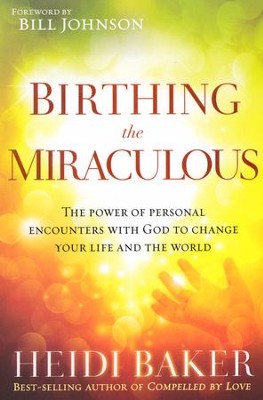
Birthing the Miraculous by Heidi BakerAdapted from Birthing the Miraculous by Heidi Baker, copyright 2014 published by Charisma House. Sometimes God’s promises seem bizarre, implausible, and even crazy, but no matter how impossible they seem we can respond with a yielded “yes” even as Mary did when Gabriel gave her the news that she would birth Jesus. This book weaves true stories from Heidi’s life and ministry to show you how you can become a catalyst for God’s glory on this earth. To order your copy click here.

PRAYER POWER FOR THE WEEK OF January 7, 2018

This week ask the Lord to give you more revelation of His lavish love. Embrace it and respond in kind as John wrote, “We love Him because He first loved us.” Because of that love, surrender your will to His and tell Him that you wholly trust Him and will show your love by your obedience. Ask Him for the grace to carry His love to the unlovely, those who have hurt and betrayed you and those with whom you disagree. Continue to pray for our nation and its leaders, Israel, our military, their families and the upcoming generation. Thank God for ordering your steps, and ask Him for more opportunities to expand His kingdom. John 1:31; 1 John 4:19 


Successful Investment Means Learning the Art of Letting Go

In many areas of life, intense activity and constant monitoring of results represent the path to success. In investment, that approach gets turned on its head.

In fact, for investing, someone who constantly goes in to adjust, tweak, manage or change their investment options is the biblical equivalent to one who is too anxious over too many things, a busybody and one who ignores wise counsel.

“Through insolence comes nothing but strife, but wisdom is with those who receive counsel” (Prov. 13:10, NASB).

The advice to heed here is this: The busier we are with our long-term investments and the more we tinker, the less likely we are to get good results.

That doesn’t mean, by the way, that we should do nothing whatsoever. But it does mean the culture of busyness and chasing returns promoted by much of the financial services industry and media can work against your best interest.

Investment is one area where constant activity and a sense of control are not well correlated. Look at the person who is forever monitoring his portfolio, who fitfully watches business TV or who sits up at night looking for stock tips on social media.

As followers of Christ, we are taught to let go of factors over which we have no control and instead understand that God is over all as He directs our path. Likewise, when you plant a tree, you choose a sunny spot with good soil and water. Apart from regular pruning, you leave the tree to grow.

But it’s not only biblical philosophy that cautions us against busyness. Financial science and experience show that our investment efforts are best directed toward areas where we can make a difference and away from things we can’t control.

So we can’t control movements in the market. We can’t control news. We have no say over the headlines that threaten to distract us. But each of us can control how much risk we take. We can diversify those risks across different assets, companies, sectors and countries. And we can exercise discipline when our emotional impulses threaten to blow us off-course.

These principles are so hard for people to absorb because the perception of investment promoted through financial media is geared around the short-term, the recent past, the ephemeral, the narrowly focused and the quick fix.

What’s more, we are programmed to focus on quirky risks—like glamour stocks—instead of systematic risks, such as the degree to which our portfolios are tilted toward the broad dimensions of risk and return.

You see, much of the media and financial services industry wants us to be busy about the wrong things. A great example of this is Martha, who was so busy planning a party that she forgot who the guest of honor was:

“But Martha was distracted by all the preparations that had to be made. She came to him and asked, ‘Lord, don’t you care that my sister has left me to do the work by myself? Tell her to help me!’

“‘Martha, Martha,’ the Lord answered, ‘you are worried and upset about many things, but only one thing is needed. Mary has chosen what is better, and it will not be taken away from her'” (Luke 10:40-42, NIV).

Financially speaking, the emphasis of busyness is often on the excitement induced by constant activity and chasing past returns, rather than on the desired end result.

Instead of anxious worry, set the proper conditions through a diversified, disciplined, nonemotional strategy by counsel that does not listen to the blaring bullhorn of the market. Listening to fearmongers only brings more chaos, and we need to remember that our God is instead a God of order (1 Cor. 14:33).

Guy Hatcher, known as the Legacy Guy, has spent his lifetime helping families plan their legacy. His latest book is Your Future Reflection: How to Leave a Legacy Beyond Money. Follow him on twitter at @guyhatcher.


‘Life of a King’ Shows the Saving Power of Chess

Murder remains one of the leading causes of death for teenagers in America. The statistic has driven one man to spend more than 30 years saving lives in a unique way. 

He uses a board game, and his story is now the subject of a new film starring Academy Award-winning actor Cuba Gooding Jr.

Eugene Brown’s story begins in Washington, D.C., home to more than half a million people and at least a million stories.

At the heart of the inspiring tale is a little white house, just seven miles from 1600 Pennsylvania Avenue.  

Bringing Chess to At-Risk Children
Brown bought the old house in the early 1990s. In a recent interview with CBN News, he described his story with a poem. 

“This is the story of a chess club, founded for inner-city youth. It’s different from most. It is distinguished and boasts of not just teaching chess, but truth. It teaches young children to reason, to rationalize, to use good sense and intelligence against deception, treachery and lies,” Brown recited.

“So at the Big Chair Chess Club we are on a mission to save the lives of our children, to teach the un-teachable, reach the unreachable and always think before you move,” he continued.

When Brown first began teaching chess to disadvantaged children in D.C., he traveled to the city’s toughest neighborhoods in an old station wagon, recruiting kids.

“I am going into my third decade of teaching chess,” Brown said. “And I can actually say I am the one who brought chess east of the river in Washington, D.C.”

Think Before You Move
Chess is more than a game to the D.C. native. It’s a personal lifesaver and a gift for the thousands of children who’ve sat down with him over the years.

“Some of them never learn chess. They never learn how to be real good chess players. But that is not our mission. Our mission is to get them to think before they move,” Brown told CBN News.

“I have seen too many kinds who make impulsive decisions that end up costing them the rest of their life,” he said.

Impulsive decisions put Brown’s son in jail for 16 years. His grandson is behind bars now. And despite his parents’ love and hard work, Eugene did time too. 

CBN News paid a visit to the jail where Brown was sentenced after trying to hold up a bank for $3,200.

“I must have done almost 20 years on layaway plans. Seven years here. Eight years here. Six months here,” Brown said, reflecting on his time in prison.

Brown spent more than a dozen years locked up at the New Jersey State Prison for that botched robbery attempt.

“I went in Trenton State Prison in New Jersey in 1969. I was a young guy. I didn’t know anyone in that prison,” he recalled.

Doing Time on the Chess Board
His time in New Jersey was among the toughest years of his life. But he still took solace in playing the game of chess.

“That’s how I did my time, on the chess board,” Brown said.

“I saw the Muslims. I saw the Christians. I saw the stick-up guys. I saw everybody has their cliques, and my click was chess, and that’s what I carried around,” he said.

Applying Chess to Your Life
The big change came when another inmate taught Brown to apply the game to his life.

“I said, ‘Man, I lost,’ and he said, ‘Man you are never losing. You are learning lessons or you are teaching lessons. Chess is the only game that can’t be won. It can only be played. Just like life,’ ” he explained.

Brown has been sharing those lessons with children since his release from that prison. The work has earned his chess team awards and recognition from the city.

Chess on the Big Screen
Their story now moves to the big and small screen in the film, Life of a King, starring Gooding.

Gooding compares this role to noble characters he played in films like Men of Honor, Red Tails and Gifted Hands.

Gooding discussed his new film with CBN News in New York City.

“When you learn about people doing great things like this, who have been incarcerated, it’s easy to say he is a felon. He is an ex-convict,” Gooding said. “But this is an ex-convict who made a difference in the life of these kids who are now considered intellectuals. And that connective tissue of society and life is what intrigues me.”

“And I hope that people find healing in stories like this,” Gooding continued.

Praying for Generational Blessings
Brown loves the film, but said he can’t take credit for this latest move in his end game.

“The only reason this movie was made, the only reason I am here is it is an ancestral blessing. It is from my great, great grandmother: my grandmother prayed,” Brown said. “I know my mother prayed. So, this is all of those people who prayed for our family, for me.”

Looking back on his life, he thanked God for turning his tale of disgrace into a story of dignity.


Abortions Can Cement a Relationship, Suggests ‘Cosmopolitan’ Mag

Cosmopolitan is known for its raunchy sex tips proudly displayed on its cover each and every month. Now, the progressive women’s magazine is turning its attention to the most disturbing sex tip of all: abortion.

Headlined “Our Choice: How Abortion Changed Our Relationship,” author Liz Welch explores the world of couples who opted for abortion and suggested three possible relationship outcomes for those who choose to end their pre-born baby’s life: “Abortion can test a relationship, cement it, or end it.”

Welch opines, “The more people tell their personal stories the better. It gets these conversations out of the political realm and into people’s real lives.” That’s only correct if women tell the truth about the horrifying aftermath of abortion. Some women may never share the pain, but life after abortion is never the same.

After two botched abortions, a good friend of mine was forced to undergo a hysterectomy in her early 30s due to ongoing complications. Not only can she never birth children, but she’s also suffering from ongoing health issues and the psychological consequences of her decision. Through our work with Bound4LIFE Fort Lauderdale, she often tells her testimony. But the truth about the aftermath of abortion is still largely unknown to women—until after they’ve experienced the pain firsthand.

The National Abortion Federation claims there’s a “post-abortion myth” circulating, but the reality is few women who walk into an abortion mill understand the ripple effect the decision to end their baby’s life will have days, months and even years later. From a psychological perspective, part of that ripple effect is called post-abortion syndrome, a form of post-traumatic stress disorder (PTSD). PTSD is the result of suffering an event so traumatic that the person is unable to cope normally. This is the territory of war veterans, police offers and, yes, many post-abortive women.

Although studies show post-abortive women initially feel relieved, those feelings are often followed by what some researchers call “post-abortion numbness.” According to Aborted Women, Silent No More, within the first few weeks after abortion, between 40 and 60 percent of the women questioned reported at least some negative reactions.

In another study, Psychosocial Sequelae of Therapeutic Abortion in Young Unmarried Women,” 50 percent expressed negative feelings, and up to 10 percent were classified as having developed “serious psychiatric complications.” Within 12 months of the abortion, Scandinavian women experienced a suicide rate of 34.9 percent compared to a suicide rate of 5.9 percent for women who delivered their babies, according to a Gissler study in the British Medical Journal. That’s six times the suicide rate! And that’s not the only study that ties higher suicide rates to post-abortive women.

A study sponsored by the College of Physicians and Surgeons of Ontario found that after three months, aborted women had a rate of 5.2 percent for hospitalizations for psychiatric problems, compared to a rate of 1.1 percent for the control group. The studies go on and on. Post-abortive women have lower fertility rates and are more likely to contract sexually transmitted diseases, suffer breast cancer, have pre-term births if they do carry again and more.

Of course, the Cosmo article—which was pushed out to at least 3 million subscribers and will reach God only knows how many more women online—doesn’t offer these sorts of details. The article didn’t tell the horror stories; it largely focused on feel-good aspects of how men supported the woman through the abortion, how these women felt they would be a good mom someday (just not now), how the abortion mill played Beyonce during the surgery and the like.

But in the end, even Welch and Cosmo could not deny the psychological impact of abortion. The story ends with information for the Exhale After-Abortion Talkline, which offers free counseling for post-abortive women. And they’ll need the help—and probably more than a talkline can offer. There is life after abortion. There is recovery, but the process is painful, and I’m told the memory never goes away. It’s time to tell the truth about abortion, not glorify abortion mills in magazines that offer tips for better sex.

Jennifer LeClaire is news editor at Charisma. She is also the author of several books, including The Making of a Prophet. You can email Jennifer at [email protected] or visit her website here. You can also join Jennifer on Facebook or follow her on Twitter.


Moving From the Called to the Chosen

“For many are called but few are chosen” (Matt. 22:14, NLT, emphasis added). 

In Matthew 22, Jesus shares a secret of how the kingdom of God works by telling a story. There are five groups of people in this story that illustrate how one can move from being the called to the chosen. They are sent a grand invitation to a king’s wedding feast. What would you do if you were invited to a king’s wedding feast? Their response to his royal invitation shows the value they placed on the king. Here are the five groups of people:

The Called Who Refuse to Respond

“The Kingdom of Heaven can be illustrated by the story of a king who prepared a great wedding feast for his son. When the banquet was ready, he sent his servants to notify those who were invited. But they all refused to come!” (vv. 2-3). 

This is an invitation to a royal wedding feast, yet they refuse to attend. Their hearts show a blatant disregard for the king. Their response says the royal invitation isn’t worthy of their time.

The Called Who Ignore the Invitation

“So he sent other servants to tell them, ‘The feast has been prepared. The bulls and fattened cattle have been killed, and everything is ready. Come to the banquet!’ But the guests he had invited ignored them and went their own way, one to his farm, another to his business” (vv. 4-5).

The royal invitation is ignored by those who are too busy and entangled with their responsibilities and businesses. Everyday He calls out to us. Do we ignore His royal invitation with our busyness?

The Called Who Kill the Messengers

“Others seized his messengers and insulted them and killed them” (v. 6). This is the ultimate insult—to kill the king’s messengers. The king is furious and sends his army to destroy the murderers and burn their town (v. 7).

The Unworthy Who Respond

“‘Now go out to the street corners and invite everyone you see.’ So the servants brought in everyone they could find, good and bad alike, and the banquet hall was filled with guests” (vv. 9-10).

The king expands his guest list to include the good and bad alike. Everyone is invited to the wedding feast. Everyone is called.

The Unworthy Who Are Called but Not Dressed Appropriately

“But when the king came in to meet the guests, he noticed a man who wasn’t wearing the proper clothes for a wedding. ‘Friend,’ he asked, ‘how is it that you are here without wedding clothes?’ But the man had no reply. Then the king said to his aides, ‘Bind his hands and feet and throw him into the outer darkness, where there will be weeping and gnashing of teeth’” (vv. 11-13).

It was customary for the king to provide wedding garments for his guests. To not wear the garments the host provided was considered an outright insult worthy of severe punishment. The guest with no wedding clothes is banished.

From this passage, we know that Jesus is speaking prophetically to the Jews who had rejected and persecuted Him. He came to His own and was treated like an outcast.

From these responses, here’s how we can move from being called to chosen.

Respond to Him Like He Is a King

Giving honor, worshipping and treating Him like a king will make you stand out. When the president walks into a room, everyone knows it. He walks in with an entourage and is given honor regardless of anyone’s personal politics.

I had the honor of hosting Barbara Bush, the wife of former President George Bush. She had a corps of security guards around her. I adjusted everything for her when I hosted her. If I had a bad day, it didn’t matter. Mrs. Bush was on the scene. In the same way, we can learn how to respond to Jesus like He is a king.

A king doesn’t take orders. He gives orders. A king doesn’t want to hear about your past or how bad of a day you’re having. A king has a job that needs to be done. There is a time for relationship with the king, but that grows with time. There is a protocol for entering a king’s presence and leaving his presence.

Be Ready to Respond to Him Always

When you’re working for a king, you’re working 24/7. He can summon you at any time. Be available to respond to the king anytime, anywhere. I responded to the call of the King by moving to Kansas City in 2000. I left my husband and children for a brief season to move, and it was hard. But the King had called me, and I responded.

I listen throughout the day for gentle promptings from the King to encourage someone, pray for someone, call someone. You see, the King is the servant of the people. The morale and health of the people are always on His mind. When you think like a king, you’re thinking about someone else.

Learn About the King

Learn how the King thinks, how He acts and how He responds. Spend time in His Word. Spend time in prayer and worship. There is no shortcut to building a relationship with the King. Your pastor or your church leader can’t do this for you. You have to dig into the Scriptures. You have to spend time in worship. You have to pray.

Dress for the King

Wear your royal garments provided by the King. What does this mean—to wear your royal garments? Take up your authority on behalf of the King. Exercise His authority over your life. If you belong to Him, then act like it. So many Christians think and live like orphans. This is so degrading to the King of kings because it sends a message to the enemy that we don’t believe Him.

Believe that He is the King, and dress for Him by wearing your royal robes of righteousness and your clothing of salvation that He has provided.

“I am overwhelmed with joy in the Lord my God! For he has dressed me with the clothing of salvation and draped me in a robe of righteousness. I am like a bridegroom in his wedding suit or a bride with her jewels” (Is. 61:10). 

When you treat Him like a king—which is rare and will make you instantly stand out—and consistently respond to Him and show a hunger for His ways, you will become the chosen. You will enjoy the royal feast of His presence. Having the King in your life brings royal benefits, such as prosperity, His presence and His authority.

Make way for the King in your life. Become the chosen.

Leilani Haywood is editor of SpiritLed Woman and a frequent contributor to Charisma. She is a Kansas City, Mo.-based award-winning writer and columnist. She has been published in the Kansas City Star, Metro Voice and other publications. Follow her on Twitter @leilanihaywood.


Is Food Your God?

Is food occupying your mind where God should be? “Food is not the fix for everything” was a hard lesson I had to learn when I struggled with emotional eating.

You see, if I was mad, I ate; if I was sad, I ate; if I was bored, I ate; if I was tired, I ate. Eventually, I ate my way up to 240 pounds!

But God showed me that He is the fix for everything! He could give me the daily answers I needed to glorify Him in every situation, including my eating habits.

I once counted how many times I thought about food in a single day. I counted 77 times! No wonder I wanted to eat all the time back then.

In Matthew 22:37, Jesus said, “You shall love the Lord your God with all your heart, with all your soul, and with all your mind.” I had a problem loving the Lord with all my mind when food occupied so much of it. Because I did not know or practice Biblical wisdom to take every thought captive to the obedience of Christ (see 2 Corinthians 10:5), food grew into an obsession.

In fact, my food obsession became idol worship for me. Idol worship is simply investing a person, inanimate object, or activity with powers it does not have.

To see what I mean, imagine how some oft-quoted bible verses would sound if you replaced God/Lord with food:

• “The joy of food is my strength.”

• “Food heals the brokenhearted and binds up their wounds.”

• “Be strong and let your heart take courage, all you who hope in food.”

• “Trust in food with all your heart and do not lean on your own understanding.”

• “The righteous man will be glad in food and will take refuge in it; and all the upright in heart will glory.”

I used to live as if I believed that. It is estimated that 10 million people in the United States suffer from binge-eating disorder. So clearly, this is not a small problem. From my experience, Christians are vulnerable to this issue as much as anyone else. Perhaps even more. Here is why:

We have a real enemy who hates us because of the God we love. Ephesians 6:12 says, “For we do not wrestle against flesh and blood, but against principalities, against powers, against the rulers of the darkness of this age, against spiritual hosts of wickedness in the heavenly places.”

What better way can the enemy destroy us than through food obsession and food abuse? He exploits our need for food to survive. So rather than suggesting we grab a Bible (whose Words can Spiritually defeat him), he suggests that we instead grab a bag, box, plate, knife, or a fork!

The apostle Paul wrote about people who elevated filling their stomachs above God in Philippians 3:18-19: “For many walk, of whom I have told you often, and now tell you even weeping, that they are the enemies of the cross of Christ: whose end is destruction, whose god is their belly, and whose glory is in their shame—who set their mind on earthly things.”

It’s time, Christian brothers and sisters, to flip the script. In Luke 4:18, Jesus said what He came to do:

“The Spirit of the Lord is upon Me,

Because He has anointed Me

To preach the gospel to the poor;

He has sent Me to heal the brokenhearted,

To proclaim liberty to the captives

And recovery of sight to the blind,

To set at liberty those who are oppressed;”

If you are suffering from emotional hurts (brokenhearted), captive to food obsession, blind to the destruction this habit is causing you, and oppressed by food abuse, then you qualify for Jesus’ help!

Invite Jesus into this issue through prayer and then start renewing your mind to His Living Word daily. The book of John is a great place to start to get to know how your Savior lived. As you study the Bible more, you will learn to recognize thoughts that exalt themselves above God.

Cast those lies down with the truth. Only by taking every thought captive will you be free from captivity to food obsession.

Once 240 pounds and a size 22, Kimberly Taylor can testify of God’s healing power to end binge eating. She is the creator of the new online course ‘How to Stop Binge Eating’ (https://www.udemy.com/how-to-stop-binge-eating). Charisma readers can get a discount today with the coupon code: Charisma.